Who Is the Target Audience? a Guide to Audience Profiles
Who is the target audience? Get a clear definition, an audience-profile table and a four-step process for turning audience traits into content decisions.
If you hand two skilled writers the same audience description, say "small business owners aged 25 to 54," will they produce the same article? Almost never. One will write an introductory guide to basic terms, while the other will write a technical comparison for experienced buyers, and both will insist they followed the brief.
That mismatch happens because many teams treat who is the target audience as a marketing label you slap onto a slide deck rather than an editorial planning input. When an audience description doesn't narrow down what you commission, what you cut, or how you structure a page, it isn't doing any real work.
A useful audience profile changes editorial decisions before a single draft gets written. Learning how specific audience traits map directly onto content choices turns a vague guessing game into a repeatable system any writer or editor can follow.
Table of Contents
- What a Target Audience Really Means
- The Traits That Define an Audience
- How to Build an Audience Profile in Four Steps
- Worked Examples Across Content Types
- Applying the Definition to Real Audiences
- Where Audience Definitions Break Down and How to Re-Test Them
What a Target Audience Really Means
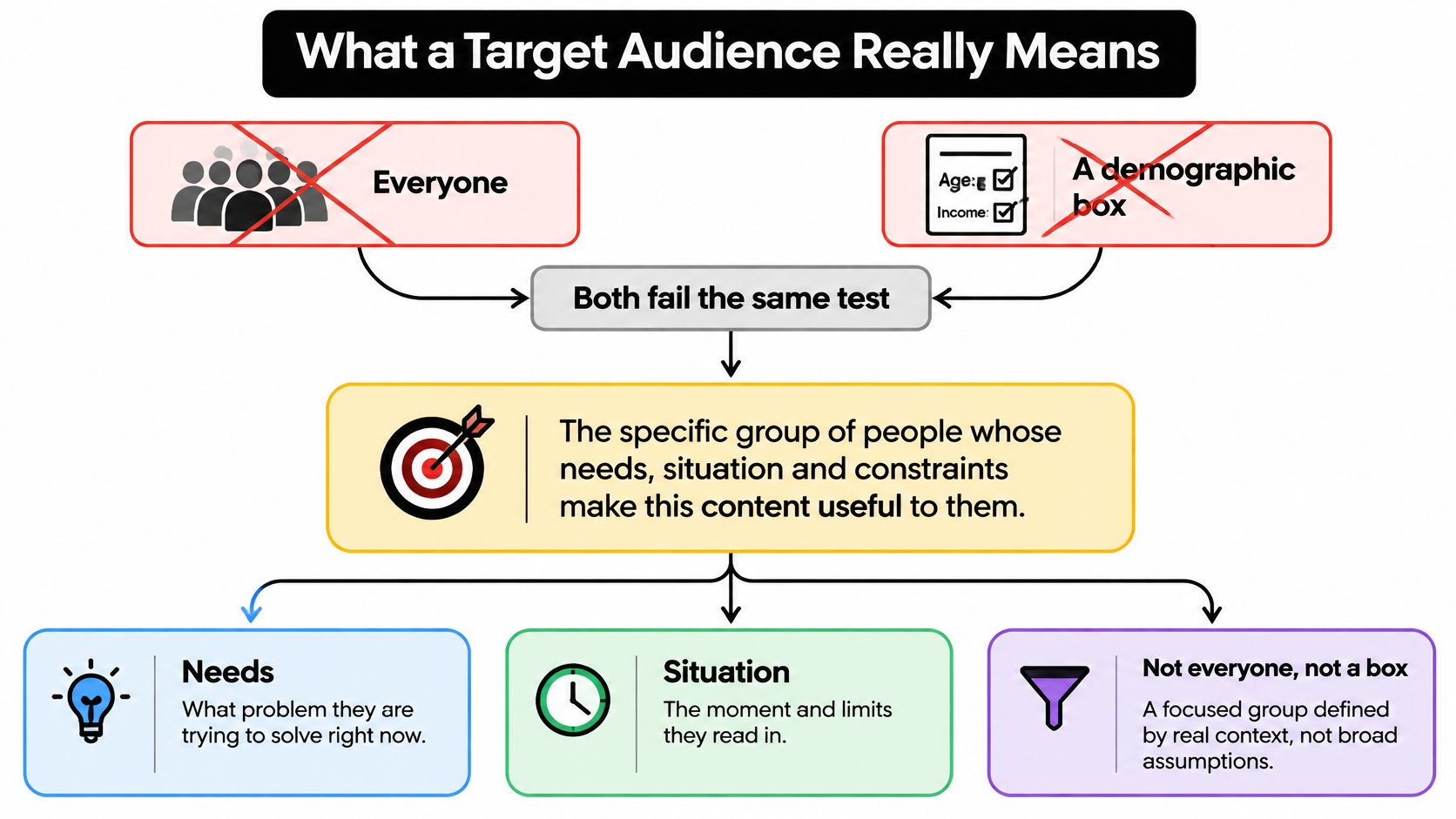
Ask a room full of stakeholders who a new article is for, and you'll usually hear one of two answers. Someone says "everyone who might find it useful," or someone pastes a demographic box describing age, location, and household income. Both answers fail for the exact same reason: neither tells a writer what problem the reader is solving right now or what limits their attention.
A target audience is the specific group of people whose needs, situation, and constraints a piece of content is built to serve, described precisely enough that two different writers would make the same editorial decisions. Think of it the way you'd think about the recipient of a letter. Addressing an envelope "to whom it may concern" guarantees polite, vague prose that lands softly with nobody. Naming the exact person waiting for an answer immediately tells you what background to skip, what proof to include, and what to ask for at the end.
Part of the confusion comes from teams using four closely related words interchangeably. Resources like Carlos Alba Media's guide to defining your target audience properly highlight how easily broad commercial categories blur into editorial ones. Separating those terms clears up most planning arguments before they start.
Separating Audience From Neighbouring Terms
- Target market: The broad pool of potential buyers a business aims to sell to over time, which usually contains several distinct content needs under one roof.
- Buyer persona: A semi-fictional composite character, often given a stock photo and a first name, used to humanize a segment rather than dictate the scope of a single article.
- Individual reader: One specific person encountering your work today, whose personal quirks shouldn't bend a brief away from the broader group you're serving.
- Target audience: The defined segment a specific campaign, publication, or piece of content is engineered to help right now.
The fit test: If your audience definition doesn't change what you would commission, brief, cut, or prioritize, it is decoration, not a target audience.
The Traits That Define an Audience
Once you stop relying on broad age brackets, you need a set of traits that steer editorial judgment. Order matters here, because each trait narrows the choices left to the next one.
Start with the primary goal, or the concrete job the person is trying to finish. That goal dictates the core promise of your piece and the steps you can't leave out. Next comes knowledge level, which decides whether you pause to define industry terminology or assume familiarity and move straight to execution.
Third is situation and constraints, meaning the time, device, budget authority, and mental bandwidth available at the moment of reading. A commuter checking a phone between train stops needs a scannable checklist, not a long-form essay packed with dense tables. Fourth is decision stage, which tells you whether the piece should explain a concept, compare competing approaches, or help someone finish a purchase.
How Consumption Channels Reshape the Brief
The fifth trait is consumption channel, or where this group already looks for answers. That trait governs headline phrasing, heading hierarchy, metadata, and whether key passages can stand alone without surrounding context. In U.S. search research published via a Marketing Dive press release, 86% of online searchers reported using a traditional search engine in the previous 30 days, while 25% used AI assistants, primarily seeking direct answers (63%), verification (37%), and summaries (31%). Because a growing share of readers encounter summarized answers before clicking through, your channel trait now determines whether your opening claims are clear enough to be accurately cited without a page visit.
Reading the table below from left to right shows how each trait translates directly into an editorial decision rather than sitting as passive background notes.
| Trait | Question it answers | Example value | Content decision it changes |
|---|---|---|---|
| Primary goal | What are they trying to get done? | File an expense claim correctly the first time | The promise of the piece and the steps it must contain |
| Knowledge level | What do they already know? | First month in the role | Whether terms are defined or assumed; depth of background |
| Situation and constraints | What limits them while reading? | Phone, five-minute break, no budget approval | Format, length, scannability, downloadability |
| Decision stage | Where are they in the buying or learning process? | Comparing three options | Explainer, comparison table or recommendation |
| Consumption channel | Where do they already look? | Search and AI assistant summaries | Title wording, structure, metadata, citable passages |
| Accessibility needs | How do they receive the content? | Screen-reader use, low vision, cognitive load | Headings, alt text, captions, plain language, layout |
| Language and market | What vocabulary do they use? | UK English, regulated industry | Terminology, examples, compliance notes |
The Trait Most Teams Overlook
Notice the sixth row in the table. Accessibility needs are routinely treated as a technical fix left to developers after publication, yet they directly shape how millions of people receive your work. According to Tenet's web accessibility statistics, approximately 1.3 billion people worldwide, or 16% of the global population, live with a disability affecting how they use the internet, while an estimated 96.3% of websites fail basic accessibility standards. Separate testing noted in the same report shows only about 2% of websites pass at least 70% of tested accessibility criteria, with an average of 297 WCAG-related issues per webpage.
Treating accessibility as an editorial trait changes how you plan from day one. Writers build logical heading hierarchies, draft descriptive alternative text for charts, caption embedded video, and keep sentence structures direct so screen-reader users and busy mobile readers both move through the page without friction.
A usable audience profile needs one primary goal and one binding constraint. Every other trait is secondary until those two are locked in.
How to Build an Audience Profile in Four Steps
Knowing which traits matter is half the work. The other half is assembling a profile grounded in real evidence instead of guesswork from a conference room whiteboard.
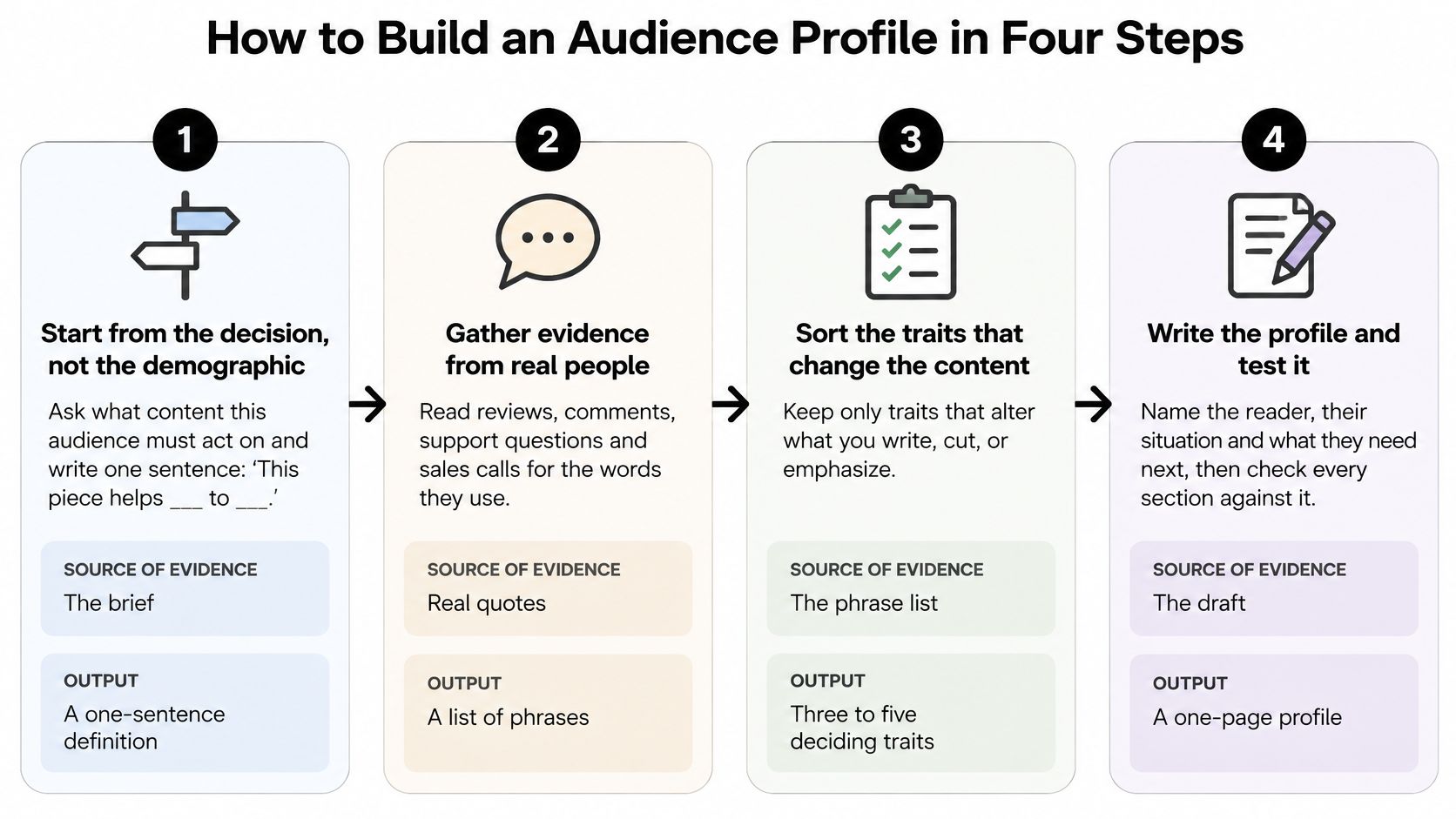
Follow these four steps in sequence, keeping the evidence source and concrete output visible at every stage.
1. Start From the Decision, Not the Demographic
Look at your editorial brief or product goal first, and identify the exact action the reader needs to take after reading. Your output here is a single working sentence: "This piece is for [role] who needs to [goal] before [moment]."
- Evidence source: The project brief, campaign objective, or customer journey milestone.
- Common slip: Opening a blank persona template and spending an hour inventing ages, coffee habits, and fictional job histories that never influence a single paragraph.
2. Mine Evidence You Already Own
Before commissioning an expensive survey, pull real phrasing from places where your audience already asks questions. Support tickets in tools like Zendesk, sales-call transcripts, internal site search logs in Google Analytics, and comment threads show the exact friction points people hit and the plain words they use to describe them.
When you do run a questionnaire, a small batch of structured responses from genuine users beats a pile of casual internal opinions. Published industry benchmarks can calibrate your assumptions, while verbatim customer quotes anchor your vocabulary. Your output is a clean list of real audience phrases and recurring questions.
- Common slip: Confusing your company's internal product vocabulary with the words readers type into a search bar.
3. Sort Traits Into One Goal and One Binding Constraint
Map your phrase list against the seven traits from earlier, keeping only the details that change editorial execution. Force yourself to pick a single primary goal and one binding constraint, such as reading on a phone during a five-minute break or needing approval from a compliance officer.
Your output is a concise, one-page profile highlighting three to five deciding traits rather than an exhaustive biography. Slot that profile directly into your broader content marketing plan so topic selection and channel priorities stay aligned.
- Common slip: Listing five competing goals in the same profile so writers try to please beginners, executives, and technical buyers on one page and satisfy none of them.
4. Pressure-Test the Profile Against Three Real Pieces
Pull three planned articles or recent drafts and ask a blunt question: would this audience definition change the outline, the word count, or the concrete examples used? If the answer is "no" for all three, your profile is still too broad and needs sharper constraints.
Reality check: If you can swap your audience profile onto a competitor's completely different article and nothing feels out of place, tighten the primary goal and binding constraint until the fit breaks.
Worked Examples Across Content Types
Abstract definitions click into place the moment you watch them change real editorial output. The three scenarios below show how swapping a vague label for a one-sentence definition alters length, examples, and structure across very different formats.
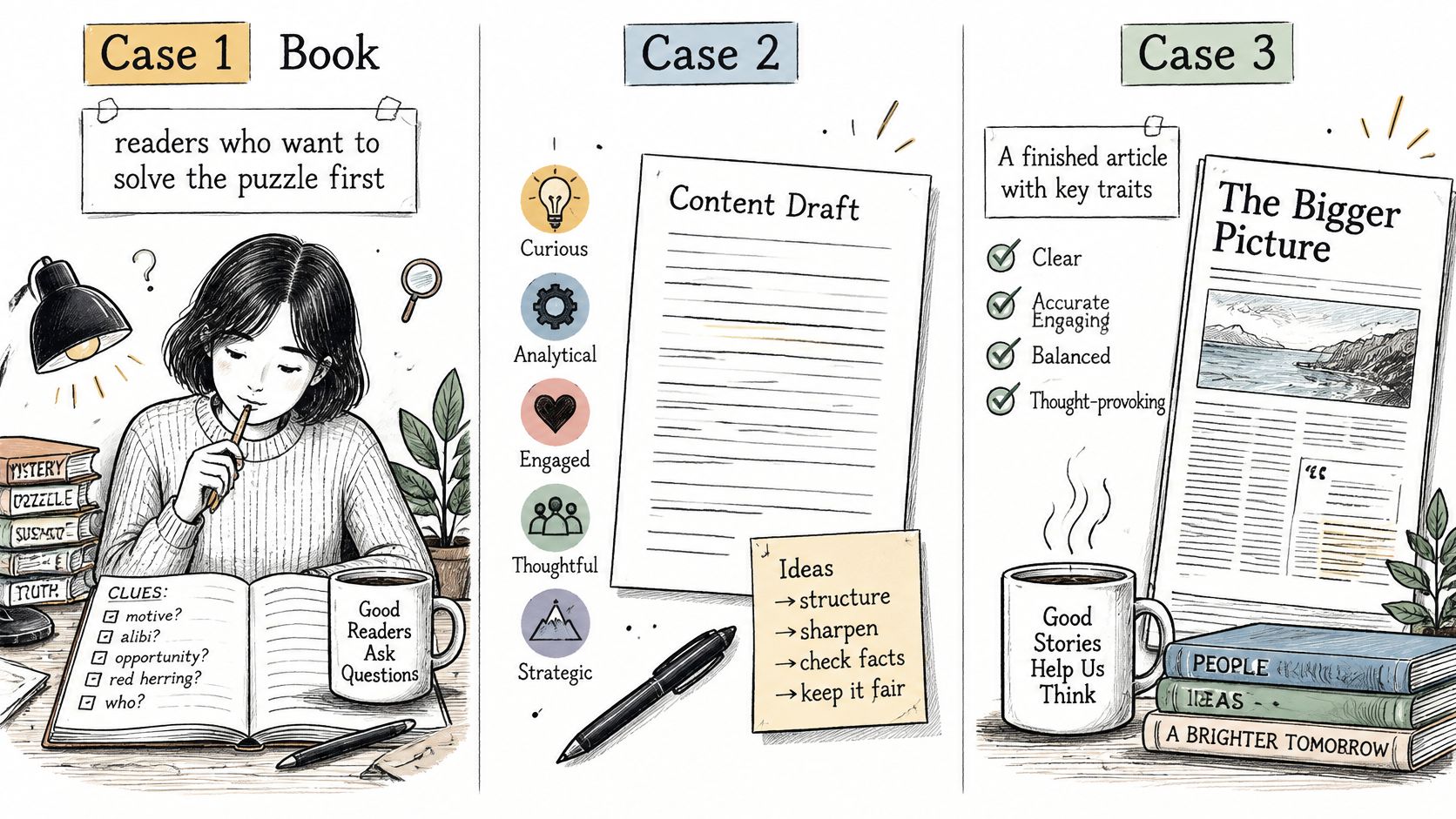
The illustration below maps how analytical profiling shapes the bridge between how someone reads and how a team writes.
A Novel Positioned for Commuters
Say a publisher describes a new book's audience as "people who like thrillers." That vague label invites generic jacket copy, meandering opening chapters, and broad advertising aimed at every mystery fan online.
Now narrow it to a sharp working definition: "readers who finished two domestic thrillers in the last year and want a fast, twist-driven read for a daily commute." Two traits immediately take over: the desire for rapid pacing and the constraint of short reading windows. The editorial and marketing team shortens chapter lengths so readers can finish sections between stops, leads the back-cover blurb with the central domestic hook instead of world-building, and picks exact comparison titles from recent bestseller lists rather than classic spy novels.
A Software Explainer for Spreadsheet Switchers
Suppose a B2B software team writes a guide for "operations professionals." Left that broad, a writer naturally opens with a history of operations software, defines basic project management terms, and runs on for pages before addressing how a switch works.
Tighten the definition: "an operations manager in a 50 to 200 person company evaluating whether to replace spreadsheets, reading on a laptop in a comparison mindset." Knowledge level is already high, and the decision stage is active evaluation. The outline drops the introductory history entirely, opens with a side-by-side comparison table contrasting spreadsheet limits against dedicated tools, and finishes with a practical migration checklist. Placing that one-sentence definition at the top of a content brief template prevents the writer from padding the opening with material an experienced manager already knows.
For a quick visual walkthrough of how sharp audience targeting shifts messaging across campaigns, watch the short overview below before looking at our final case.
A Mobile Help Centre Article
Consider a SaaS support team writing documentation for "customers with account settings questions." That broad description often produces a conceptual overview explaining how permissions work across the platform, burying the actual instructions three screens down.
Rewrite it for the moment of need: "a user mid-task on a phone who needs the next click, not the concept." The binding constraint is a small screen and zero patience for theory. The page transforms into five numbered steps paired with cropped mobile screenshots, while the conceptual background moves to a separate link at the bottom for anyone who wants deeper context later.
Applying the Definition to Real Audiences
Seeing the difference between a broad category and a working definition becomes even clearer when you look at real editorial and marketing roles. Two common groups illustrate why lumping similar job titles together breaks content relevance.
In-House Marketing and Content Operations
Content marketing inside B2B companies is rarely a solo writing hobby. A 2024 global survey of 1,186 marketers (including 980 B2B respondents, weighted toward North America) by the Content Marketing Institute and MarketingProfs found that 76% of B2B organizations had a dedicated content-marketing team or at least one employee responsible for content marketing, and 87% of B2B marketers reported that content marketing helped create brand awareness over the previous 12 months.
Written as a planning definition, this audience becomes: "a content-operations manager in a B2B company who must assign, review, and track work across several stakeholders before each publishing cycle."
- Primary goal: Establish a repeatable workflow that marketing, sales, and subject-matter experts will adopt.
- Binding constraint: Shared approvals across multiple functions without stalling release dates.
- Consumption channel: Internal planning reviews first, followed by targeted search when evaluating software or templates.
Digital Publishers and Editor-Led Networks
Now contrast that group with media organizations, editorial agencies, and freelance networks. The U.S. Bureau of Labor Statistics Occupational Outlook Handbook defines editors as professionals who plan, review, and revise content for publication, while writers produce drafts across magazines, blogs, and online channels for editor or client feedback. That structure creates a distributed handoff where one editor governs release timing while multiple external contributors deliver assets.
The operational stakes keep rising as revenue shifts online. The World Press Trends Outlook 2024-2025, summarized by Global Print Monitor, reported that digital activities generated more than 30% of publishers' total revenue on average in 2025, roughly 7 percentage points higher than the year before. Meanwhile, the scale of the contributor pool is substantial: 2,080 freelance content writers participated in the 2025 global survey by Elorites Content.
Written as a working definition, this second audience is: "an editor at a digital publication who coordinates several freelance contributors and needs role-based assignment and clear sign-off before publication."
Put those two definitions side by side and apply the fit test. A generic article aimed at "B2B content teams" would misplace examples, mix up approval terminology, and pitch the wrong call to action to at least half its readers. Just as focused positioning separates distinct customer groups across strong examples of branding strategies, sound editorial planning picks one primary audience per piece and serves the second group with its own dedicated asset.
Where Audience Definitions Break Down and How to Re-Test Them
Even a sharp profile decays once an editorial calendar gets busy. Most audience failures aren't caused by bad initial research; they happen during execution and reuse.
Four Failure Modes and Their Fixes
- Channel drift: A brief built for organic search gets recycled for a weekly newsletter and a LinkedIn post, where the same reader arrives with less context and less patience. Fix: Add a mandatory one-line channel note to every brief whenever a topic crosses formats.
- Committee creep: During kickoff meetings, sales adds enterprise buyers, product adds developers, and leadership adds executives until the profile describes three incompatible audiences. Fix: Cut back to one primary goal and one binding constraint, and move the secondary requests into separate backlog items.
- Assumption rot: A profile drafted two years ago still assumes desktop-first research habits or outdated pricing objections. Fix: Stamp every audience profile with a quarterly review date and maintain a single editable version rather than scattered PDFs.
- Silent audience shift: Readers increasingly encounter condensed summaries, social feeds, or aggregators instead of clicking straight into a publisher's homepage. In 2024, just 22% of respondents across 47 markets named news websites or apps as their main source of online news, according to the Reuters Institute for the Study of Journalism. Fix: Write opening paragraphs that establish your core claim independently, and avoid claiming audience reach your analytics cannot measure.
Keeping the Profile Alive Across Handoffs
Once multiple writers, editors, and reviewers share an audience profile, storing it in an archived slide deck guarantees nobody checks it during drafting. The definition has to live inside the assignment, the editorial review checklist, and the publishing workflow itself.
In TheContentMap, topics and tags organise content by topic, channel, and campaign so teams never blur distinct audience tracks together. Team collaboration lets users assign writers and leave comments for editors, writers, and stakeholders directly alongside the brief, while content insights track what is published and show which topics and formats perform so you can verify whether your assumptions hold up after launch.
Choose the single audience whose needs, when met well, make the piece worth publishing, and let other segments be served by pieces built specifically for them. Asking who is the target audience isn't a box you tick once during annual planning. It's a practical editorial decision you re-test at the start of every cycle, beginning with that one-sentence definition at the top of each brief.
Keeping audience definitions attached to every draft, assignment, and review cycle is much easier when your editorial calendar and collaboration tools live in one place. TheContentMap gives editors and content teams a visual workflow, topic tagging, writer assignments, and performance insights to turn clear audience profiles into consistent publishing. Visit TheContentMap to organize your planning workflow and keep every piece focused on the people it's built to serve.
Related Articles
Content Governance: What It Is and How to Build It
You've probably lived this scene. A campaign page goes live with a claim that legal flagged six...
SoftwarePublishing Project Management: A Stage-by-Stage Guide
The spring list has twelve titles, three editors sharing the commissioning, two designers handling c...
SoftwareHow to Manage Multiple Projects: A 2026 Playbook
It's Tuesday morning. Three projects need the same senior editor, every stakeholder has labelled...
Comments (0)
No comments yet. Be the first to share your thoughts.