Content Marketing Plan: Step-by-Step for Editorial Teams
Build a content marketing plan step by step: goals, audience, topics, calendar, distribution and KPIs, with templates and examples for editorial teams.

You opened the spreadsheet again. The dates are filled, the titles look plausible, and the month still ends with three unpublished drafts and a sales lead asking where the pricing guide went. That is what a content marketing plan looks like when it is only a list of publish dates.
The break is rarely the calendar view. It sits between a goal someone stated in January and the work that ships. The owner cell is blank, the metric says "traffic," and nobody looks at the queue until a date has already slipped.
A plan that holds up is closer to an operating system. It names who moves each piece, which numbers you watch before results show up, and when the team sits down to change course. I would build it in the order below, and I would not add another headline until the blank rows are filled.
Table of Contents
- Content Marketing Plan Components at a Glance
- Set Goals and Audience Before You Pick Topics
- Source Topics From Search and Audience Questions
- Build an Editorial Calendar and Distribution Rules
- Measure Performance With the Right KPIs
- Copy a Full Quarterly Plan Template
- Start Your First Quarter With a Plan Review
Content Marketing Plan Components at a Glance
| Component | Question it answers | Example entry |
|---|---|---|
| Goals | What business result does this content serve? | Grow demo requests from guides by 15% over two quarters |
| Audience | Who reads it and what do they need next? | Operations managers at mid-size SaaS companies comparing vendors |
| Topic sourcing | Where do the ideas come from? | Search Console queries and questions from sales calls |
| Editorial calendar | When does each piece publish and who owns it? | Pricing guide, owner Maya, due 14 March |
| Distribution | Where does each piece go after publishing? | Newsletter, LinkedIn and a partner site |
| KPIs | How do we know it worked? | Organic visits to guide pages and demo requests from those pages |
| Budget and roles | Who does the work and with what money? | One writer, one editor and a freelance budget per quarter |
These seven rows are the whole content marketing plan. Goals and audience sit at the top because every later row inherits them. A topic with no buyer is a guess. A date with no owner is a wish.
Goals name the business result, with a number and a window. "Grow demo requests from guides by 15% over two quarters" is usable. "More awareness" is not. This row feeds audience choice, because you only study people who can move that result.
Audience names who reads and what they need next. "Operations managers at mid-size SaaS companies comparing vendors" is tight enough to reject a topic. One vague persona for three buyers is how calendars fill with pieces nobody requested. This row feeds topic sourcing.
Topic sourcing records where ideas come from. Search Console queries and questions from sales calls beat a brainstorm with no evidence. This row feeds the calendar, so you only schedule work you have already judged.
Editorial calendar locks when a piece publishes and who owns it. "Pricing guide, owner Maya, due 14 March" is a commitment. A theme with no name is a meeting that will happen again next week. This row feeds distribution, because a publish date with no channel plan dies on the blog.
Distribution states where the piece goes after it is live. Newsletter, LinkedIn, and a partner site are three jobs. This row feeds KPIs, because you measure the paths you ran.
KPIs say how you will know it worked. Organic visits to the guide pages, plus demo requests from those pages, tie the piece back to the goal. This row feeds budget, because you stop paying for formats that never move the number.
Budget and roles say who does the work and with what money. One writer, one editor, and a freelance line per quarter is a capacity statement. In 2024, 45% of B2B marketers expected their content marketing budget to increase compared with 2023, while 42% expected it to remain unchanged, according to MarketingProfs' summary of the Content Marketing Institute and MarketingProfs survey. Rising or flat spend still needs a person and a line, or the money sits in a deck while drafts wait on one editor.
Practical rule: A document full of dates is not a plan unless every row has an owner and a number.
Where a blank row breaks first
Read your current plan against the table. If any row is empty, that row is where the quarter fails, usually before the writing starts. I would fill the blank before anyone adds another title to the month.
Set Goals and Audience Before You Pick Topics
Topics are the tempting part. They are also the wrong place to start. Write outcomes, name the buyers, then list the questions those buyers already ask. Skip that order and the calendar becomes a pile of interesting posts that sales cannot use.
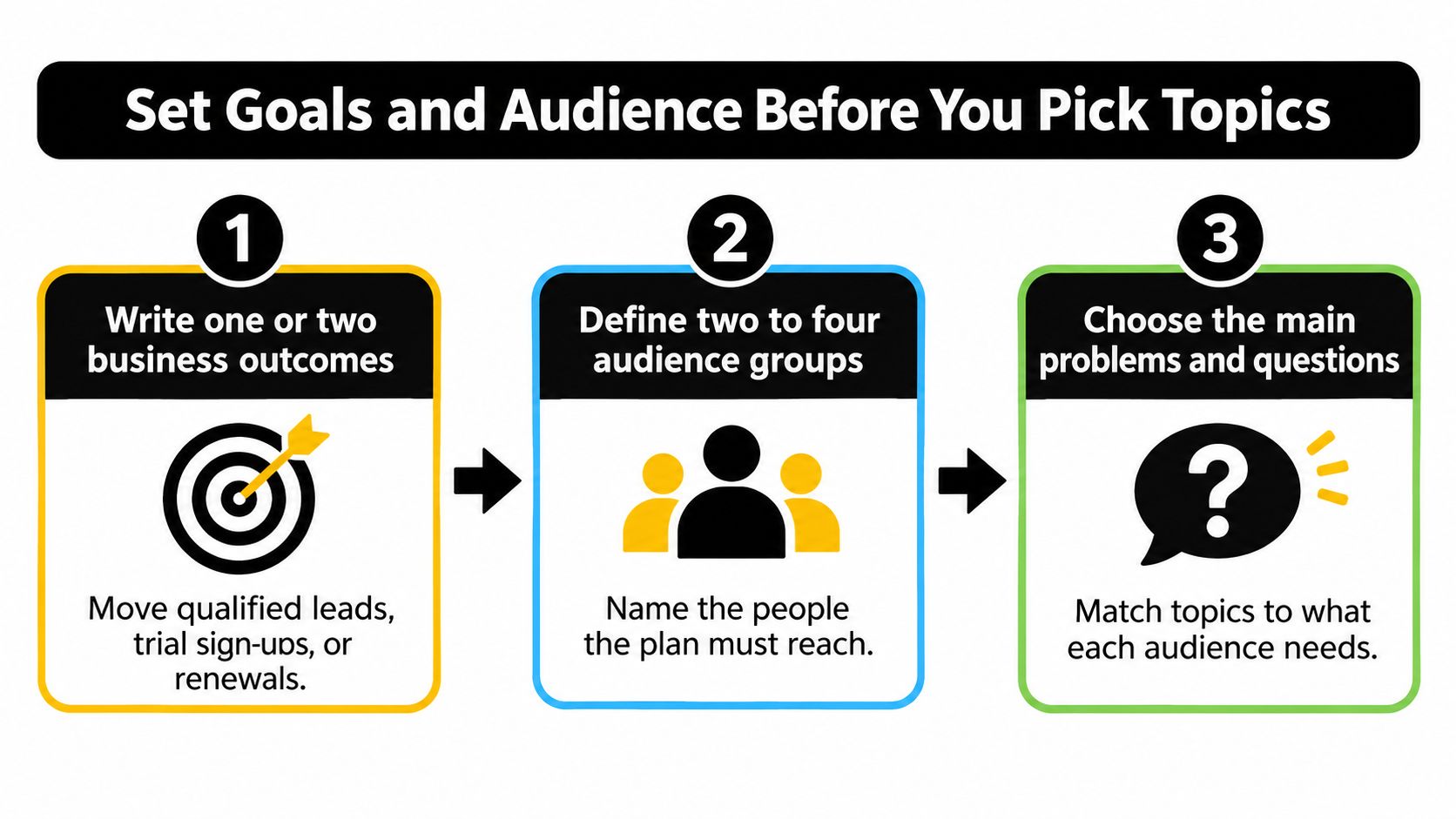
42% of B2B marketers whose strategy is moderately effective or worse cite a lack of clear goals as a contributing problem, in Content Marketing Institute global B2B research. The steps below are the fix, and each one has a slip that looks productive while it wastes a quarter.
Three decisions, in order
Write one or two business outcomes. Pick results the business already tracks, such as qualified leads, trial sign-ups, or renewals, and put a target and a quarter on each. The slip is "more traffic" with no target and no page. Traffic can rise while demos stay flat, and you will not know which piece to stop. A goal you cannot read on a dashboard by the end of the quarter is a slogan.
Define two to four audience segments by role and buying stage. A managing editor evaluating tools is not the same reader as a freelance writer hunting for briefs. The slip is one persona standing in for a team that sells to three buyers. That persona gets every asset, the other two get nothing, and the sales calls keep repeating questions you never published.
Map each segment to funnel stages and write the question they ask there. Awareness, consideration, and decision each need a different answer. An operations manager comparing vendors asks "how do teams price a retainer," not "what is content." The slip is a topic list sorted by what the writers want to write. If a segment cannot name a question they would type into search, you do not have a segment yet. You have a job title on a slide.
Say a B2B software team starts the quarter with 24 topics. They keep a piece only when it names a segment and a stage. The list drops to 12. The cut pieces were not bad writing. They were answers for buyers the company does not sell to this quarter.
If a goal cannot be measured within one quarter, and a segment cannot name a search question, do not brief the piece.
Run that test on today's plan before the next editorial meeting. Anything that fails the test goes back to the goal row, not onto the calendar.
Source Topics From Search and Audience Questions
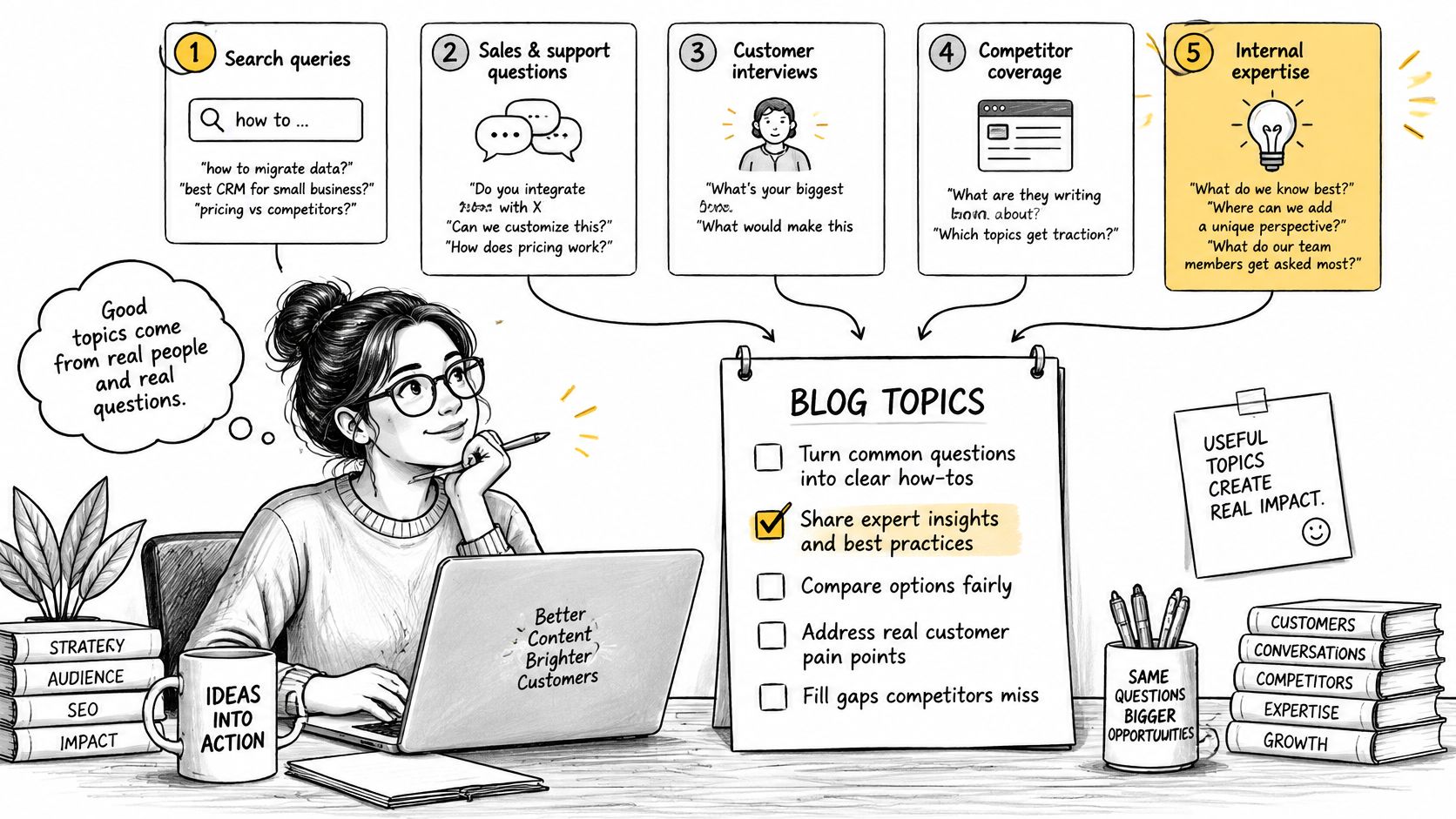
Usable topics come from places where a buyer is already asking, not from a blank doc on Monday morning. Rank your sources, score what they produce, and keep about six weeks of passed topics so the calendar never runs on fumes.
Five sources, best first
- Search queries. Pull them from Search Console or a keyword tool. These are questions people typed, so the demand is not a guess.
- Sales and support calls. If the same question shows up weekly, you already have a reader and a distribution path through the people who heard it.
- Comments on past articles. Readers tell you the paragraph that failed. That is a follow-up, not a new brand campaign.
- Competitor gaps. Useful after the first three, and only when the missing piece maps to your segment. A gap on their blog can be a topic your buyer does not care about.
- Internal subject experts. Strong on accuracy, weak as a demand signal. Use them to check a sourced idea, not to invent the backlog. When the same experts also post on LinkedIn, a tool to find ideas for LinkedIn posts can turn one expert answer into a short public version without inventing a new topic.
Google introduced the Zero Moment of Truth (ZMOT) in 2011 for the moment people search for answers, reviews, or comparisons before they decide on a brand. In Google's research on Asia, 78% of Asian women said search was a vital part of their decision process for consumer packaged-goods brands, as described in Google's ZMOT briefing. Your buyer is often in that search before a sales call. A topic that does not answer a decision question is a calendar slot, not a plan.
Score it or drop it
Rate each candidate 1 to 3 on audience need, business fit, and effort. Effort of 3 means light work, 1 means a heavy lift. Keep a total of 7 or higher.
A brief on how to price a retainer for content work scores 8: audience need 3, business fit 3, effort 2. Sales hears the question every week, and search demand is steady. That is a keep. Group the keepers into clusters so you are not publishing orphans. Our guide to topic clusters shows how those scored pieces should point at one pillar instead of competing with each other.
A trending topic can score high on interest and low on business fit. Skip it unless it maps to a segment and a funnel stage you already named. Interest without a buyer is how teams spend a week on a post that never reaches a call to action.
Hold about six weeks of scored topics. Fewer than that and the calendar goes empty the moment one draft slips. More than that and you are planning fiction.
Build an Editorial Calendar and Distribution Rules
A scored backlog still fails if the calendar item is only a title and a date. Every item needs eight fields, and each field stops a specific kind of slip.
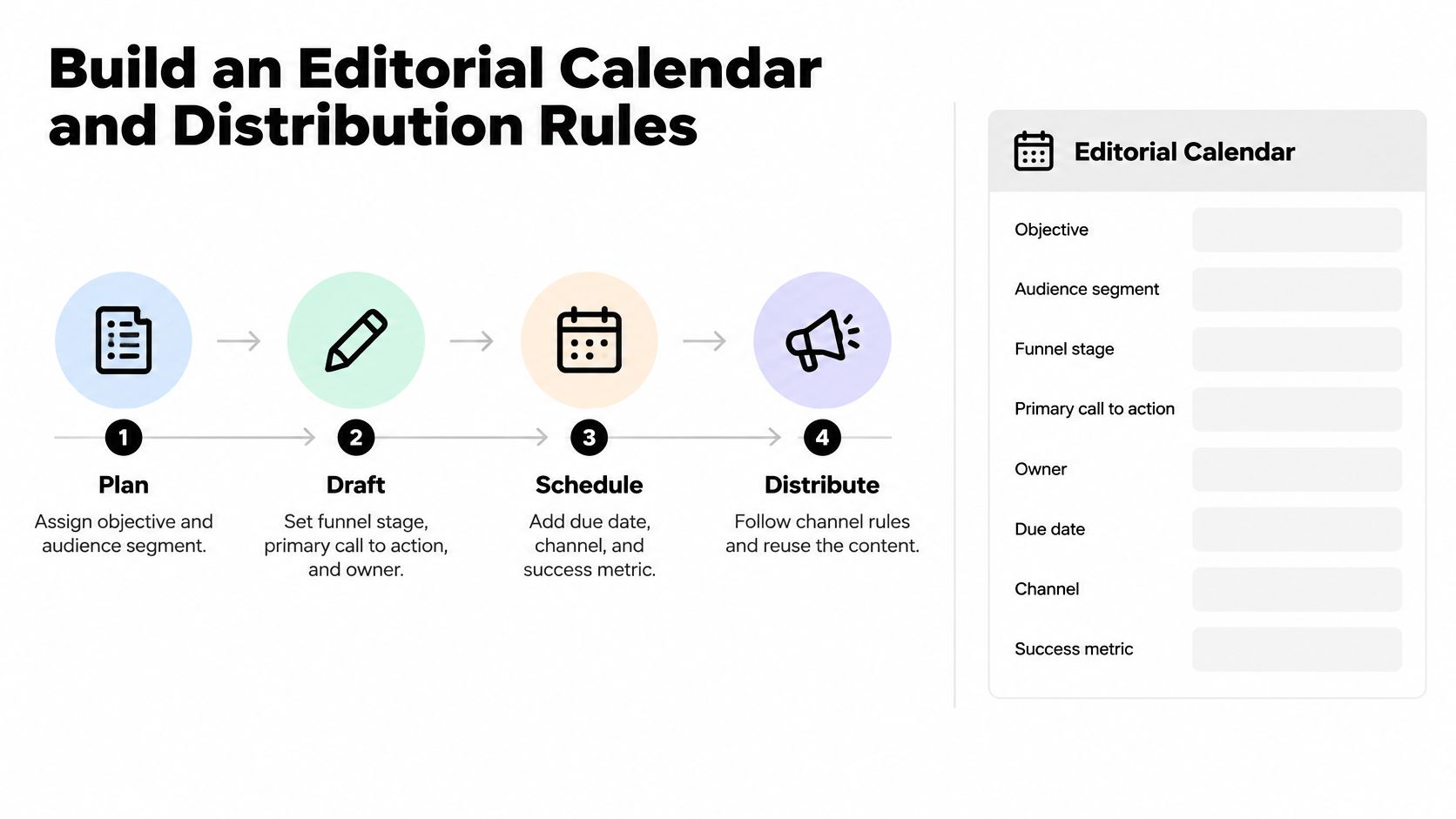
- Objective: the business result this piece serves, so a writer can refuse scope that does not move it.
- Audience segment: who it is for, so the example and the vocabulary stay in one buyer's world.
- Funnel stage: awareness, consideration, or decision, so you do not write a manifesto when the reader wants a comparison.
- Primary call to action: one next step, not three buttons.
- Owner: one name who is accountable for the due date, even if others contribute.
- Due date: the publish date, with the draft date set earlier so review has room.
- Channel: where it goes, decided before drafting.
- Success metric: the one number you will read for this piece.
The operating rhythm
We run the work in three moves. Capture ideas in a pipeline. Plan them on the calendar by assigning owners and setting publish dates. Publish, then review what worked. Capture without an owner produces a graveyard of "someday" cards. Planning without a review produces the same month twice.
Distribution rules and a small-team cadence
Decide, before anyone drafts, which two or three channels the piece will use. Assign a named person to each channel. The newsletter editor owns email. The social lead owns LinkedIn. "The team will share it" means nobody will.
A team of three can hold this cadence without heroics. Two long guides a month, a weekly newsletter, and four social posts per guide. The guide is the asset. The newsletter and the posts are scheduled jobs with their own owners, not leftovers. A LinkedIn post scheduler keeps those four posts on the dates you set, so the social lead is not rebuilding the queue from memory every Monday. One guide should also leave the building in more than one shape. The walkthrough on repurposing one piece into ten is the checklist for that, and it belongs on the calendar as tasks, not as a hope after publish day.
When a launch date moves, move the distribution tasks with it. Reschedule the newsletter slot and the social posts. Publishing them on the old date sends people to a page that is not live, and then you spend the next week explaining a 404.
Before the month starts, every item has an owner. If a row has a date and no name, it is not scheduled. It is a wish with a number next to it.
Measure Performance With the Right KPIs
| Indicator | Type | Review cadence | Example target |
|---|---|---|---|
| Brief approval time | Leading | Weekly | Under 2 business days |
| Production cycle time | Leading | Weekly | 7 to 10 days from brief to publish |
| On-time publication rate | Leading | Weekly | Set from first-month baseline |
| Content reuse rate | Leading | Monthly | 30% of pieces repurposed |
| Organic traffic to target pages | Lagging | Monthly | Growth quarter over quarter |
| Qualified leads or demo requests | Lagging | Monthly | Set from first-month baseline |
| Pipeline influence | Lagging | Quarterly | Set from first-quarter baseline |
| Retention or revenue | Lagging | Quarterly | Set from first-quarter baseline |
The targets in that table are starting points. Set the ones marked from a baseline after the first month or the first quarter. Copying another team's number will make a healthy queue look late, or a slow queue look fine.
Leading numbers first
Leading indicators tell you whether the system is moving this week. Brief approval under two business days means legal and the editor are not the bottleneck. A production cycle of 7 to 10 days from brief to publish is a pace a small team can repeat. On-time publication rate shows whether the calendar is fiction. Content reuse, with a starting aim that 30% of pieces get repurposed, shows whether distribution is a habit or a one-off.
Lagging indicators show whether the work changed the business. Organic traffic to the pages you meant to grow, qualified leads or demo requests, pipeline influence, and retention or revenue. Read traffic and leads monthly. Read pipeline, retention, and revenue quarterly. They will not twitch because you published on Tuesday.
A cadence you can keep
- Weekly, 30 minutes: workflow only. Approval time, cycle time, and what is late. No debate about headlines.
- Monthly: read traffic to target pages and the reuse rate. Kill or rewrite the piece that missed its one metric.
- Quarterly: connect the set of pieces to pipeline, retention, or revenue, and change next quarter's goals if the link is weak.
Judging a new blog section after six weeks of traffic is the common mistake. Search often takes months to respond. A quiet sixth week is not a verdict. A missed on-time rate in week two is.
Drop raw page views that do not connect to a goal. A post with a crowd and no demos, trials, or renewals did not serve the outcome you wrote down. If you want a wider menu of numbers and which ones to ignore, measuring content performance separates activity from outcomes, and you can track content-driven growth with Narrareach when you need the business side of the same story in one place.
Each piece names one primary metric before it is published. If the brief cannot say which number it owns, it is not ready to schedule.
Copy a Full Quarterly Plan Template
Copy this into a shared doc. One owner per row. A blank row is a risk you mark before the quarter starts, not a surprise in week six.
- Quarter goals. One or two outcomes, each with a target and a date. Worked entry: grow demo requests from guides by 15% over two quarters, reviewed at the end of the second quarter.
- Audience segments. Two to four, each with a role and a buying stage. Worked entry: operations managers at mid-size SaaS firms in a vendor comparison, and marketing managers renewing an editorial tool.
- Topic backlog. About six weeks, each topic with its score. Worked entry: "how to price a content retainer," score 8 (need 3, fit 3, effort 2).
- Calendar rows. Piece, owner, due date, channel. Worked entry: pricing guide, Maya, 14 March, newsletter and LinkedIn.
- Distribution owners. One named person per channel. Worked entry: Priya owns the newsletter, Jordan owns LinkedIn, Maya confirms the partner site.
- KPIs. One primary metric per piece, plus the weekly leading indicators (approval time, cycle time, on-time rate). Worked entry: demo requests from the pricing guide, checked monthly.
- Review dates. Put them on the calendar now. Worked entry: Wednesdays at 9:00 for the 30-minute workflow check, first Monday of the month for the content review, and the last Friday of the quarter for the business review.
- Budget and roles. Worked entry: one writer, one editor, and a freelance budget per quarter for design and the overflow draft.
The check before day one
Assign a name to every numbered row, including the review dates. A review with no owner does not happen. Highlight any blank in red and treat it as a blocked task. Do not publish the first guide until the red is gone. Teams that "start writing and fill the plan later" spend the quarter rebuilding the plan in Slack, one urgent message at a time.
Start Your First Quarter With a Plan Review
Decide this week whether you will run the plan for one quarter as a test, and book the review before the first draft starts. A quarter is long enough to see on-time rate and a first read on leads. It is short enough to change owners without a reorg.
- Write the seven components as your own plan. Use your numbers, not the examples. If a row has no owner, it is not done.
- Fill goals, segments, and owners for this quarter from the template. Two outcomes, two to four segments, one name per calendar row.
- Book the first monthly review before publishing begins. If the meeting is not on the calendar, the plan is a document, not an operating rhythm.
Say a three-person team runs that pilot. Guides ship. The newsletter and the social posts slip every week, because "someone" was supposed to post them after publish. In the second quarter they name a channel owner on each piece before drafting. The bottleneck moves, and the same two guides a month finally leave the site.
The Starter plan is free and includes an editorial calendar, up to 3 projects, 1 editor seat, and community support. The idea pipeline lets you capture topics and move them through draft, review, and published in one visual workflow, which is the capture step the pilot was missing when work lived in three docs.
Before you start, answer one question. Which single goal will this quarter's plan be judged on? If you cannot say it in one sentence, with a number and a date, you are not ready to brief the first piece.
TheContentMap is the editorial planning workspace for this kind of operating plan. You capture ideas, assign owners, set dates, and see what shipped, so the quarter is a system rather than a list of titles. Start with your seven rows and your one goal, then build the quarter in TheContentMap.
Related Articles
Contingency Planning Example: 7 Content Backup Plans
It's 9 a.m. Your feature writer is sick, the product launch has slipped, and the newsletter stil...
SoftwareHow to Build a Publishing Schedule That Holds
You set a publishing schedule for daily posts on Monday. By Thursday, two drafts are waiting on an e...
SoftwareSeat Management for Editorial Teams in 2026
Your editorial calendar is full, a legal approval is holding up publication, and finance wants to kn...
Comments (0)
No comments yet. Be the first to share your thoughts.