Publishing Project Management: A Stage-by-Stage Guide
Learn how publishing project management works, from idea capture and editorial calendars to rights checks, AI use and the metrics that keep titles on schedule.
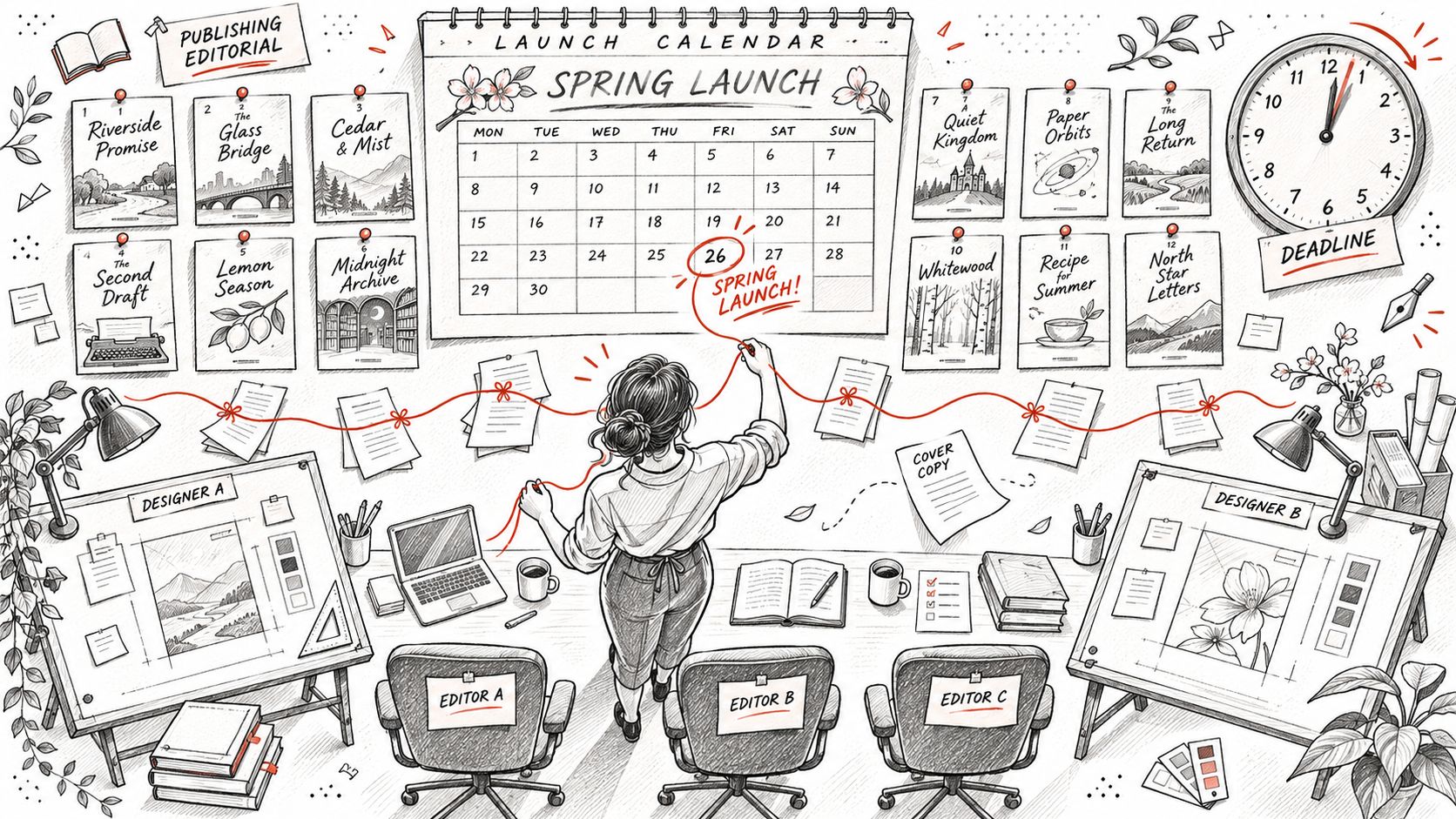
The spring list has twelve titles, three editors sharing the commissioning, two designers handling covers and interiors, and a launch date fixed back in January when the retailer's catalogue closed. Everything holds together until a production meeting in early March, when somebody asks who wrote the back-cover copy for title seven. Nobody knows. It wasn't on anyone's list, and there are nine days left.
That's the ordinary shape of a publishing delay. Not a dramatic collapse, just a gap in ownership that widens over time until the date stops being achievable. The lists that ship on time aren't usually the ones with the best manuscripts. They're the ones where each handoff had a name, a date and a check that had to pass before the next person touched the file.
Table of Contents
- What Publishing Project Management Actually Covers
- The Stages a Title Moves Through, and Who Owns Each
- Why Coordination Breaks as Output Goes Digital
- Metrics That Reveal Where Publishing Schedules Slip
- Managing Rights and AI Use as Workflow Layers
- How to Run a Weekly Publishing Coordination Cycle
- Set Up Your Publishing Workflow This Week
What Publishing Project Management Actually Covers
Publishing project management is the discipline of planning, assigning, sequencing and tracking every title, article or asset from first idea to live publication, in every format and on every channel it ships to. It isn't the writing, and it isn't the design. What it owns is the visibility that lets both happen without colliding.
An air traffic controller doesn't fly the planes. The controller sees every runway, every departure slot and every aircraft waiting at a gate, all at once, and moves one before another becomes a delay. An editorial operations lead does the same for a list of titles, and the value shows up in the same place: nothing sits on the tarmac unnoticed for a week.
That job runs on three layers, and teams that blur them end up with a calendar nobody trusts.
- The portfolio view. Which titles go out, and when. Twelve books across print, ebook, audio and web extracts, all readable on one calendar a publisher can scan in a board meeting.
- The item view. Who owns each piece, what it needs next, and what's blocking it. This is the layer an editor checks on a Tuesday morning.
- The control view. Which gates must pass, which reminders fire, and what the last three cycles taught you about capacity.
The people in those layers carry titles: managing editors, commissioning editors, writers, designers, producers, rights and permissions staff, and the approvers who sign off. The split between the writing side and the design side is old and stubborn. A study of publishing workflows published through ACM found that all 16 participants referred to the traditional division between text workers and design workers, while 12 of 16 actively used it.
Digitization didn't remove the coordination work. It redistributed it across more roles and more software. Read your workflow as a chain of gated handoffs rather than a list of tasks, and you can draw it on one page before the week ends.
The Stages a Title Moves Through, and Who Owns Each
A publishing workflow holds up best as a dependency-controlled lifecycle, not a list of tasks. The practical minimum, as the content operations guide at Seowind sets out, is to define stages such as intake, prioritization, briefing, production, editorial review, approval, publishing, distribution, measurement and maintenance, and to give each stage an accountable owner, an explicit output, entry and exit criteria, and escalation rules.
That framing turns a vague handoff into an observable state transition. A draft can't enter approval until the required editorial checks are complete. A publication task can't close until formatting, metadata, links and channel scheduling are verified. The difference between a to-do list and a lifecycle is the gate in the middle.
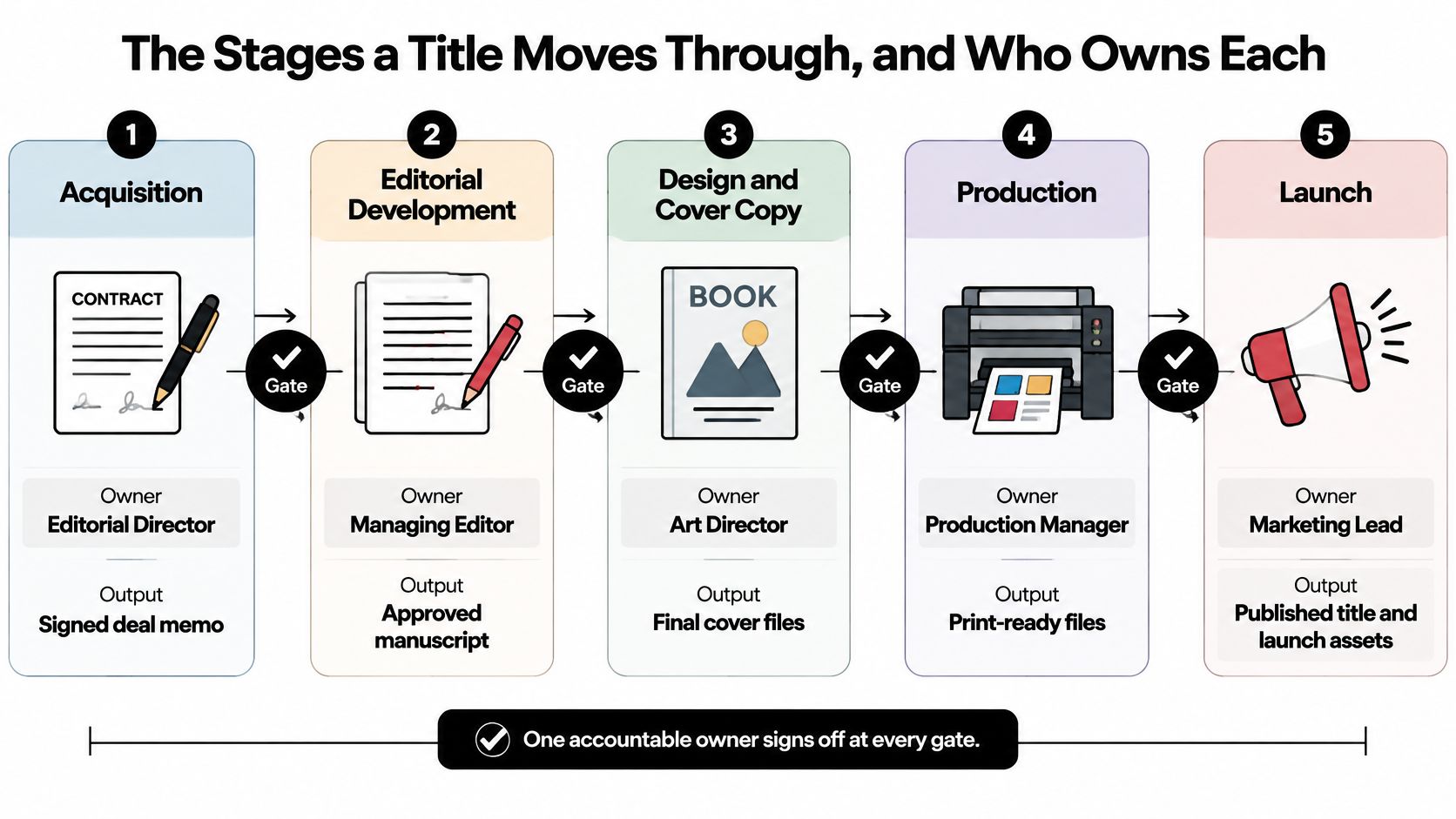
Walk it in order. A pitch logged at intake becomes a real item only when it carries a channel, a campaign, an owner and a target date. At briefing it becomes a signed document that fixes word count, format, image needs and deadline, which is the cheapest way to stop a writer guessing. Production delivers a draft with its assets and metadata attached, review logs a revision round, and approval confirms that rights data exists before anyone schedules a release. Publishing verifies the mechanics, and distribution plus measurement close the loop with a results record that feeds the next slate.
| Stage | Accountable owner | Required output | Gate before moving on |
|---|---|---|---|
| Intake | Managing editor | Logged idea with channel and campaign | Owner and target date assigned |
| Prioritization | Managing editor | Ranked slate with dates | Capacity checked against the slate |
| Briefing | Commissioning editor | Approved brief with word count and deadline | Brief signed off |
| Production | Writer or designer | Draft with assets and metadata | Required checks complete |
| Editorial review | Editor | Revised draft with revision round logged | Factual and style checks passed |
| Approval | Approver or rights lead | Approved version | Rights data recorded and complete |
| Publishing | Producer | Live item | Formatting, metadata and links verified |
| Distribution and measurement | Content operations | Channel schedule and results report | Outcome logged for next planning cycle |
| Maintenance | Content operations | Update log and refresh schedule | Stale items reviewed and dated |
A gate is a yes or no answer
Moving a card from "in review" to "approved" is a label change. A gate is the question underneath it: are the factual and style checks finished, and has a named editor signed off? If the honest answer is "sort of", you don't have a gate yet, and everything behind it is queued on optimism.
When review is where items pile up, the guide to structuring an editorial review process is the stage to redesign first, because a slow review gate holds every downstream stage hostage. The underlying shape stays simple enough: capture ideas in a pipeline, plan them on an editorial calendar with owners and publish dates, then publish and review what worked. Gates are what make that shape reliable instead of merely hopeful.
Why Coordination Breaks as Output Goes Digital
The coordination problem grew with the formats, not with the presses. One title now ships as print, ebook, audiobook and web extracts, and each carries its own file specification, metadata set and channel deadline. A single manuscript becomes several parallel workflows that all descend from one brief.
The World Intellectual Property Organization's 2022 global publishing report, developed with the International Publishers Association and Nielsen BookData from responses of 76 IPA members, describes exactly that shift to multi-format, digitally distributed output, where coordination depends on reusable content, metadata, digital channels and cross-functional collaboration. The volume behind it shows in WIPO's own records: books deposited in national repositories rose from 2.4 million in 2018 to 2.7 million in 2019, an increase of roughly 12.5%, with the growth attributed mainly to digital deposits.
Every added format adds handoffs. A file gets reformatted, its metadata gets re-checked, and its channel date gets reconciled against the master schedule. Digital tools didn't absorb that work. They spread it across more roles and more software, which is why coordination effort keeps rising even as production effort falls.
The honest test: if you can't name who owns the next handoff on a given title, no tool will answer that question for you.
The everyday evidence sits in the tooling. In a 2025 survey, 58% of business professionals said email was their most common tool for project and task management in long-form content work, according to Adobe's State of Long-form Content Management research. Email can carry one editor and one title. It can't show who owns the next handoff, which item is blocked, or whether the audio edition is late. A shared status record tied to the lifecycle gates closes that gap, and the guide to cross-team collaboration covers the habits that keep it current.
Metrics That Reveal Where Publishing Schedules Slip
Treat schedule reliability as a systems problem involving capacity, dependencies and quality gates. The Storyteq guide on standardizing content production draws the cause and effect plainly: incomplete briefs create downstream clarification and revision work, undefined approvers create waiting time, untracked dependencies let late assets or translations block publication, and missing final checks raise the odds of formatting, metadata or factual errors after release.
The control model that makes this measurable is dull and effective. Give every content item a planned publish date, internal handoff deadlines, a responsible role, predecessor dependencies and a written definition of done. Then calculate schedule adherence as completed publications delivered by the committed date divided by total committed publications. Track lead time and blocked time separately, because a team can hit a high output number while its queues rot.
| Metric | What it measures | Warning sign | Likely cause |
|---|---|---|---|
| Cycle time | Days from brief to publication | Rising across consecutive cycles | Unclear requirements or thin capacity |
| Queue time | Days an item waits between stages | Long wait before editorial review | Review bottleneck |
| Revision rounds | Edits per item before approval | Routinely more than two rounds | Incomplete briefs |
| Approval latency | Days from review to sign-off | Items sitting with one approver | Undefined or overloaded approver |
| On-time publication rate | Committed items published by their date | Falling below target | Untracked dependencies such as late assets |
| Post-publication error rate | Corrections needed after release | Corrections rising month on month | Missing final checks |
Reading a queue problem correctly
Say a title spends nine days waiting for review and two days being edited. Its cycle time looks alarming, but the cause isn't writing capacity, and hiring another writer would make the queue longer. The same logic applies to revision rounds: a title that routinely needs four rounds is telling you the brief was thin, not that the writer is slow.
A number worth agreeing in advance: anything sitting in review past five working days gets escalated to the approver's manager that same week, before the queue grows another item.
Feeding the numbers back into planning
Performance data belongs in the next planning cycle, not in a report nobody opens. Topics, formats and channels that meet quality and audience objectives earn more capacity. A recurring bottleneck earns a workflow change or a staffing decision, and both are cheaper than a permanent coordinator for every two titles.
That closes the loop from planning to production to learning, which is how editorial operations scale across projects and markets. For the post-release half of that loop, the content performance metrics guide covers what to measure once a piece is live.
Managing Rights and AI Use as Workflow Layers
The most expensive failure in a publishing schedule usually isn't a late manuscript. It's an asset that has already travelled through the entire workflow with permissions nobody can produce. A missed date costs a week. An unlicensed image in a printed book costs a reprint, a legal review, or both, and a late deadline is easier to explain than a takedown.
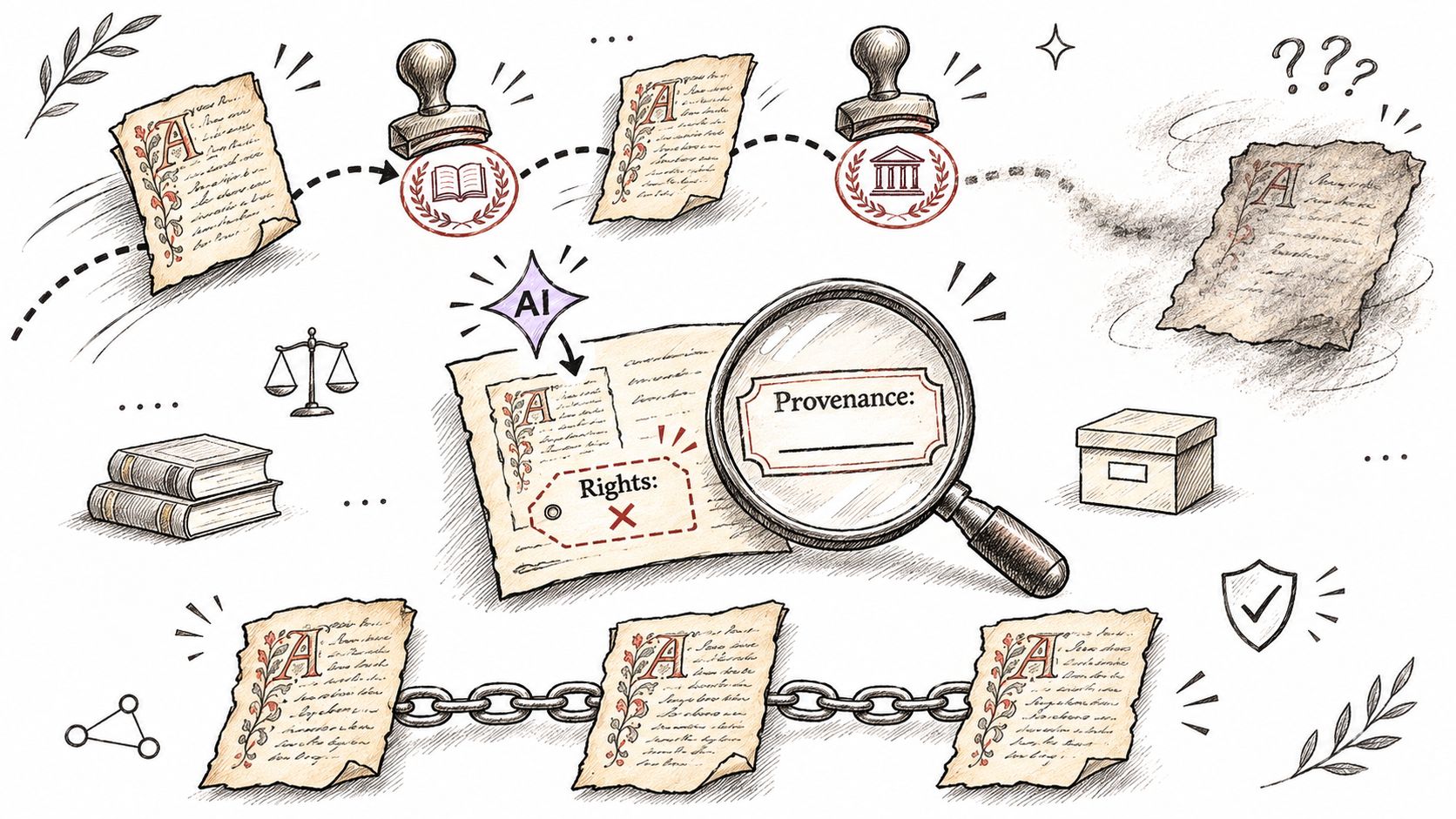
AI has made that failure easier to reach and harder to see. A 2025 survey of 40 publisher professionals found generative AI already in use for creative production and design by 61% of respondents and for copy editing by 57%, according to Digiday's research on how publishers are approaching AI.
The reframing that matters isn't more automation. It's reversibility and accountability: the ability to say, months later, what produced this text or image, who approved it, and what they were permitted to do. That means structured fields rather than notes in a margins comment.
- Tool record. Which model or tool touched the text, image or audio, and on what date.
- Contribution split. Which passages are human-authored, which are machine-generated, and who edited what.
- Source provenance. Where the claims and assets came from, with links or document references attached to the item.
- Consent. Whether the creator agreed to AI use in writing, and the exact scope they agreed to.
- Licence scope. Territories, formats, translations, excerpts and AI uses permitted, plus expiry and attribution terms.
Risk tiers do the routing work. A grammar pass needs no committee. A generated illustration destined for a cover needs a rights check and a named human sign-off before it reaches approval. Define approved use cases, mandatory disclosure fields, sign-off points and an escalation route for copyright, privacy, hallucination and reputational risk, then hold that line while the tools change underneath you.
Consent is the field teams skip. In a 2025 Australian Society of Authors survey, 92% of traditionally published respondents said their publisher had not asked them to license their work for AI-training purposes, as reported by the Australian Society of Authors. A workflow that never asks the question can't record the answer, and the gap only surfaces when someone objects.
The workflow layer only works when people can see it in practice. This walkthrough shows how provenance documentation sits alongside ordinary editorial stages.
One trap belongs in every rights checklist: a clean file is not evidence of a clean licence. Stripping a watermark doesn't establish origin, and why watermark removal can't be verified is a useful reminder that visual markers were never a reliable audit trail.
End with two hard rules written into the workflow itself. The publication gate blocks release when mandatory rights fields are empty: owner, licence scope, consent, expiry. The withdrawal rule handles consent revoked after scheduling, sending the item back to review, clearing its channel date, and flagging anything already published for takedown or correction. Both rules need to live where people work, not in a policy document nobody opens at six on a Thursday evening.
How to Run a Weekly Publishing Coordination Cycle
A weekly cycle is the cheapest control mechanism in publishing. Fifty minutes, seven steps, the same order every week, and a written record that survives the people in the room.
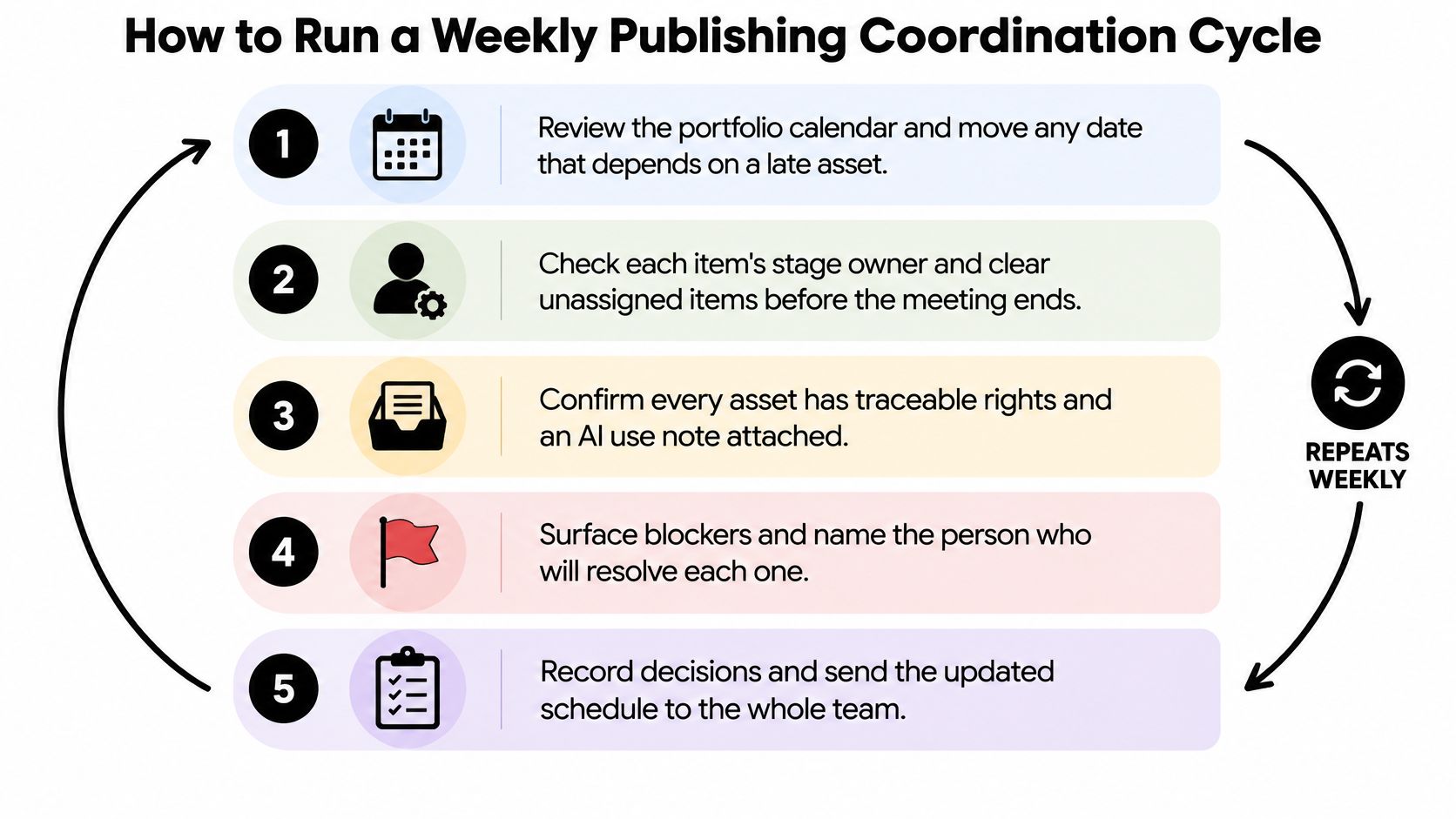
- Reconcile the calendar against dependencies. Start at portfolio level and move any date that rests on a late asset. A calendar that isn't reconciled shows dates that can't be met, and a team that meets impossible dates twice learns to ignore the calendar altogether.
- Confirm a stage owner for every item. Clear unassigned items in the room, not after it. An item without an owner isn't waiting on work, it's waiting on a decision, and nobody is making it.
- Read queue time and cycle time out loud. Flag anything waiting longer than your agreed limit. Numbers read aloud get acted on. Numbers sitting in a dashboard get admired once and forgotten.
- Check the approval queue for complete briefs and rights fields. Skipping the rights check on a fast-moving item is precisely how the untraceable asset gets created, and speed is the reason people skip it.
- Send reminders for handoffs due within 48 hours. A nudge three days out costs nothing. Chasing a designer on the morning of a print deadline costs a day you didn't budget.
- Log revision rounds and corrections from the past week. Two data points per item are enough: how many rounds it took, and whether anything needed fixing after release. Those two numbers diagnose most schedule problems within a month.
- Change one thing the numbers justify. One capacity shift or one workflow edit per week. Make seven changes at once and you can't tell which one worked.
Most of the mechanics are calendar hygiene. You want one shared view where pieces can be dragged between dates so the plan stays honest when reality moves, plus reminders that reach owners before a handoff slips rather than after it. Publish reminders and a whole-plan calendar view do more for on-time delivery than any amount of team goodwill, because goodwill doesn't scale across four formats and twelve titles.
Expect the first two cycles to look worse. Surfacing blocked items and empty rights fields increases the number of visible problems in week one. That's the system working, not the system failing.
A healthy week ends with no unassigned items, two or three escalations already resolved, and a calendar where every date traces back to an owner who confirmed it. If the meeting ends with everyone agreeing things are busy, the cycle hasn't done its job.
Set Up Your Publishing Workflow This Week
Pick one action and finish it this week: map your current workflow onto the lifecycle stages, name one accountable owner for each stage, and add one gate. A useful first gate is the rights check before approval, because its absence is the most expensive.
The order matters. Define gates first, build the calendar on those gates, and add metrics once you have data worth reading. Don't start by choosing a tool. A team that buys a calendar before deciding who owns each handoff is just digitizing the confusion that shows up in email threads.
Run three checks during the mapping. Every stage needs an owner who can say no. Every gate needs to return a yes or a no rather than a status label. The rights check needs to block publication when its fields are empty, otherwise it's a reminder, not a control.
If you'd rather test this on software than in a spreadsheet, our Starter plan is free and includes an editorial calendar, up to 3 projects and 1 editor seat, which is enough to run one real title through real gates. The Team plan is arranged through sales contact rather than a self-serve button, so map the workflow before that conversation rather than during it.
Then take the one stuck item in your current schedule and run it through the lifecycle a stage at a time, noting where it waits and which gate it fails. That real case, not a theory, becomes the first agenda item of your next weekly cycle.
TheContentMap gives editorial teams one place to capture ideas, schedule them on a shared calendar with named owners, and review how published work performed. If you're tired of reconstructing who owned what from an email thread, TheContentMap puts every item in a visual pipeline with a stage, an owner, comments, and reminders that keep deadlines in front of the people who owe them. Start on the free Starter plan and run one title end to end through it this week.
Related Articles
How to Manage Multiple Projects: A 2026 Playbook
It's Tuesday morning. Three projects need the same senior editor, every stakeholder has labelled...
SoftwareA Practical Editorial Review Process for Content Teams
An editorial review process is a defined sequence of stages, owners, and decision points that carrie...
SoftwareEditorial Calendar Management: Setup, Stages and Metrics
Your calendar says an article will publish on Thursday. The writer says the draft is finished, the e...
Comments (0)
No comments yet. Be the first to share your thoughts.