How to Manage Multiple Projects: A 2026 Playbook
Learn how to manage multiple projects with a weighted priority score, one capacity-limited schedule, five tracking numbers, and a weekly coordination rhythm.
It's Tuesday morning. Three projects need the same senior editor, every stakeholder has labelled their request urgent, and a writer is waiting for feedback before starting the next assignment. Your calendar looks organized, but the people doing the work are already overbooked.
Learning how to manage multiple projects starts with recognizing that mismatch. You don't need a longer to-do list. You need a system that decides which work earns capacity, makes resource conflicts visible, and preserves enough context for people to switch projects without starting from scratch.
Table of Contents
- The Four Levers of Multi-Project Control
- Score Every Project Before You Schedule Anything
- Build One Schedule That Holds Every Project
- Track Progress With Five Numbers Instead of Status Meetings
- Coordinate Owners, Handoffs and Review Queues
- Fix Interruptions and Priority Drift Before They Break the Plan
- Choose Your System and Start This Week
The Four Levers of Multi-Project Control
Multi-project management is a portfolio problem. Each project can look reasonable on its own while the combined workload is impossible. A launch campaign, an evergreen refresh, and a client series might each have a credible deadline, until you discover that all their approvals depend on the same person.
Control comes from making decisions in a fixed order: prioritize, schedule, track, then coordinate. These aren't competing management techniques. They answer different questions, and each needs a visible artifact rather than an agreement buried in a conversation.
The Four Levers of Multi-Project Control
| Lever | Question it answers | Artifact to build | Review cadence | Cost of skipping it |
|---|---|---|---|---|
| Prioritize | Which projects earn capacity this month? | Weighted portfolio scorecard | Monthly, weekly for deadline work | Scarce editors get split across work that cannot all ship |
| Schedule | When does each deliverable actually fit? | One capacity-constrained calendar | Weekly | Two launches land in the same week with one writer |
| Track | Which projects are on track right now? | Single status board with visible stage changes | Twice a week | Delays surface at the deadline instead of while there's still time to act |
| Coordinate | Who owns each handoff and review? | Owner and approver map plus escalation rules | Daily for blockers, weekly for risk | Review queues stall and approved work gets reopened |
Treat those review cadences as a starting operating policy, not a universal benchmark. A daily publication and a quarterly research program need different levels of attention. What shouldn't change is the distinction between choosing work and managing work already accepted.
Why the Order Matters
Scores feed the schedule. The schedule establishes the baseline that tracking measures against. Coordination keeps that baseline credible by making sure the next person can accept a handoff.
Overwhelmed teams often skip straight to scheduling. They put every requested deliverable on a calendar, then rebuild it whenever someone points out a conflict. The calendar becomes a record of competing wishes rather than a commitment the team can defend.
Practical rule: A date isn't a commitment until the people needed to deliver it have room to do the work.
Small operations need this discipline too. Blog Health App's content planning for part-time bloggers is relevant when publishing must fit around limited working hours. A solo operator still has competing projects, even when the writer, editor, and publisher are the same person.
Keep the artifacts connected rather than creating separate administrative chores. A project's priority should explain its place on the calendar; its status should explain whether that place is still realistic. Once those decisions are visible, interruptions and tool selection become easier to handle without renegotiating the entire portfolio.
Score Every Project Before You Schedule Anything
A useful ranking is one you can defend when a stakeholder asks for another deliverable. It should explain both why a project matters and why the team can afford to accept it now.
McKinsey's analysis of matching projects with resources describes organizations combining financial measures with drivers such as risk, time to launch, and strategic importance. The practical lesson is to make project selection and resource allocation the same decision, not separate approvals.
Build a Ranking You Can Defend
Start with an inventory. Give every live project a row containing its expected value, strategic alignment, risk, required skills, dependencies, fixed deadline, and estimated person-days. Include work that people have informally promised, not just formally approved projects.
Then apply the same scoring model across campaigns, client work, and evergreen maintenance. The following is an illustrative model, with proposed weights and rating anchors, not an industry benchmark.
A Weighted Scoring Model for a Content Portfolio
| Criterion | Weight | A 5 looks like | A 1 looks like |
|---|---|---|---|
| Expected value or revenue impact | 20% | Directly tied to a revenue or retention target | No measurable outcome |
| Strategic alignment | 15% | Serves a stated annual goal | Legacy obligation nobody can explain |
| Deadline rigidity | 15% | Fixed external event, launch, or contract date | Can slip without consequence |
| Dependency risk | 15% | Blocks several downstream deliverables | Fully standalone |
| Specialist demand | 15% | Requires the only qualified specialist | Anyone on the team can deliver |
| Review and approval load | 10% | Small approval group with a clear sign-off path | Multiple approvers plus legal review |
| Effort demand | 10% | Small, well-defined effort within available capacity | Large or uncertain effort that displaces commitments |
| Total | 100% | Score equals the sum of weight times rating | Rank projects by score, highest first |
Multiply each rating by its weight, expressed as a decimal, then add the results. Don't mistake the total for an automatic authorization: specialist demand and downstream dependencies signal scheduling exposure, so they still require a resource check.
This model deliberately prioritizes work that needs scarce expertise. If your problem is too much specialist-dependent work entering production, reverse that criterion's direction before using it. Keep the rating direction consistent within the portfolio, and don't change it to favor a particular proposal.
Draw the Capacity Line
Define capacity before deciding what fits. For each person, calculate available focus time after meetings, leave, operational duties, and existing commitments. Express that time in person-days, but retain the skill breakdown: spare writing capacity can't substitute for an unavailable technical reviewer.
Use this decision cycle:
- Inventory the demand. Capture all proposed and committed work.
- Score consistently. Apply agreed criteria rather than stakeholder seniority.
- Draw the commitment line. Accept only the work that fits the available people.
- Check specialist conflicts. Sequence projects that need the same reviewer.
- Re-score regularly. Review deadline-sensitive work weekly and the wider portfolio monthly, recording why rankings change.
For a hypothetical portfolio, suppose projects score 4.2, 3.8, and 2.9, and the required skills and effort allow only the highest-ranked pair to proceed. Queue the remaining project explicitly. Don't assign it a deadline and hope someone finds spare time.
Use an operational plan template to turn accepted priorities into responsibilities and resource commitments. Ranking by expected revenue alone can overload scarce editors, while treating prioritization as a one-off exercise lets informal requests bypass the model. Adding workload isn't a substitute for deciding what stops.
Build One Schedule That Holds Every Project
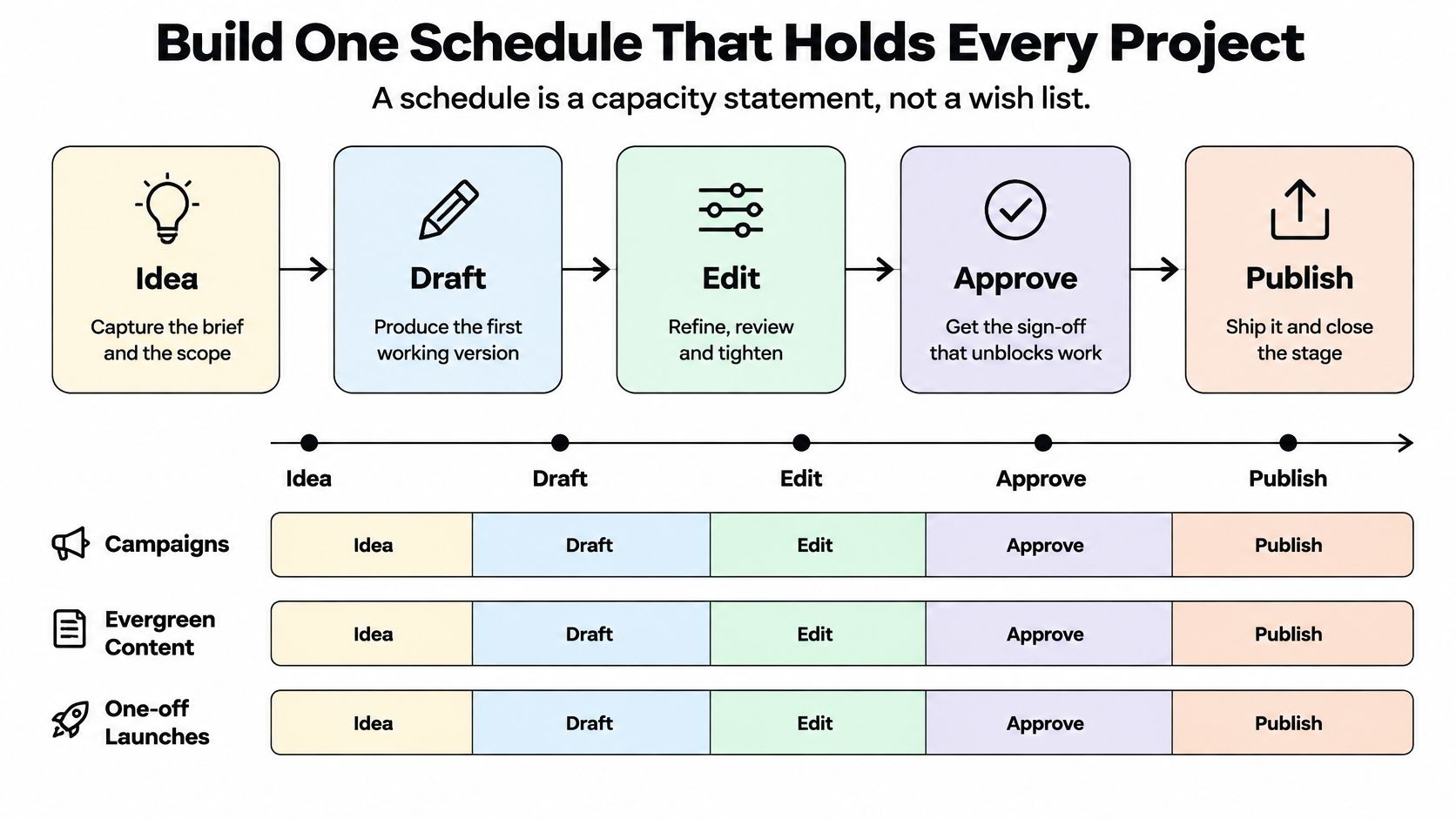
A schedule is a capacity statement, not a wish list. Build it around deliverables and the people who must move them forward, rather than filling empty calendar cells with publication dates.
Use a shared stage map to make different kinds of content comparable without forcing their production methods to be identical.
Build Backward From the Commitment
Begin with idea, draft, edit, approve, and publish as common reporting stages. Define their exit conditions. A draft isn't ready for editing if its required evidence is still missing, and approval isn't complete if another stakeholder can reopen the decision without explanation.
Work backward from immovable dates. Reserve production time, reviewer waiting time, revision time, and publishing preparation separately. If you combine them into one drafting estimate, the writer appears late when the problem is an approval delay.
For a hypothetical launch schedule, you might reserve several working days for review and a separate revision buffer. Replace that assumption with your own measured turnaround as completed work gives you better estimates. A reviewer's availability matters more than how quickly they could read the document under ideal conditions.
Set explicit entry rules:
- Drafting capacity: As a starting policy, allow one active draft per writer rather than scattering effort across unfinished pieces.
- Review capacity: Give each editor a bounded queue based on what they can clear before the next handoff.
- Approval capacity: Limit simultaneous submissions to what named approvers have agreed to handle.
- Production protection: Reserve uninterrupted work blocks and group meetings into predictable windows.
Sequence the Bottleneck, Not Just the Launch
Stagger projects that share approvers. Moving publication dates won't solve the problem if all the drafts still arrive for review together. Schedule the review reservation first when that specialist is the limiting resource.
Put accepted work on a shared calendar, then update affected dependencies when dates move. Keep separate views for teams if useful, but don't maintain competing versions of the commitment.
This doesn't require identical project methods. PMI's 2024 Pulse of the Profession concluded that predictive, agile, and hybrid approaches can produce comparable performance when appropriately matched to project circumstances. Fixed-date campaigns can use firm milestones while evergreen work uses iterative review, provided owners, status, deadlines, and risks remain comparable.
Use this video alongside a calendar walkthrough to discuss how your team will apply the workflow.
If the approval work assigned to a week exceeds the editor's available review time, the schedule needs a cut, a scope change, or a different date.
Don't fix that mismatch by shortening every estimate. Ask which deliverable can move without breaking a genuine external commitment, then confirm the new sequence with affected owners.
Track Progress With Five Numbers Instead of Status Meetings
A status board should show each deliverable's stage, owner, next committed date, and blocker. The person doing the work updates it when the situation changes. A manager shouldn't have to reconstruct progress from private messages.
PMI's global comparison report reports that 50% of projects globally finish on time, while 39% experience scope creep. Those figures don't predict your editorial performance, but they support monitoring timing and scope rather than counting completed tasks alone.
The Five Tracking Numbers and Their Thresholds
The thresholds below are example intervention rules to calibrate against your team's baseline, not published performance benchmarks.
| Metric | What it tells you | Threshold to watch |
|---|---|---|
| Cycle time | Days from draft start to publish | Rising across successive completed pieces |
| Blocked hours | Working hours a project waits on a decision | Waiting consumes the remaining schedule buffer |
| Deadline reliability | Share of committed publish dates hit | Falls below the team's agreed service target |
| Reopened work | Share of pieces sent back after approval | Any reopening without a documented reason |
| Approval latency | Working days from submission to sign-off | Exceeds the review allowance reserved in the schedule |
Read the numbers together. Rising cycle time with stable approval latency suggests investigating drafting, revisions, or production capacity. Rising approval latency while completed-work cycle time remains stable can be an early warning that submissions are accumulating before the delay appears in published output.
Review Exceptions, Not Everyone's Activity
Use a short board sweep during the week to catch missing updates and blocked handoffs. Hold a weekly cross-project risk review, then compare forecast effort with actual effort and planned publication dates with actual dates monthly.
Keep the discussion centered on a decision:
Review question: Is the next committed date still credible, and what must change if it isn't?
Add a scope-change gate. A new request can displace an accepted commitment only when someone records what it replaces, the delivery consequence, and who agreed.
A missed dependency can consume the reviewer time another project needs. Make that consequence visible before accepting the change, rather than explaining the collision after both dates have slipped.
Coordinate Owners, Handoffs and Review Queues
Handoffs need an acceptance rule, not just a notification. An editor must know what's ready, which decision they own, and when the contributor needs an answer.
A Saner.AI summary of context-switching evidence reports that experimental research summarized by the American Psychological Association found task switching can reduce productivity by up to 40%. That's a reason to protect concentrated work, not a prediction of your team's exact productivity loss.
Make the Handoff Explicit
Use these example operating windows as a starting agreement:
- Assign before work begins. Write an accountable owner and a final approver into every deliverable. Confirm acceptance before production starts.
- Map shared resources weekly. Check writers, designers, subject-matter experts, and reviewers across all active projects, including informal requests.
- Escalate blockers daily. Flag a blocker at the next daily sweep. If it threatens a committed date, get a decision immediately rather than waiting for the weekly meeting.
- Agree on review response times. For example, request acknowledgement within a working day, with either sign-off or a realistic completion time. Acknowledgement isn't the same as completed review.
- Batch administrative work. Set predictable daily windows for approvals, updates, and routine requests, while preserving a separate route for genuine emergencies.
Use reminders for actions that someone can take, not every status transition. Otherwise, contributors learn to ignore them.
Effective cross-team collaboration depends on these agreements surviving departmental boundaries. A marketing deadline doesn't create legal-review capacity unless the reviewer has accepted the reservation.
Fix Interruptions and Priority Drift Before They Break the Plan
Don't design a system that works only when nobody interrupts anyone. Content teams need clarifications, corrections, stakeholder decisions, and occasional emergency changes. The useful intervention is making each switch cheaper and less ambiguous, not pretending switching can disappear.
Workplace research available through the University of Oulu repository found participants deviated from their main task every 3.5 minutes on average, with self-initiated interruptions accounting for almost 60% of off-task time. Turning off incoming notifications won't address every interruption.
Leave a Restart Point
End a work block with a resumption note inside the task. Record what's complete, what remains uncertain, and the next physical action. Replace a vague note such as continue article with something executable: compare the product claim against the source document, then revise the opening paragraph.
Keep the supporting links beside that note. Include the current draft, accepted brief, outstanding question, and latest decision. Someone returning to the assignment shouldn't need to search chat history to discover which version the editor approved.
Define urgent requests in writing. A live factual error or an external commitment at immediate risk may justify interruption. A stakeholder wanting reassurance usually needs an update, not an emergency production slot.
After a meeting-heavy or incident-heavy period, reserve a recovery block. Use it to reconcile changed decisions and restart the most important interrupted assignment, rather than filling the next available space with another request.
Symptoms, Causes and Fixes for a Derailed Multi-Project Plan
| What you notice | Likely cause | Fix to apply this week |
|---|---|---|
| You repeatedly reread the same brief before starting | Attention residue after a switch | Write the next concrete action at the end of every work block |
| A project remains almost done across repeated reviews | No work-in-progress limit | Stop starting new drafts until an active piece clears |
| Urgent requests always win | Present bias with no escalation rule | Define urgency in writing and queue the rest |
| Status updates consume the start of the day | Notification-driven prioritization | Batch approvals and updates into fixed windows |
| Drafts sit in review | Unclear approval ownership | Name the approver in the task |
| Evergreen and research work never starts | Deadline noise crowds out long-horizon work | Reserve protected capacity before accepting discretionary requests |
| Handoffs reopen after approval | Contributors lose decision context | Record decisions and supporting links in the task |
Protect Work That Doesn't Shout
A 2025 operations-management study on self-control across multiple projects found that present bias can cause suboptimal project choices. It also found that increasing workload doesn't reliably ensure prioritization by expected value.
Protect evergreen updates, audience research, technical improvements, and repurposing with an explicit capacity reservation. Set its size according to your commitments, then treat taking that capacity as a portfolio decision rather than a casual favor.
Keep a tradeoff record whenever priorities change. Capture the incoming request, business reason, displaced work, affected owner, new date, and decision-maker. Separate genuine business urgency from seniority, client visibility, or pressure created by a different time zone.
Review repeatedly deferred projects. Either protect their allocation, reduce their scope, or remove them from the active portfolio. Leaving them nominally active makes the team appear committed to work nobody is funding.
Use a contingency planning example to prepare fallback decisions for unavailable reviewers, late inputs, or changed launch requirements. A fallback should specify who decides and what changes, not merely tell the team to communicate more.
Choose Your System and Start This Week
Choose the lightest system that keeps commitments, ownership, and context visible. More features won't repair an intake process that accepts work without checking capacity.
Match the Tool to the Work
- Spreadsheet: Suitable for a small, straightforward portfolio when someone can maintain dependencies, review reservations, and status changes manually. Excel or Google Sheets can hold the scorecard, but reminders and handoffs need deliberate upkeep.
- General project tool: Useful when editorial production sits alongside engineering, events, or operations. In tools such as Asana or Trello, you'll need to define publication fields, review stages, and approval rules yourself.
- Editorial planning platform: Useful when campaigns, series, and client content share a publishing workflow. Check that its stages match how contributors work, rather than creating duplicate tracking.
Our workflow at TheContentMap starts with capturing ideas in a pipeline, planning them on an editorial calendar with owners and publish dates, then publishing and reviewing what worked. Starter is free, with up to 3 projects, 1 editor seat, an editorial calendar, and community support. Pro costs $12 per editor per month and adds unlimited projects, content insights, team collaboration, and priority support.
Make the First Week Operational
Start with the current portfolio, not an elaborate migration:
- Score the work already promised. Include hidden commitments.
- Set drafting limits. Make queued work visibly different from active work.
- Consolidate publication commitments. Resolve conflicting calendars.
- Confirm ownership. Get each handoff accepted by its recipient.
- Book the risk review. Give unresolved tradeoffs a decision forum.
- Set the next re-score date. Don't let the ranking become permanent by accident.
Finish with the drop test: if you can't say which project you would defer, reduce, or stop to accept a new one, the portfolio isn't under control yet.
TheContentMap brings idea capture, editorial scheduling, assignments, and publishing workflow into a shared workspace so you can manage commitments across projects. Visit TheContentMap and put your accepted projects on one calendar, with a named owner and a realistic publish date for each.
Related Articles
A Practical Editorial Review Process for Content Teams
An editorial review process is a defined sequence of stages, owners, and decision points that carrie...
SoftwareEditorial Calendar Management: Setup, Stages and Metrics
Your calendar says an article will publish on Thursday. The writer says the draft is finished, the e...
Software7 Editorial Calendar Example Layouts for Teams
Your spreadsheet is full of publication dates, but the team still can't agree on what belongs in...
Comments (0)
No comments yet. Be the first to share your thoughts.