9 Examples of Branding Strategies to Try in 2026
Explore 9 examples of branding strategies with real case studies, tactics, and advice on when each approach fits your brand and content plan.
The publishing schedule is full. Three posts a week, a newsletter, a podcast every other Thursday, and a backlog of case studies nobody has time to write. Then someone asks a customer what the company stands for and gets a shrug, a feature list, and a polite "they do something with software, right?"
That gap almost never comes from a small budget. It comes from having output without a strategy. A content team can publish excellent work for a year and leave no distinct impression, because nothing ties the pieces together into a single idea a buyer could repeat at lunch.
Examples of branding strategies earn their keep for exactly that reason. Not the campaign aesthetics, but the structure underneath: a promise narrow enough to be remembered, a system consistent enough to be recognized, and a plan that tells the team what to publish next.
The nine approaches below cover positioning, storytelling, voice, content, purpose, partnerships, architecture, revitalization, and community. Each comes with a real trade-off, a worked example, and a planning step an editorial team can run this quarter. That last part matters more than the campaign case studies. Most branding failures aren't creative failures. They're planning failures, where a decent idea never made it into the calendar.
Table of Contents
- 1. Brand Positioning
- 2. Brand Storytelling
- 3. Consistent Brand Voice and Visual Identity
- 4. Content Marketing as a Brand Strategy
- 5. Purpose-Driven Branding
- 6. Co-Branding and Strategic Partnerships
- 7. Brand Architecture, Branded House vs. House of Brands
- 8. Brand Revitalization and Repositioning
- 9. Community-Led and Customer-Centric Branding
- How the nine branding strategies compare at a glance
- Turning Branding Strategies Into a Publishing Plan
1. Brand Positioning
Positioning is the place you hold in a buyer's mind next to the alternatives. Volvo has owned safety for decades. Apple's 1997 "Think Different" campaign, developed with TBWA\Chiat\Day, pulled the company away from beige hardware and toward creativity and individuality. Both worked because product decisions and advertising pointed at the same attribute for years.
Nike shows what one steady promise is worth over time. "Just Do It" launched in 1988, and buyers still recognize the line decades later (Adweek's history of the Just Do It tagline). The words are three syllables. The position underneath them took years of matching product and campaign decisions to build.
A positioning statement is the map. Everything else is the route.

Write the sentence before the calendar
Use one format and stop renegotiating it every quarter: for [audience], [brand] is the [category] that [benefit] because [proof]. Leave the proof slot empty and the sentence stays a tagline.
- Test it against three competitors. If a rival could put their name on your sentence without changing a word, the difference isn't real yet.
- Give it a home. Keep the statement in the document editors open weekly, and read it aloud before approving a brief.
- Define what proof looks like. Decide in advance which metrics would show the message landing, using a shared brand awareness measurement framework instead of a monthly traffic glance.
If the sentence keeps coming out vague, study a few strong examples before writing your own brand statement and briefing a single writer.
Once the sentence holds, the calendar has to prove it. Tag each piece in the pipeline by the attribute it supports, then check the mix monthly. A brand claiming the fastest turnaround in its category should see turnaround benchmarks, customer timelines, and process pieces filling slots week after week. In TheContentMap, topics and tags organize work by topic, channel, and campaign, so an editor can filter the plan by that attribute and catch drift before a quarter disappears.
2. Brand Storytelling
Patagonia's "Don't Buy This Jacket" ran in the New York Times in 2011 and argued against overconsumption on a page selling a jacket. The ad worked against short-term sales and strengthened the brand, because the story matched what the company already did with repairs, resale, and material sourcing.
The mechanics are less romantic than the result. Storytelling holds up when a brand commits to a few recurring narratives and repeats them with evidence. One emotional hero film a year does nothing.
The hard part: proof, not prose. A story with no numbers, no names, and no process shots is a mood board with voiceover.
Give every story a proof point
Three themes carry most brands: origin (why the company started), customer (what changed for someone specific), and craft (how the work gets done). Assign each theme to a content category, then attach a proof requirement before drafting. A number, a named customer, a photograph of the workshop, a recording of the call where the problem surfaced.
Say a twelve-person design studio wants to publish a story about a rebrand that nearly failed. The version without proof is a confession. The version with a timeline, the client's own words, and the two screenshots from the week it turned around becomes the piece prospects forward to each other.
Track which of the three themes earns saves and replies, not just pageviews, and move production time toward the one that does.
3. Consistent Brand Voice and Visual Identity
Coca-Cola built recognition through ubiquity before it built it through advertising. The founder's early budget was reported at $11,000, spread across calendars, soda-fountain urns, painted wall signs, napkins, pencils and clocks rather than occasional print placements (Investopedia's evolution of the Coca-Cola brand). Later surveys named it the world's best-known and most-admired trademark.
The lesson is that a recognizable system beats a memorable campaign, because recognition accumulates across every small surface a buyer touches.
One page beats a 40-page manual
Mailchimp publishes its voice and tone guidance openly, and that transparency is the point: writers can check themselves without asking permission. The practical move for an editorial team is to treat voice as a production input inside the workflow.
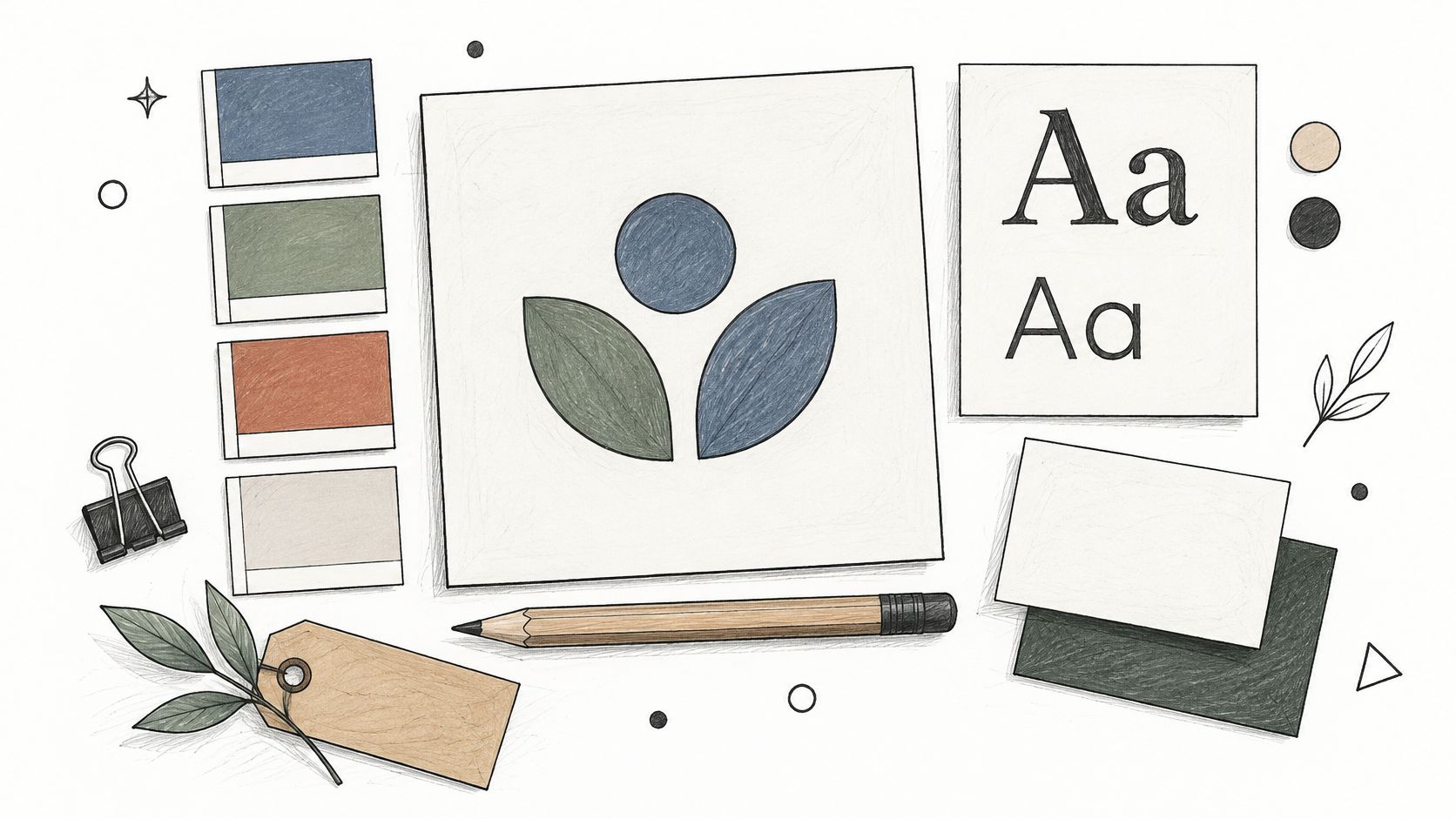
Practical rule: one page, three adjectives, ten phrases you use, ten you never use, and a link to the full writing styles guide inside every brief.
Attach that page to briefs before freelancers draft, then run the same check at publish: headline casing, the "you" register, image treatment, and the phrases that keep slipping. Log repeats in one place and review them quarterly, with an owner assigned to fix the pattern rather than chase one-off edits. Done this way, consistency compounds across campaigns and can turn branding into repeat revenue because buyers are not meeting a new brand every quarter.
4. Content Marketing as a Brand Strategy
HubSpot built a brand on educational inbound content, and its co-founders popularized the term "inbound marketing" while doing it. Red Bull Media House produces films, documentaries, and sports coverage that place the brand inside extreme sports culture rather than around a drink. In both cases the publishing output is the asset.
Chasing trends is the common shortcut, and it's measurable in how audiences react. 33% of consumers consider brands chasing viral trends embarrassing, while 46% say original content helps brands stand out, according to O'Dwyer PR's report on brands avoiding trend-hopping. Copying a format that worked elsewhere is the fastest way to look like everyone else.
Separate awareness content from conversion content
Teams often blur the two, then judge everything by leads. Split the calendar: awareness pieces answer a question the buyer hasn't priced yet, while conversion pieces compare, price, and prove. Different jobs, different success measures.
- Three to five pillars. Each one should map to a customer problem, not to an internal department.
- Plan a quarter ahead. A content marketing plan written in advance prevents the week where nobody knows what publishes Thursday.
- Review monthly. Double down on the two formats that earn replies and saves, and retire the rest without ceremony.
5. Purpose-Driven Branding
Dove's "Campaign for Real Beauty", launched in 2004 with Ogilvy, challenged narrow beauty standards and stayed in market for two decades. Ben & Jerry's ties its identity to social justice advocacy and discusses policy positions in public. Both survive scrutiny because budgets, hiring, and product behavior back the message.
The evidence is conditional rather than universal. 73% of people say their trust in a brand would increase if it authentically reflected contemporary culture, against 27% for brands that ignore culture and focus only on products, per the Edelman Trust Barometer special report on brands. Authenticity is a behavior test, not a copy test.
Practical rule: never claim a commitment you can't fund for three straight years.
Build a content-to-commitment matrix
List three commitments, then map each to observable proof: a policy, a spend line, a supplier change, a hiring practice. Put the content that demonstrates them on a schedule, and publish the proof points between promotional posts.
Picture a B2B software company claiming sustainable procurement. A landing page saying so is worth nothing. A quarterly post showing the two suppliers it dropped, the certification it paid for, and the one it failed to get is worth reading, and it survives a hostile comment section.
Purpose also narrows your audience. Accept that trade-off up front, because a purpose everyone likes usually isn't one.
6. Co-Branding and Strategic Partnerships
81% of surveyed brands had run influencer campaigns in 2024, and 92% believed long-term influencer partnerships were beneficial, according to Havas Red's study of 39 clients across 10 markets. Partnerships have moved from campaign stunts into standing arrangements.
The classics still explain the logic. Nike and Apple's Nike+ in 2006 wired running shoes into the iPod ecosystem, and Spotify's 2015 partnership with Starbucks put music selection into the ordering experience. Each pairing borrowed credibility the other brand already had with the same audience.
Agree on approvals before creative work starts
Most co-branding failures are process failures. Two legal teams, two brand guardians, and no named decision-maker on either side.
- Write the rules first. Approval roles, response times, logo placement, and who publishes what, all in one shared document.
- Build a joint calendar. Co-branded dates belong on both teams' schedules, not in one person's inbox.
- Set one measurable goal. Reach, sign-ups, or engagement, agreed before launch and reviewed after.
Say a subscription coffee brand pairs with a regional bakery on a limited roast. The creative is easy. The hard parts are who owns the landing page, who answers complaints, and what happens when the roast sells out early.
7. Brand Architecture, Branded House vs. House of Brands
Google reorganized under Alphabet Inc. in 2015 and kept the master brand on Gmail, Google Maps, and most products. Procter & Gamble runs a house of brands, with Tide, Pampers, and Gillette each carrying separate identities and separate budgets. The choice changes how marketing money is spent and how much risk one weak product puts on the rest.
Tag every asset by brand
Architecture decisions get made on slides and then break in the content library, where an editor grabs the wrong boilerplate or a sub-brand inherits the master brand's tone.
Validation should happen where customers meet the brand. A post-acquisition tea brand tested competing strategic positions and package designs instead of picking an identity internally, and the repositioned brand achieved 18% growth in its first year; the same research surfaced additional product-line opportunities under the broader umbrella (Research America's repositioning case study).
For an editorial team, the practical version is separate libraries, separate style notes, and tags that make the brand visible on every draft. Endorsed sub-brands only make sense when the master name adds credibility.
8. Brand Revitalization and Repositioning
Old Spice's "The Man Your Man Could Smell Like" in 2010, from Wieden+Kennedy with Isaiah Mustafa, revived a traditional grooming brand through humor and fast social response. Burberry under Christopher Bailey refreshed its heritage trench image with digital storytelling and runway-to-consumer communication. Neither threw the asset away. Both changed the tone and the audience.
Where revitalization fails: the brand keeps the old promise and adds new visuals. That's a repaint, not a repositioning.
Petivity shows the harder version, where the category itself moves. The smart-pet-health brand stopped selling devices and claimed "proactive pet care" as its territory, opening the audience to any owner worried about prevention. It ran a three-day awareness burst with no product selling, then benefit-led campaigns with social proof, measured through Meta's Brand Lift Study plus purchase and return-on-ad-spend data. Reported results included a 99.9% probability of increased brand awareness, a 185% purchase lift, and a 20% improvement in ROAS (Wpromote's Petivity case study).
Phase the rollout across the calendar
Audit perception first, through customer interviews and social listening, before changing anything. Keep one or two signature elements constant so recognition survives the shift. Then phase the new message across several weeks: internal briefing, proof content, comparison pages, social creative, sales enablement. A single launch-day switch confuses the audience you already have.
9. Community-Led and Customer-Centric Branding
GoPro's marketing runs on footage customers shoot. Lego Ideas lets fans submit designs, and popular submissions become official sets with credited creators. The brand sets the frame and the community fills it, which produces more content than any in-house team could.
Personalization is where most brands fall short of what buyers now expect. 88% of consumers said they were more likely to buy when brand engagement was personalized in real time, while only 44% of brands reported executing personalization at that level, according to Twilio's 2025 customer engagement report. A community is one way to close that gap, because members state their interests in public, continuously.

Turn recurring questions into planned content
Set written guidelines and name one moderator who answers. Then treat the question log as an editorial source: the same three questions asked every month are three planned articles, not three support tickets. Credit contributors by name and link, because public credit is what brings the next one forward.
How the nine branding strategies compare at a glance
| Strategy | Core focus | Best for | Signature example |
|---|---|---|---|
| Brand Positioning | Owning a distinct place in customers' minds | Differentiating from competitors | Volvo's long-standing focus on safety |
| Brand Storytelling | Communicating values through narrative | Building emotional connection and loyalty | Patagonia's “Don't Buy This Jacket” campaign |
| Consistent Brand Voice and Visual Identity | Applying consistent writing and design across touchpoints | Improving recognition across channels and teams | Coca-Cola's red, script logo, and contour bottle |
| Content Marketing as a Brand Strategy | Publishing useful content to attract and build trust with an audience | Building authority and sustained organic demand | HubSpot's educational inbound marketing content |
| Purpose-Driven Branding | Connecting the brand to a mission backed by action | Engaging values-driven customers and employees | Dove's “Campaign for Real Beauty” |
| Co-Branding and Strategic Partnerships | Combining brands in a shared product, campaign, or experience | Reaching new audiences through collaboration | Nike and Apple's Nike+ |
| Brand Architecture: Branded House vs. House of Brands | Structuring relationships among a company's brands and products | Managing a multi-product or multi-brand portfolio | Google's master brand and P&G's portfolio of distinct brands |
| Brand Revitalization and Repositioning | Refreshing a brand's image or target audience | Restoring relevance or attracting new customers | Old Spice's “The Man Your Man Could Smell Like” |
| Community-Led and Customer-Centric Branding | Shaping the brand through customer participation | Encouraging advocacy, feedback, and user-generated content | LEGO Ideas, where fans submit designs for potential sets |
Turning Branding Strategies Into a Publishing Plan
Choosing a strategy comes down to three filters: audience overlap, risk tolerance, and operational capacity. Purpose-led work attracts a narrower, more loyal audience and invites scrutiny you must be able to absorb. Co-branding buys reach and borrows someone else's approval queue. Content marketing compounds slowly and shows almost nothing in month one. Pick the one your team can sustain for four quarters, not the one that photographs best in a deck.
Budget signals point the same way. In 2025, 52% of marketers planned to increase investment in brand management, up from 42% a year earlier, according to Forrester's outlook on B2B brand and communications budgets. More money is moving toward brand, which raises the bar on being able to show what it did.
Pick one strategy per quarter
Trying to run positioning, purpose, and community simultaneously produces three half-built programs and a calendar nobody trusts. Sequence them. Quarter one, lock the positioning statement and rewrite the core pages. Quarter two, build the three story themes with proof attached. Quarter three, open the community channel or the partnership, once the message is stable enough to hand to someone else.
- Map pillars to positioning attributes. If your statement says "fastest turnaround", at least one pillar should be about speed with evidence, not opinion.
- Tag every asset by strategy, audience, and funnel stage. Untagged content can't be evaluated, so nobody learns anything.
- Review quarterly and consolidate. Keep the positioning that survived contact with the audience, retire the rest without debate.
That's where a planning workspace earns its keep. TheContentMap gives teams one place to capture ideas, schedule them with owners and publish dates, and tag content by brand, channel, or campaign, so a positioning statement turns into a repeatable publishing habit instead of a document nobody opens.
TheContentMap is built for exactly this transition, from a chosen brand strategy to a calendar that reflects it. You can capture ideas in a visual pipeline, assign owners and publish dates on a shared editorial calendar, tag every piece by brand, channel, or campaign, and review content insights to see which topics and formats carried the strategy. Start free at TheContentMap and map your next quarter's pillars against the one positioning idea you've decided to own.
Related Articles
Content Brief Template: 10 Options That Work in 2026
Why does a writer still need a clarification call after receiving a completed content brief template...
SoftwareContent Calendar Platforms Compared: How to Choose
83% of marketing leaders said they wanted to streamline workflows and reduce the number of technolog...
SoftwareContent Calendar Ideas: 10 Formats for 2026 Planning
The holiday guide is late again. The pillar page went live with nothing behind it. Last quarter'...
Comments (0)
No comments yet. Be the first to share your thoughts.