Content Governance: What It Is and How to Build It
Content governance explained: the roles, standards, approval steps and policies that keep content consistent and accountable.
You've probably lived this scene. A campaign page goes live with a claim that legal flagged six months ago, and nobody can say who approved the wording. A product page still lists a feature you retired last spring. Two writers publish near-identical explainers because neither knew the other had claimed the topic. None of this happens because people are careless. It happens because the team never agreed who owns what, who signs off, and when a page gets looked at again.
That agreement is content governance, and it's less bureaucratic than it sounds. It's the difference between a library with a catalogue and a pile of boxes in a garage.
Table of Contents
- What Content Governance Means and Why It Matters
- The Four Building Blocks of Content Governance
- Roles That Own Content From Draft to Archive
- Standards and Policies Behind Consistent Content
- How to Run an Approval Workflow Step by Step
- Governing AI-Assisted and Multilingual Content
- Measure Governance and Choose Your First Step
What Content Governance Means and Why It Matters
Content governance is the agreed system of ownership, rules, approvals and accountability that decides how content gets created, checked, published, updated and retired. Your website works like a road network. The pages are the roads, the campaigns are the traffic, and governance is everything that keeps things moving: the lights, the lane markings, the speed limits and the rule about who may close a lane. Strip that out and every team builds its own road. That's how you end up with three versions of the same pricing page and no one certain which one is live.
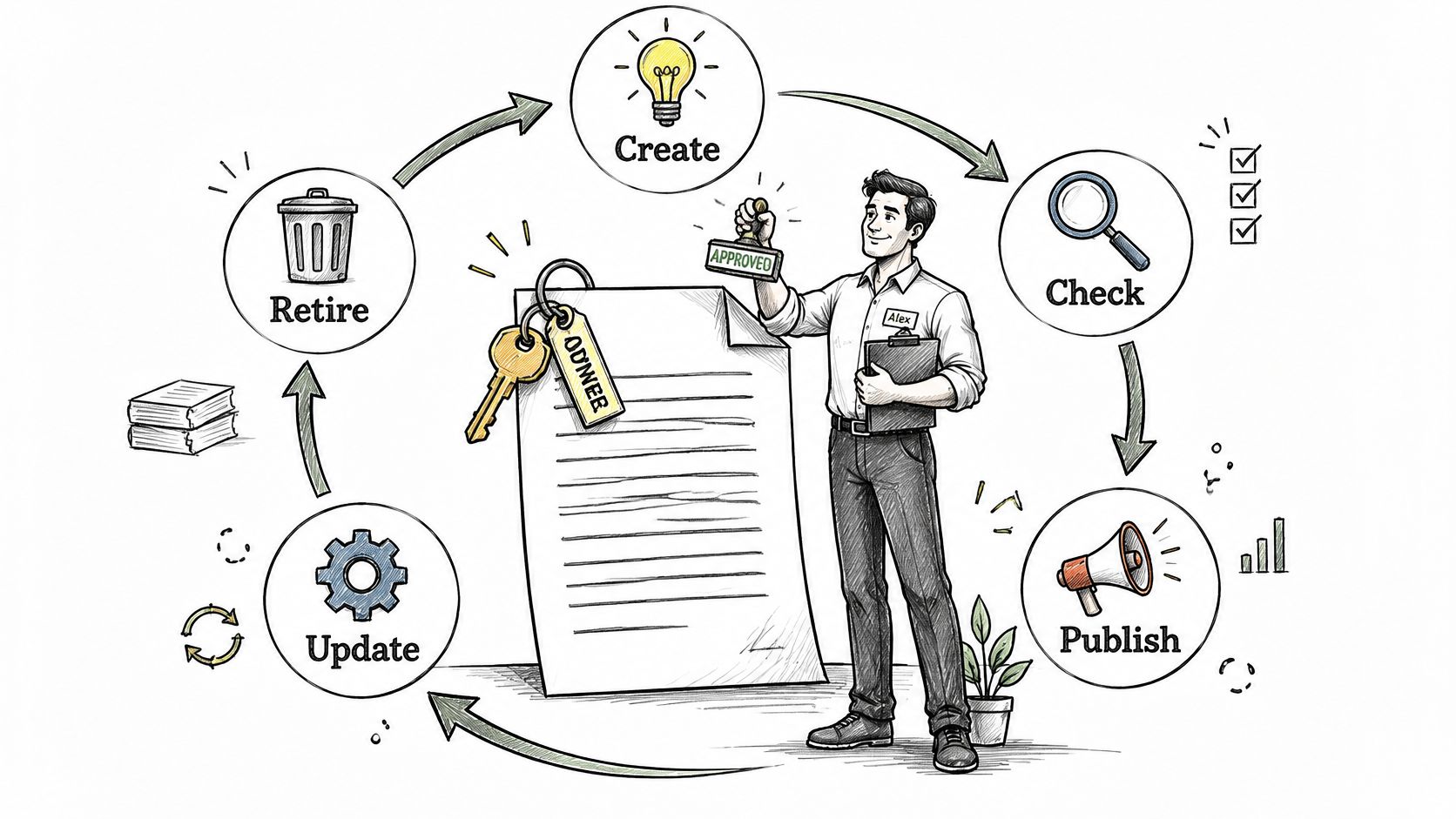
Two misconceptions stall teams before they start. The first is that governance means legal compliance, a policy document that satisfies a regulator and changes nothing about daily work. The second is that governance is a switch you flip inside a CMS. Neither holds up. Governance is an operating model people follow, and its real test is traceability: whether any page can move from draft to live to retirement with a visible record of who wrote it, who approved it, and when it comes up for review. Think of it less as a checklist and more as a service level. Each piece of content carries an implicit promise that someone owns it and someone will answer for it.
Surveys of business professionals keep surfacing the same pattern: large portions of organizational content and data sit outside any governance structure, even in teams that handle information for a living. The appetite for structure exists. The structure itself doesn't.
The gap widens because content piles up in places nobody planned: collaboration tools, shared drives, campaign folders, archives, microsites built for a single event. Duplicates multiply, orphaned pages outlive their owners, and every new hire learns the workaround rather than the rule. Decentralized teams feel this hardest, because each region or product group publishes on its own schedule. Governance done well doesn't recentralize every decision. It sets central rules, like naming owners and review dates, while leaving local judgment about tone, timing and topics with the people closest to the audience. If you want to understand how the day-to-day production side fits underneath this, our guide to what content operations covers maps the planning, workflow and measurement layers that governance sits on top of.
A one-minute audit: pick any live page. Can you name its owner, the person who approved it, and the date of its next review? If any of those three is a shrug, you have a governance gap, and it's cheaper to fix now than after the page causes a problem.
The Four Building Blocks of Content Governance
Every governance model, from a five-person startup to a multinational publisher, rests on four blocks, and each one answers a different question. The table below shows what each block controls, who typically owns it, and what it looks like in practice.
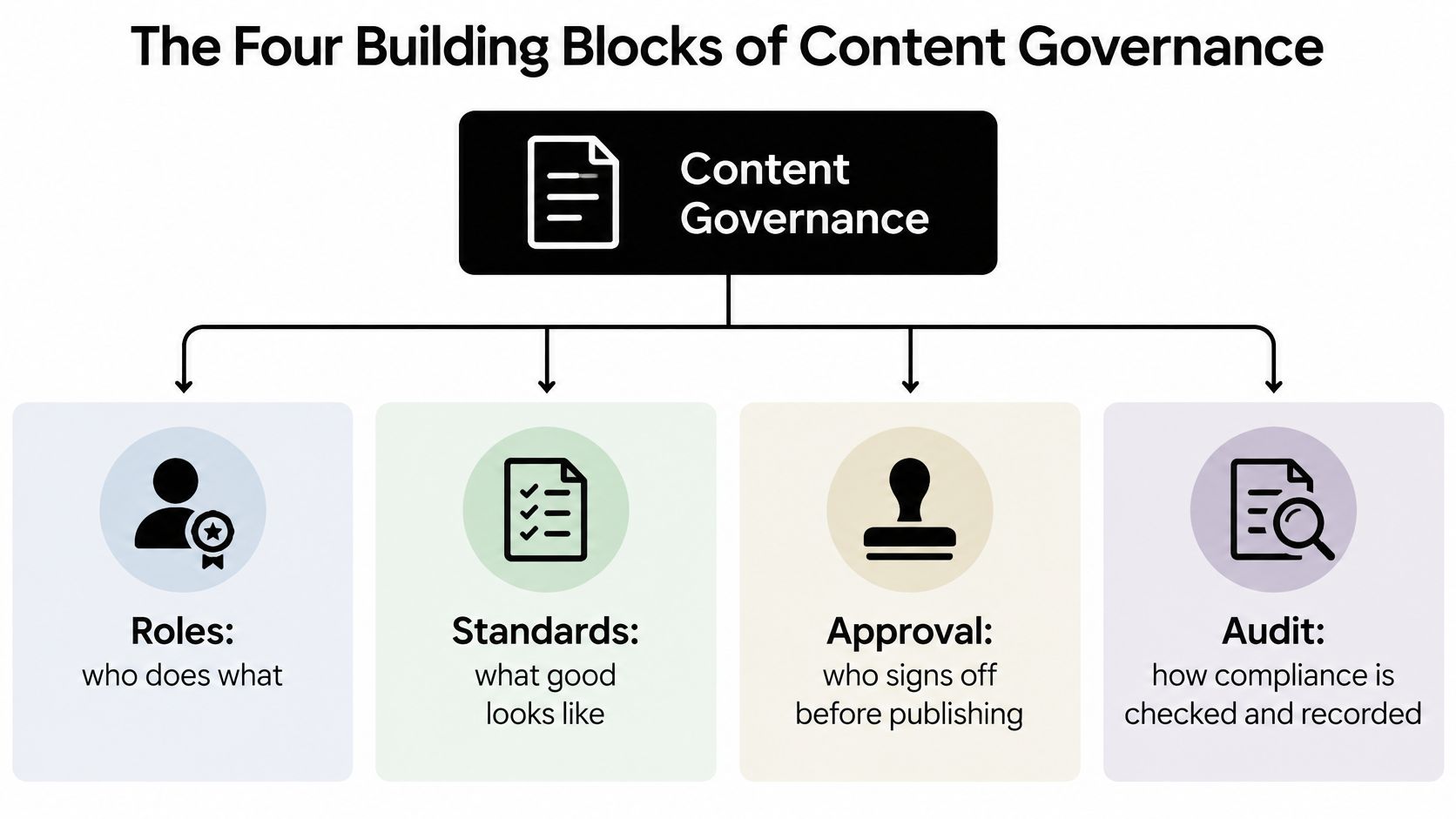
| Building block | What it controls | Typical owner | Example |
|---|---|---|---|
| Roles | Who creates, reviews, approves and retires each item | Content owner, editor, publisher | One named owner per page |
| Standards | The measurable bar for quality, accessibility and metadata | Governance lead with subject experts | Every image carries alt text |
| Approval processes | The gates an item passes before publication and who can stop it | Editor and specialist reviewers | Regulated claims need legal sign-off |
| Policies | Rules for retention, corrections, disclosure and reuse after publication | Legal, compliance and content leadership | Pages reviewed 12 months after publishing |
The blocks connect in a fixed order. Standards come first, because you can't assign a role to a bar that hasn't been defined. Roles come second, attached to specific standards rather than to general enthusiasm. Approval processes enforce those standards before anything goes live. Policies take over the moment content is published and keep working for as long as the page exists, which is usually far longer than anyone expects.
Get the order wrong and the model wobbles. Teams that write a retention schedule before agreeing what "complete metadata" means end up archiving pages they can't identify. Teams that assign reviewers before writing testable standards end up with reviews that consist of someone saying "looks fine to me."
The blocks also give you a diagnostic tool, which is the part most governance guides skip. When content goes wrong, don't ask who to blame. Ask which block failed.
- A factual error in a live page usually points to a missing standard or a review step that was skipped, not to a careless writer.
- An orphaned page with no owner points to a role gap, and it will keep producing problems until someone is named.
- A page that's three years out of date points to a missing policy, because nothing in the workflow ever forced a second look.
- An approval that got overridden points to an approval process without real authority behind it.
Name your weakest block. Many teams discover it's roles, because standards and approval steps tend to get written down while ownership stays informal. That's the one to fix first, since every other block depends on someone being accountable for the outcome.
Roles That Own Content From Draft to Archive
The single most useful rule in governance is this: assign one owner per item, not one owner per team. A team can't be accountable. A person can. Here's the set of roles that covers a full lifecycle without creating a committee for every page.
- Content owner: accountable for accuracy and for the next review date. This person doesn't write everything, but they answer for whether it's right and whether it's still current.
- Creator or writer: drafts against the standards checklist rather than from memory, so headings, alt text, link purpose and metadata are handled during writing instead of during a panicked pre-publish scramble.
- Editor: checks consistency, clarity and claims, then signs off or returns the draft with specific notes.
- Specialist reviewer: called in only when content triggers a rule, such as financial, medical or regulated claims. Keeping this role conditional is what stops approvals from taking three weeks.
- Publisher: makes the final move to live and confirms the publish checklist is complete, including the review date.
- Governance lead: writes the rules, runs audits, handles exceptions and owns the change log when a standard shifts.
- Records or archive owner: handles retention and disposal, so archived content is distinguishable from deleted content.
Who decides what when the team is decentralized
Centralizing every editorial decision is the reflex, and it usually creates a bottleneck at headquarters while local teams route around it. The 2025 Content Science research found that 51% of organizations had decentralized content structures, and that the most successful organizations used integrated governance supported by a center of content excellence (Content Science report). That combination is the interesting part. Decentralized structure plus integrated governance, not decentralization instead of governance.
In practice, the split looks like this. The center defines principles, metadata fields, risk tiers and escalation rules, and it owns anything that must read identically everywhere. Local editors keep authority over audience context, regional claims, cultural adaptation and market-specific legal review. Both sides get measured on service levels: review-cycle time, percentage of content with a named owner, overdue approvals, localization rework and correction rates.
The center decides what must be the same everywhere. The local team decides what must fit the audience.
That sentence resolves most arguments before they start. Every article we publish goes through the editorial team before it goes live, which is the same principle at smaller scale: a named reviewer, a recorded decision, no page published by accident.
Standards and Policies Behind Consistent Content
Standards and policies get used interchangeably in conversation, and that's where teams lose clarity. A standard describes the bar something must clear. A policy describes what happens to content over time and who acts when something goes wrong. One is judged at publication. The other keeps operating long after.
The reference set most content teams need is smaller than they expect.
| Standard or policy | Source | What it requires | Enforced by |
|---|---|---|---|
| WCAG 2.1 Level AA | W3C | Alt text, keyboard operability, readable language and captions where relevant | Accessibility reviewer |
| Section 508 | US federal accessibility requirement | Accessible federal web content aligned with WCAG guidance | Web owner |
| ISO 15489 | International Organization for Standardization | Policies, assigned responsibilities, monitoring, training and controls over records | Records owner |
| Brand and style guide | Internal | Voice, terminology and approved claim wording | Editor |
| Retention schedule | Internal with legal input | Retention period and disposal action for each content class | Governance lead |
| Correction policy | Internal | How errors are fixed, logged and disclosed | Content owner |
The historical anchor here is ISO 15489, the first international standard dedicated to records management. It was published in 2001, has been adopted in more than 50 countries and translated into over 15 languages, and ISO issued a substantially revised Part 1 in 2016 after three years of review and consultation (ISO 15489 records management). Its scope goes well beyond storage. It emphasizes policies, assigned responsibilities, monitoring, training and systematic controls, which is exactly the skeleton modern content governance borrows.
Write standards as checks and policies as triggers
A standard nobody can test is only an opinion. "Content should be accessible" can't be verified. "Every image has alt text, every page has one H1, every link makes sense out of context" can be checked in a minute by someone who didn't write the page.
Policies need the same precision in a different form. Each one should name an owner and a trigger. A correction policy that says "errors will be corrected promptly" has no trigger. A correction policy that says "any factual error reported by a customer is logged within one business day, corrected by the content owner, and disclosed on the page if the change affects a claim" has one.
Where your standards live matters as much as what they say, because a rule buried in a folder nobody opens is effectively unwritten. If you're choosing a home for the style guide, the claim rules and the retention schedule, this comparison of Mojolin's knowledge base software picks covers the options teams use. Pair that with a practical writing styles guide so the voice standard is written down once and referenced, rather than reinvented by every new writer.
How to Run an Approval Workflow Step by Step
A regional marketing lead publishes a product update on Friday afternoon. Nobody approved it, nobody knows who wrote the final paragraph, and by Monday the claims in it are wrong. The team did have an approval process. It lived in a shared document nobody opened, and it had no power to stop the page from going live.
That failure is a traceability problem, not a legal one. An approval workflow earns its keep when it is short, recorded and able to stop a bad page. The sequence below does all three, and it works the same whether your team sits in one office or publishes from five regional sites under one set of central rules.
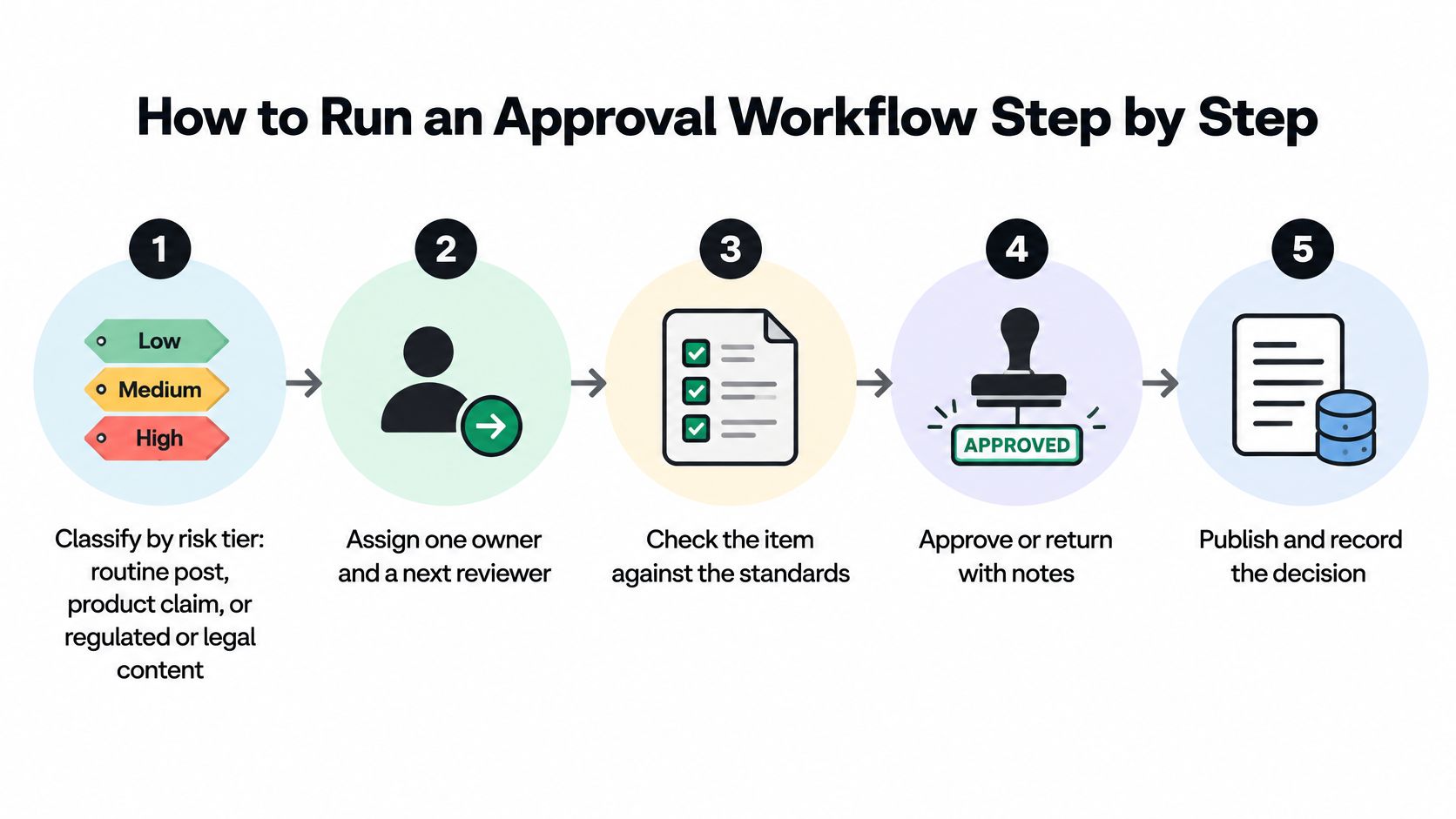
- Classify the item by risk tier. Routine post, product claim, or regulated and legal content. The tier decides who must review, so it comes first. Most delays happen because a routine post sat in the same queue as a legal review.
- Assign one owner and a next review date at creation. Not after drafting. Setting the date later means it competes with deadline pressure, and it loses.
- Draft against the standards checklist. Semantic headings, alt text, meaningful link text, complete metadata. Defects caught here cost minutes. Defects caught after publication cost a correction, a log entry and sometimes a conversation with a customer.
- Run editorial review for accuracy, brand and claims. The editor returns the draft with specific notes or approves it, and either way the decision gets recorded.
- Trigger specialist checks by tier. Accessibility review applies to every item. Legal review applies to regulated claims. Conditional gates are what keep the process fast enough that people follow it.
- Approve and record the approver, timestamp and version. An approval that isn't recorded isn't an approval. It's a memory.
- Publish only when the required fields are complete. Owner, audience, channel, accessibility check, review date. If a field is empty, the publish button stays locked.
- Review on the scheduled date. Then correct, update or archive. This step is the one that turns governance from a launch process into a lifecycle.
Two things in that list tend to confuse teams. The first is step five: conditional gates feel like extra bureaucracy, but they are what make the workflow fast. When only regulated claims go to legal, the routine posts move in hours instead of weeks, and nobody is tempted to skip the queue. The second is step seven. Teams assume the lock is about control. It is about evidence. A page that cannot publish without an owner and a review date is a page you can always trace back to a person and a decision.
Central rules, local judgment. The tiers, fields and gates are set once for the whole organization. The editor reviewing a regional draft still decides whether the tone fits that market. Governance defines what must be true before publication, not how every sentence reads.
Public-sector practice supports gating checks before publication rather than fixing afterwards. The IRS web-content procedure assigns business representatives, web strategists and publishers responsibility for content scope and plans while requiring records-management controls and accessible content aligned with Section 508 and WCAG Level AA (IRS web content procedure). Testable criteria sit in front of the author while the author still controls the source, which is the cheapest possible moment to catch a defect.
The logic mirrors other review-heavy fields, where Planstone on abstract scoring workflows shows reviewers scoring against explicit criteria rather than impressions. Content review works the same way: a checklist produces consistent decisions, and vague standards produce reviewers who approve whatever looks finished.
Two slips break this workflow more often than any other. The first is an approval that never gets recorded, leaving a page live with no evidence of who cleared it. The second is a gate that exists on paper but never blocks publishing, which teaches the team within a month that the process is decorative.
A lightweight version of the same shape runs in three steps: capture ideas in a pipeline, plan them on an editorial calendar by assigning owners and setting publish dates, then publish and review what worked. Tools that support publish reminders keep the review dates from step two visible instead of buried, so step eight happens. Governance lives in the assignments and the dates, not in a separate document.
Governing AI-Assisted and Multilingual Content
A regional marketing lead opens a draft produced overnight by an AI writing assistant, translates it into two more languages, and schedules it for morning publication. Nobody wrote down whether the claims inside were checked. Nobody knows who approved the source version, let alone the translated ones. This is the failure pattern AI introduces at scale, and it is why the rules in many content teams lag far behind the drafting speed. The 2025 Content Science study found that 86% of respondents used AI in content operations and nearly 20% considered AI central to their approach (Content Science AI insights). Bynder's 2024 marketing trends survey found that 81% of surveyed content leaders identified establishing AI guidelines as a primary concern for the year and beyond (Bynder trends survey). Adoption is settled. Traceability is not.

The practical answer is a lightweight content record attached to every AI-assisted draft, working like the chain-of-custody tag on a piece of evidence. It travels with the item wherever the item goes. Six fields are enough: AI involvement, responsible editor, source verification, risk category, approval status and publication disclosure. Each field answers one question an auditor, a client or an angry reader will eventually ask. If any of them is blank, the item is not ready, the same way an unsigned handoff means nobody owns the result yet.
Set hard triggers for mandatory human review rather than leaving it to judgment: public claims, health or financial advice, personal data, and anything quoting a source. Triggers work because they remove the debate. An editor facing a deadline does not have to decide whether this draft is risky; the checklist decides for both of you. Disclosure decisions belong in the workflow now rather than in a memo later, because transparency expectations for AI-generated content are tightening in many markets, and retroactive disclosure on a live page costs far more than a checkbox filled in before publication.
Global rules, local judgment, and one translation edge case
Multilingual teams face a version of the same problem with a second layer on top. Decide deliberately which decisions stay global and which stay local. Global means the rules that protect every market at once: accessibility, core brand terms, claim policy and the metadata fields each item must carry. Local means the judgment only a regional team can exercise: cultural adaptation, regional claims and market legal review. Confusing the two creates the two classic failures. Centralizing everything turns headquarters into a queue, and localizing everything dissolves the standards that make the brand one brand. Add a pre-approved emergency path with mandatory post-publication review inside a fixed window, so urgent content moves fast without teaching anyone that the gates are optional.
One edge case trips up nearly every team: a translation inherits its source approval only when the claim is unchanged. If the local team alters a claim, a statistic or a comparison, the item goes back to the local reviewer. No inheritance, no shortcut. The reason is traceability, not caution for its own sake. Approval is attached to specific wording, and changed wording is a new item wearing an old stamp. Teams that skip this rule discover it when a regulator or client questions a claim that nobody in the central team ever wrote or approved.
When video sits inside a publish package, corporate video production services usually need the same approval gates and disclosure records as text, and they're often the item nobody thought to govern. A subtitled clip crosses every boundary this section covers at once: AI-assisted production, translation and multi-market publishing. If your content record works for a video, it will work for everything lighter than a video.
Measure Governance and Choose Your First Step
Governance you can't measure is governance you can't defend in a budget conversation. In 2024, 57% of surveyed marketers planned to personalize content experiences or introduce more efficient content management and governance, according to Bynder's 2024 content marketing research. Intent isn't the constraint. Visibility is.
| Metric | How to calculate | Warning sign |
|---|---|---|
| Review compliance rate | Items reviewed on time divided by items due for review | Falling month on month |
| Metadata completeness | Assets with owner, status, dates and retention class divided by all assets | New content published without an owner |
| Duplicate-content rate | Duplicate or near-duplicate pages divided by total pages | Rising across campaigns |
| Defect escape rate | Accessibility or policy issues found after publication divided by items published | Any rise after an approval change |
| Approval-cycle time | Average days from submission to approval | Items stalling at one reviewer |
| First-pass approval rate | Items approved without rework divided by items submitted | Low rates point to unclear standards |
The metadata behind those numbers isn't optional bookkeeping. The Library of Virginia identifies four properties of trustworthy electronic records, reliability, authenticity, integrity and usability, and recommends that organizations governing websites or social platforms define which materials qualify as public records, assign retention periods and specify the authoritative format and storage location (Library of Virginia electronic records guidance). Translated into editorial terms, every item needs machine-readable fields for owner, status, publication date, review date, retention class, canonical location and disposition action, with archived content kept separate from deleted content.
Start with an inventory of what has no owner, no review date or no retention class. A content inventory template makes that list manageable instead of overwhelming, and the gaps it surfaces are exactly what your first governance cycle has to close.
Then pick one workflow this month. Choose the riskiest content type you have, usually product claims or regulated pages. Assign an owner and a review date to every item in it, record every approval, and run the six metrics for 30 days. At the end of the month you'll know which gate slows publication, which one causes rework and which owner misses dates. That's a governance program with evidence behind it, and it's a far stronger position than a policy document nobody has tested.
TheContentMap gives editorial teams the structure governance needs without adding another layer of admin. Our editorial calendar, idea pipeline and workflow stages make ownership, review dates and approval status visible on every item, and our content insights show which topics and formats performed once a piece is live. If your team is ready to replace scattered spreadsheets with a workflow you can audit, visit TheContentMap and start planning your first governed cycle.
Related Articles
Publishing Project Management: A Stage-by-Stage Guide
The spring list has twelve titles, three editors sharing the commissioning, two designers handling c...
SoftwareHow to Manage Multiple Projects: A 2026 Playbook
It's Tuesday morning. Three projects need the same senior editor, every stakeholder has labelled...
SoftwareA Practical Editorial Review Process for Content Teams
An editorial review process is a defined sequence of stages, owners, and decision points that carrie...
Comments (0)
No comments yet. Be the first to share your thoughts.