What Is Cross Team Collaboration and How It Works
What is cross team collaboration? Learn the definition, benefits, common barriers and the editorial workflows that keep content teams moving on schedule.
Cross-team collaboration is the coordinated work of people from different functions, such as editorial, marketing, design and analytics, toward a shared business goal, with clear ownership and handoffs between them.
You might already have the people involved but not the coordination. A writer has finished the draft, the designer is waiting for approved copy, and the editor thinks a subject-matter expert is still checking the facts. Everyone's working, yet nobody knows who should act next.
The missing piece isn't necessarily another meeting. It's an agreed way to move work between specialists without losing the decisions, deadlines and context they need.
Table of Contents
- What Cross-Team Collaboration Means
- Why Cross-Team Work Pays Off
- Where Cross-Team Work Breaks Down
- How Shared Context Keeps Handoffs Working
- How to Run a Cross-Team Editorial Workflow
- Editorial Planning Tools That Make It Work
- Choose One Workflow to Fix This Month
What Cross-Team Collaboration Means
Cross-team collaboration connects specialized contributions across departmental reporting lines. People don't need the same manager or identical responsibilities. They need to understand the outcome they're helping deliver and where their responsibility begins and ends.
Coordinated work means those contributions fit together. Different functions means participants bring distinct expertise. A shared business goal gives them a reason to resolve competing priorities rather than finish their own tasks.
Think of a relay race. Each runner owns a leg, but a fast runner can't compensate for a dropped baton. In editorial work, that baton includes the content itself and the information the next contributor needs to use it.
The diagram shows how separate functions contribute toward a common destination.
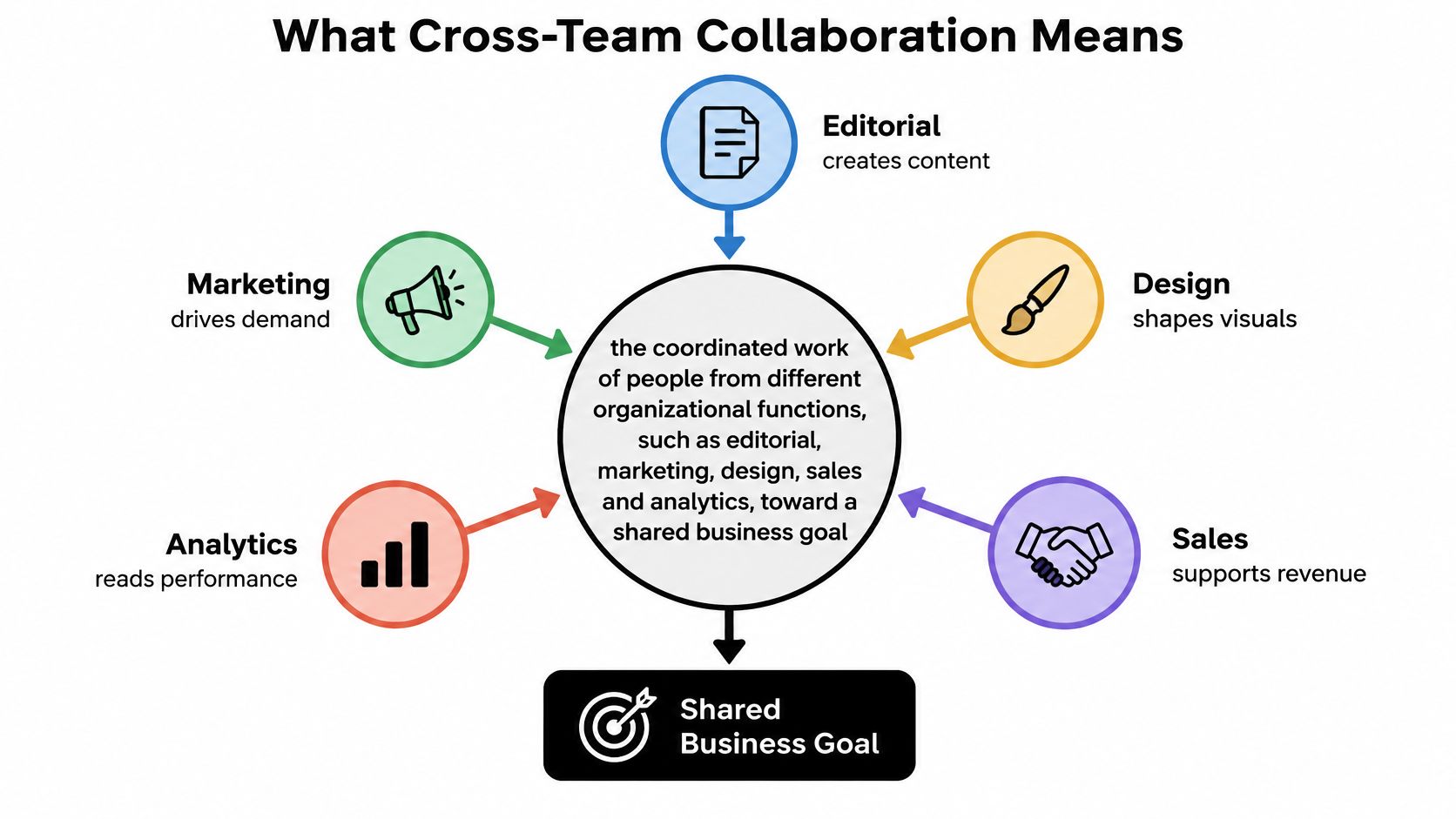
Different expertise, connected responsibilities
This is a widespread working practice: the CIPD report on effective cross-functional collaboration reports that 73% of surveyed respondents in the United Kingdom, 64% in Ireland, 68% across Asia-Pacific countries and 67% in the Middle East agreed they collaborate across business functions to meet business needs.
For an editorial article, the shared outcome might be helping prospective customers understand a technical problem. The writer supplies an explanation, but other contributors determine whether it's accurate, discoverable, usable and worth producing again.
Who contributes what to an editorial article
| Function | Contributes | Hands off to |
|---|---|---|
| Writer | First draft, sources, angle | Subject-matter expert |
| Subject-matter expert | Fact checks and technical accuracy | Editor |
| Editor | Structure, clarity, final sign-off | Designer and SEO lead |
| SEO lead | Target keyword, search intent, metadata | Editor |
| Designer | Charts, images, layout | Publisher |
| Analyst | Performance data after publication | Content planner |
These handoffs aren't necessarily a rigid sequence. The SEO lead should help shape the brief before drafting, then return when metadata needs approval. Designers can develop a visual concept before the copy is final.
The same outcome-first thinking applies beyond publishing. SpecStory, Inc.’s guide to align product teams around shared outcomes offers a related perspective for colleagues coordinating product work.
Cross-team and cross-functional collaboration overlap in this setting. The useful distinction isn't the label, but whether the work crosses specialist boundaries. A standing meeting schedule or shared inbox doesn't establish that connection by itself.
Why Cross-Team Work Pays Off
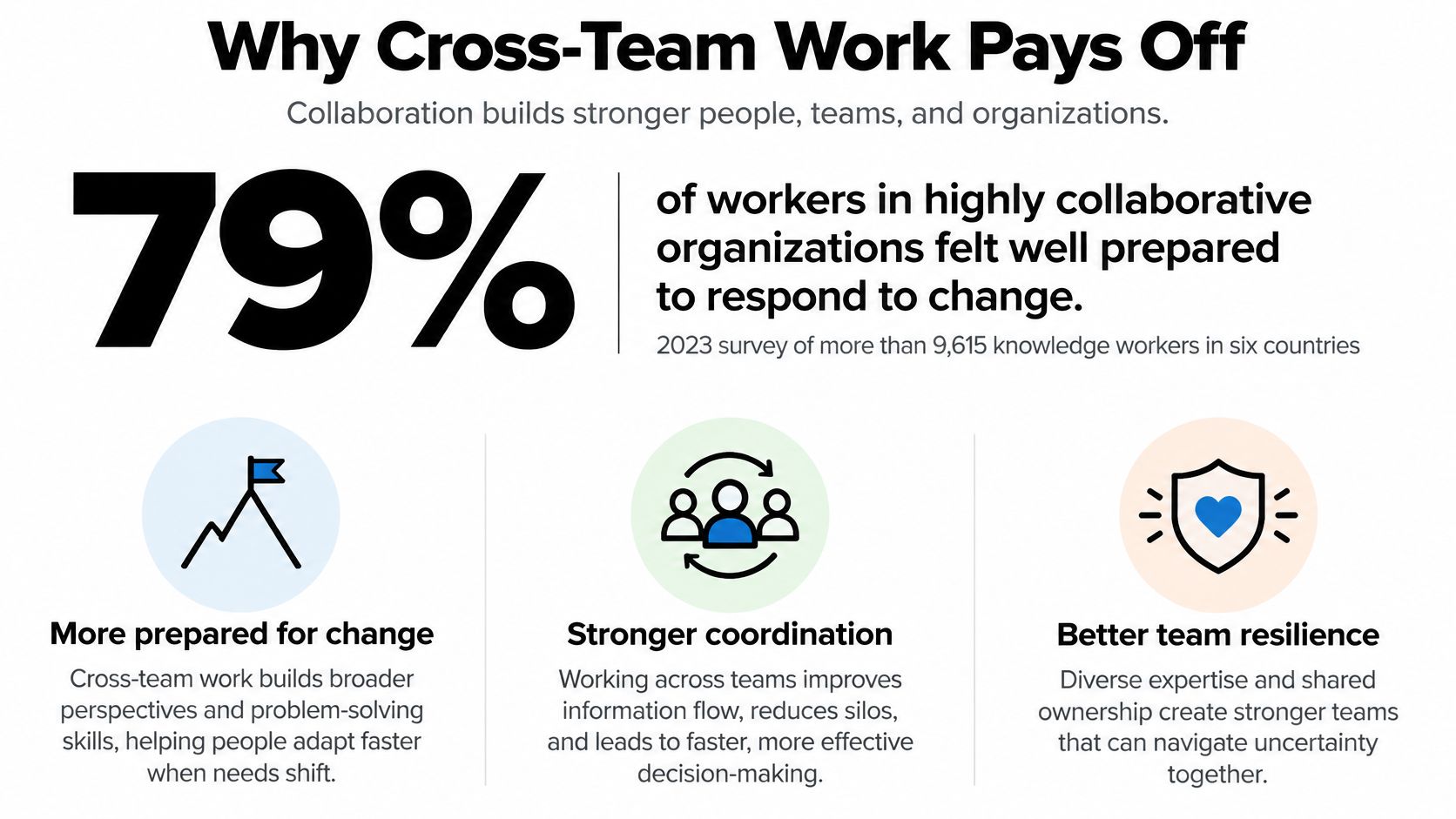
79% of workers in highly collaborative organizations felt well prepared to respond to challenges, four times the proportion in organizations with weak collaboration, according to Asana's 2023 survey of more than 9,615 knowledge workers in the United States, United Kingdom, Australia, France, Germany and Japan. That survey also found unnecessary meetings consumed 3.6 hours per week for senior leaders and 2.8 hours for knowledge workers.
The findings support a distinction: collaboration can help people respond collectively, but interaction has a cost. The survey describes an association, not a guarantee that adding collaboration activities will improve performance.
The visual highlights the preparedness finding.
Catch problems while they're cheap to change
Say an editor commissions an article about choosing analytics software. The SEO lead recognizes that readers want a comparison, while the initial outline explains only how analytics works.
If they resolve that difference before drafting, the writer can build the right article. If they discover it during final review, the writer must restructure finished copy and the designer may need to replace graphics.
That's the practical value of combining expertise early. An editor evaluates the argument, an SEO lead evaluates reader intent, and a subject-matter expert checks whether the proposed advice is defensible. They don't need to make every decision together.
- Earlier information: Contributors can flag a constraint before someone builds around a mistaken assumption.
- Broader judgment: Specialists can test a proposal against requirements outside the writer's expertise.
- Less dependence on memory: Recorded decisions remain available when the original contributor isn't.
The aim is reliable handoffs, not maximum interaction.
Account for the coordination bill
Every review request takes attention away from another task. Asking every stakeholder to review every draft can create conflicting feedback, longer approval queues and uncertainty over whose comments matter.
Be selective about participation. Ask the technical expert to check claims, not rewrite the introduction. Ask the channel owner to confirm distribution requirements, not reopen the approved audience.
Collaboration pays off when the right contribution arrives at the right moment. Inviting more people without defining their role can make the work slower rather than safer.
Where Cross-Team Work Breaks Down
51% of 6,148 full-time knowledge workers across eight global markets said organizational silos impeded true cross-functional collaboration in Miro's 2025 Momentum at Work Report, as reported by HR Dive. Separately, Gallup's 2023 workplace trends research found that 18% of employees identified reduced cross-functional communication and collaboration as a major workplace challenge.
Before buying software or scheduling check-ins, identify what's failing. A draft waiting for approval and a draft waiting for missing evidence may look identical on a calendar, but they need different interventions.
Common cross-team barriers and their causes
| Barrier | Typical symptom | Root cause |
|---|---|---|
| Departmental silos | Updates arrive late or not at all | Teams measured on separate goals |
| Unclear ownership | Items sit in review with no name attached | No single owner per content item |
| Meeting overload | Calendars full, output flat | Routine updates handled live instead of asynchronously |
| Tool sprawl | Status lives across disconnected workspaces | Each team adopts its own tool |
| Vocabulary gaps | Editors and analysts argue past each other | Different success criteria and jargon |
| Hidden dependencies | Deadlines slip after the publish date is set | Blockers aren't logged when they appear |
A new platform can preserve the old problem
In the 2025 Cisco global study covering 21,513 employers and employees across 21 markets, only 49% of employees said workflows were smooth across work locations, while 38% reported occasional collaboration-platform integration challenges and 8% reported significant difficulty.
Integration matters, but a connected platform can't decide who has approval authority. If nobody owns technical sign-off, transferring the same unassigned task between tools won't resolve the delay.
Separate goals also need management attention. Ekipa's discussion of breaking down silos with Ekipa is useful context when departments need to change how they coordinate, not just where they exchange updates.
Translate disagreements into explicit choices
Say a brief defines success as page views, while the editor prioritizes matching a narrow search intent. The writer produces a broad, attention-grabbing article, then faces rejection for insufficient depth.
Both stakeholders may have legitimate priorities. The failure was leaving their trade-off unresolved until review.
Ask them to agree on the primary audience, desired reader action and acceptable scope before assigning the draft. Record who resolves any remaining conflict.
For dependencies that might fail, such as an unavailable expert, use a contingency planning example to define an alternative reviewer or a reduced scope. Most barriers here require changes to ownership, decision rights or information flow, not more messages.
How Shared Context Keeps Handoffs Working
Shared context means contributors understand the goal, roles, constraints, sequence of work and definition of success. In team research, that common understanding is described through shared mental models.
Communication, cooperation and coordination aren't interchangeable. People can exchange messages constantly and willingly help each other while still failing to connect their tasks.
Know the work and know the expert
A study of 40 graduate teams completing complex research reports over eight weeks found that communication quality and transactive memory systems, knowing who possesses which expertise, both significantly improved teamwork outcomes. The setting wasn't a commercial editorial department, but the distinction offers a useful operating principle.
A writer doesn't need to know every technical answer. They need to know which expert can answer the question and whether that person is responsible for reviewing the claim.
Think of a kitchen order ticket. Each station can see what's needed and how its contribution connects to the order. A content record should give contributors the equivalent instructions without requiring them to reconstruct a conversation.
Make the handoff usable
Attach these details to the item before moving it:
- Owner: Name the person expected to take the next action.
- Deliverable: Specify what they should produce or review.
- Acceptance criteria: Explain what must be true before the work can proceed.
- Due date: State when the next contributor needs the result.
- Open questions: Identify unresolved issues and who can decide them.
A request to review a draft is ambiguous. A request to verify the product limitations, flag unsupported claims and approve the comparison table tells the expert what useful completion looks like.
For teams connecting content creation with distribution, ContentBuck's guidance to improve SaaS production and marketing workflows provides related workflow context.
Practical rule: Preserve the reason for a decision, not just the decision itself.
Monitor whether people can act on that context rather than counting messages:
- Aging items: Work staying in a stage beyond its expected turnaround.
- Blocked handoffs: Tasks awaiting an unmet dependency.
- Reassignments: Ownership changes that may indicate capacity or role confusion.
- Unresolved comments: Questions preventing acceptance.
- Deadline variance: The gap between planned and actual completion.
Read these indicators together. An aging draft with an acknowledged blocker needs a different response from an untouched review request.
How to Run a Cross-Team Editorial Workflow
Build the workflow around decisions and deliverables, not around the number of people who might want an update. At a broad level, our process is to capture ideas in a pipeline, plan them on an editorial calendar by assigning owners and setting publish dates, then publish and review what worked.
The diagram breaks that operating pattern into actionable stages.
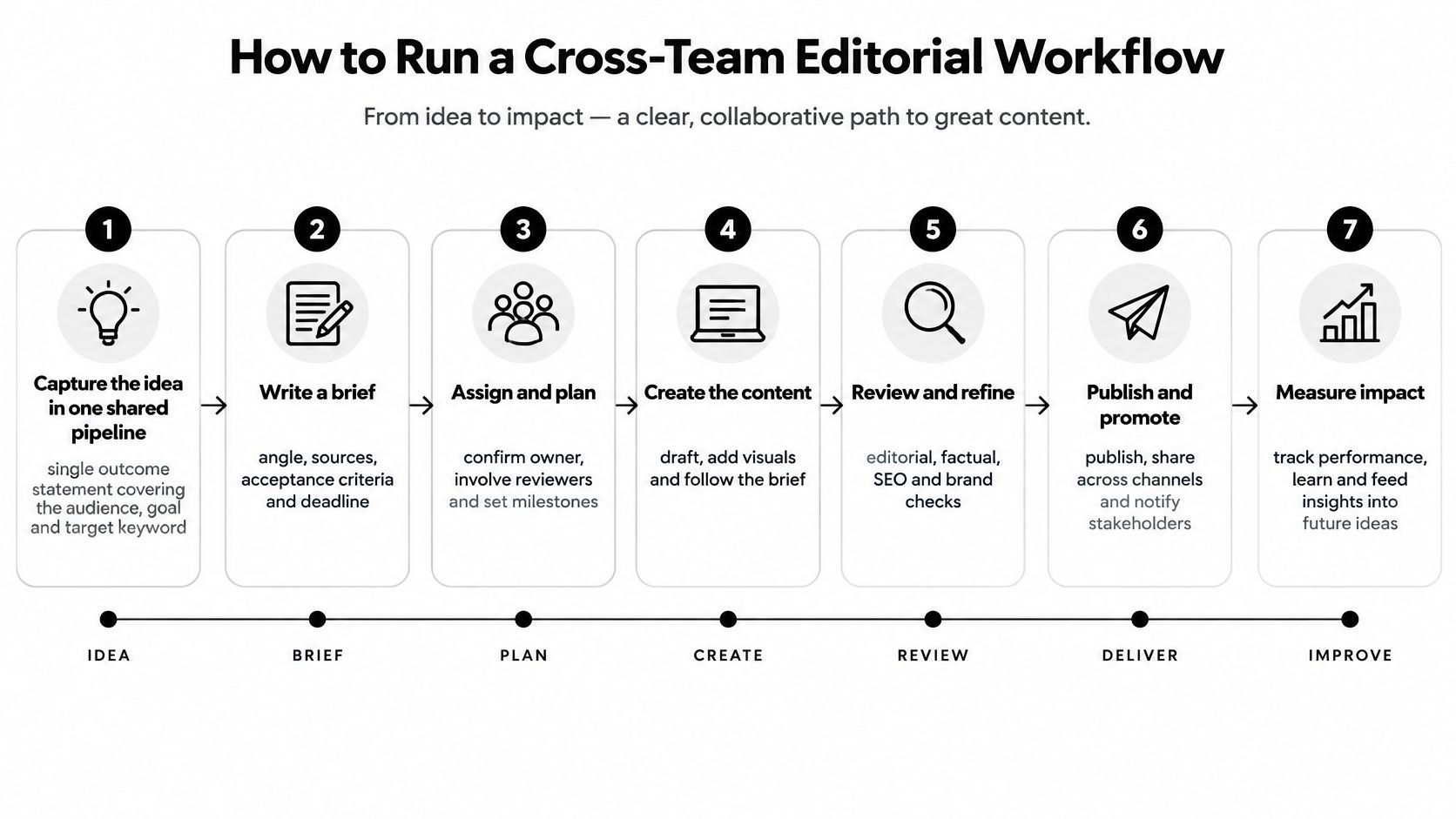
From an idea to an accepted deliverable
Capture the idea in a shared pipeline. Write an outcome statement covering the audience, business goal and target keyword. This gives the planner enough context to accept, combine or decline the idea before commissioning work.
Write a brief with the angle, sources, acceptance criteria and deadline. For a comparison article, specify which alternatives belong in scope and what evidence supports the recommendations.
Assign an owner to each stage, then record who approves and who can veto. Separate required approval from optional advice so a late preference does not become a publication blocker.
Map dependencies such as subject-matter review, design and legal approval. Log each blocker with a date, the missing input and the person responsible for obtaining it.
Schedule stage deadlines, not just publication. Work backward from launch and leave room to address rejected claims, missing visuals or substantial edits.
Use asynchronous comments for routine feedback. Hold a meeting when contributors need to resolve a judgment call, such as choosing between incompatible recommendations, and document the resulting decision on the item.
Publish and review against the brief. Ask whether the article reached the intended audience and supported the intended action, then use those findings to refine future commissions.
A documented content marketing workflow helps contributors follow the same operating rules without forcing every article into identical creative choices.
Keep coordination proportional
For a pilot, try a brief weekly triage of aging items. Agree on a review-wait threshold in advance, then escalate untouched items to the stage owner rather than inviting the entire team to another status meeting.
That balance matters: a 2025 McLean & Company workplace-collaboration survey found that nearly one in three professionals believed their organizations didn't collaborate enough, while excessive collaboration, including too many meetings, unclear roles and information overload, also slowed work and contributed to burnout.
Use the following video as a discussion prompt when agreeing how your team will coordinate.
Keep the operating agreement short enough to use. Contributors should be able to find their next action, approval authority and deadline without interpreting a lengthy process manual.
Editorial Planning Tools That Make It Work
| Capability | Collaboration problem it solves | What goes wrong without it |
|---|---|---|
| Workflow stages | Shows where each item sits, from draft to review to published | Stalled items remain unnoticed |
| Named assignments | Gives a person ownership of each stage | Tasks sit with no owner |
| Shared editorial calendar | Makes publish dates and deadlines visible to everyone | Launch dates slip without warning |
| Comments on the item | Keeps feedback attached to the content | Feedback gets lost in email threads |
| Deadline reminders | Surfaces due dates before they're missed | Missed deadlines are discovered after the fact |
| Topic and tag library | Shows existing coverage by topic and channel | Duplicate briefs and overlapping articles |
| Performance review | Connects published results to the next topic | Teams repeat weak formats without examining results |
These capabilities support different decisions. Workflow stages help an editor locate a delay; assignments establish who should respond; comments reveal whether the problem is missing information or unresolved disagreement.
Don't choose a platform solely because its feature list is long. Evaluate content collaboration tools by testing whether contributors can perform the actual handoffs your process requires.
A managing editor's Monday review
Consider a hypothetical managing editor who opens the calendar and finds several overdue reviews. Some have no comments, while another contains a question that only a technical specialist can answer.
She checks reviewer availability before reassigning an untouched draft to a named editor. On another item, she agrees a revised deadline with the existing reviewer and updates the calendar so the publisher can adjust preparation.
For the technical question, she logs the missing expert input as a blocker rather than leaving the article marked as in review. The publisher can now distinguish work awaiting editorial attention from work that can't proceed without evidence.
The illustration represents the planning workspace behind those decisions.
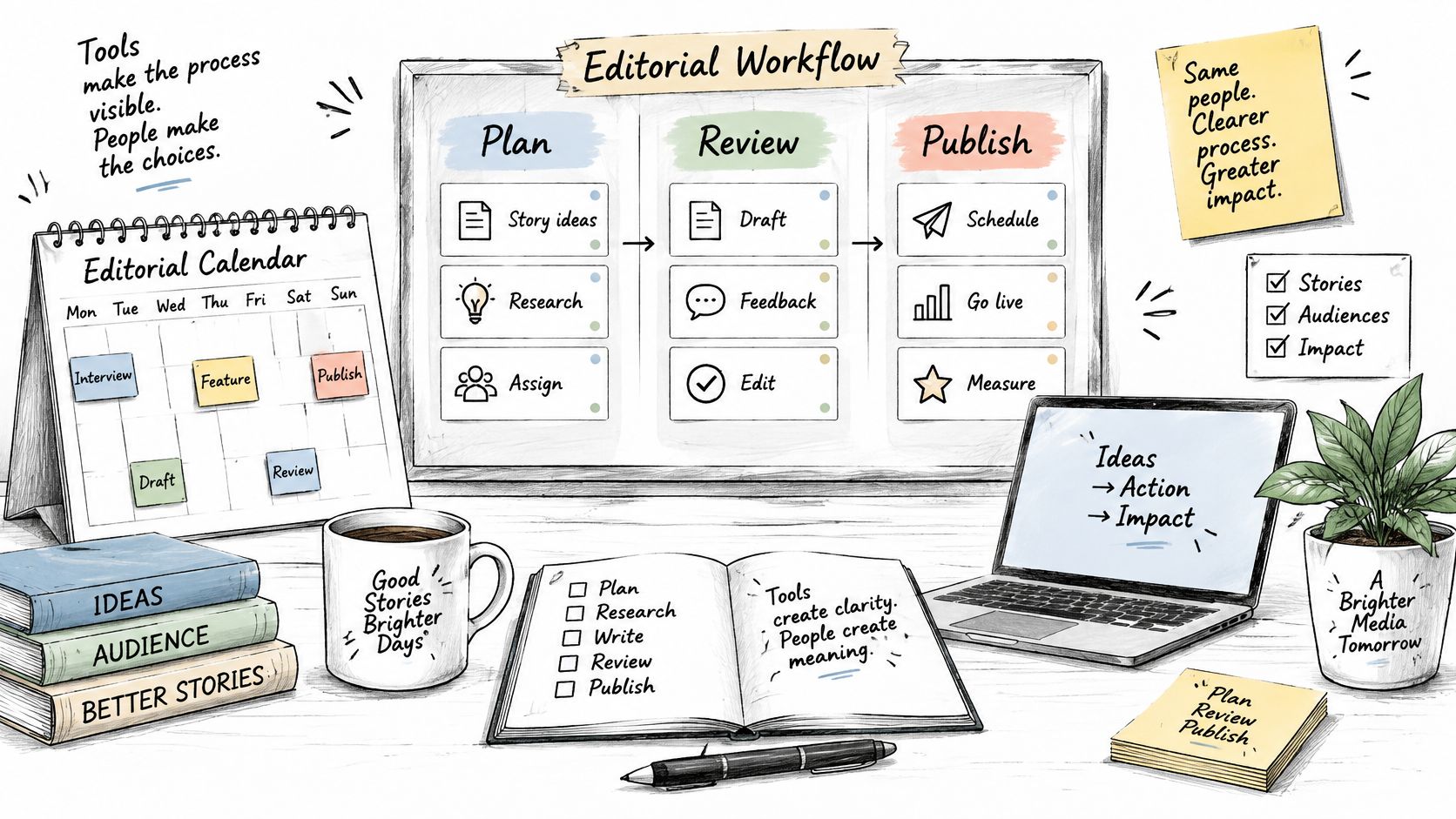
Configure the minimum useful workspace
Start with stages, assignments and dates. Add a clear place for blockers and attach the brief to the content record. Topic libraries and performance views become more useful once contributors reliably maintain the active work.
Test access as well as functionality. A reviewer who can't open the supporting document will still ask for files through email, even if the task itself is assigned correctly.
A calendar with empty owner fields reproduces the same silence as an unanswered email.
Ask a writer, reviewer and publisher to walk a sample item through the workspace. Watch where they need an explanation, permission or missing document, then fix those gaps before introducing the process across content streams.
The editor still makes the judgment calls. The tool should make those calls easier to carry out and leave a usable record for everyone affected.
Choose One Workflow to Fix This Month
Choose a specific bottleneck, such as unassigned reviews or missed approval deadlines. Don't start with an organization-wide promise to improve collaboration. Start with a content stream whose progress you can observe.
Record a baseline over a representative planning cycle. Count items aging in review, missed dates and time spent in coordination meetings, and keep those observations somewhere the pilot team can see.
Run a bounded experiment
- Define the change: For unclear ownership, require a named reviewer before a draft enters review.
- Name the pilot lead: Give someone responsibility for maintaining the process and resolving exceptions.
- Set the first deadline: Agree when the initial item should leave its current stage before admitting it to the pilot.
- Compare equivalent work: Check similar content types and workloads so a quieter publishing period doesn't look like a process improvement.
At the pilot review, examine the delayed items rather than discussing collaboration in the abstract. Did reviewers lack time, authority, evidence or a clear request? Each answer calls for a different adjustment.
Expand only when you can explain what improved and why. If the results haven't changed, revise the operating rule before extending it to more contributors.
TheContentMap is one option for running this experiment: our visual idea pipeline moves content through draft, review and published stages, while collaboration features let you assign writers and leave comments for editors, writers and stakeholders. Evaluate it against the same test you'd apply to any platform: can everyone identify the next action and its owner without adding another meeting?
TheContentMap brings idea capture, editorial scheduling and content collaboration into a shared planning workspace. Visit TheContentMap and use an upcoming article to test a clearer handoff from assignment through review to publication.
Related Articles
Content Marketing Plan: Step-by-Step for Editorial Teams
You opened the spreadsheet again. The dates are filled, the titles look plausible, and the month sti...
SoftwareContingency Planning Example: 7 Content Backup Plans
It's 9 a.m. Your feature writer is sick, the product launch has slipped, and the newsletter stil...
SoftwareHow to Build a Publishing Schedule That Holds
You set a publishing schedule for daily posts on Monday. By Thursday, two drafts are waiting on an e...
Comments (0)
No comments yet. Be the first to share your thoughts.