A Practical Editorial Review Process for Content Teams
Learn how an editorial review process moves content from idea to publication, with clear stages, roles, and best practices for teams that publish often.
An editorial review process is a defined sequence of stages, owners, and decision points that carries a piece of content from first idea to publication. Its job is to keep quality, accuracy, and deadlines under control. Think of it as a quality checkpoint on a factory line, where each station has a clear task and a clear person responsible for it.
Table of Contents
- Why Drafts Stall Between Writing and Publishing
- How the Editorial Review Process Grew Up
- The Rhythm Strong Content Teams Follow
- Intake Captures the Idea
- Triage Decides Whether an Idea Earns Time
- Drafting and Review Tie Feedback to Passages
- Approval and Publishing Lock in the Date
- Core Stages of an Editorial Review Process
- Who Does What in the Chain
- Why Named Owners Keep the Editorial Review Process Moving
- Avoiding the Equal Authority Trap
- Matching Authority to Responsibility
- Three Questions Every Idea Must Answer
- Tags Make Duplicates Easy to Spot
- Rejections Deserve a Paper Trail
- Archive Ideas Instead of Losing Them
- Protecting Capacity and Credibility
- Where Bottlenecks Appear First
- Making Date Changes Visible
- Spotting Your Own Weak Points
- Keeping Standards Consistent as Teams Grow
- A Simple Rule for Growing Teams
- The In-House Marketing Newsroom
- Agency Work with Different Approvers
- Freelance Writers and a Single Editor
- Mistakes That Quietly Stall Review
- Your Practical Starting Point
- How TheContentMap Supports the Workflow
Why Drafts Stall Between Writing and Publishing

Picture a draft sitting in an inbox for a week. Two editors disagree about the angle, and the publish date quietly slips. Nobody made a bad call, but nobody made a clear one either.
That gap between writing and publishing is exactly where a review process earns its keep. Without one, feedback ends up scattered across emails and chat threads. Work only moves when someone remembers to chase it.
How the Editorial Review Process Grew Up
Review started as informal judgment. An editor read a piece, gave a gut reaction, and the writer made changes. That approach worked fine for small teams, but it leaned heavily on memory and personal relationships.
As output grew, those handshake agreements began to fall apart. Teams needed something closer to a signed contract, with defined steps and terms everyone could see.
Making review a visible stage beats an informal conversation buried in email every time.
A visible pipeline shows every piece as draft, in review, or published, so nobody has to ask where a draft stands. That visibility is what turns review from a favor into a routine.
The Rhythm Strong Content Teams Follow
Most teams settle into a simple rhythm. They capture ideas, plan them on a calendar with named owners and dates, then publish and learn from the results.
- Capture every idea along with its audience and goal.
- Plan each piece with an owner and a publish date.
- Learn which topics actually performed after release.
A general content hub can be a helpful reference when you're making the case for structured review before publishing. For a real-world example of how one publisher keeps readers informed, take a look at match previews and fixture updates.
This article follows that rhythm for in-house marketing teams, digital publishers, agencies, and freelance writers working with editors. Each section adds one piece, from the four core stages to the people who own them.
Think of a relay race. A fast runner still loses if the baton hits the track. An editorial review process works the same way, and each stage should pass the piece forward only when it's genuinely ready, not just when the calendar says so.
There are four core stages, and each one answers a different question. The diagram below shows how they connect from left to right, with every stage handing the next one exactly what it needs.
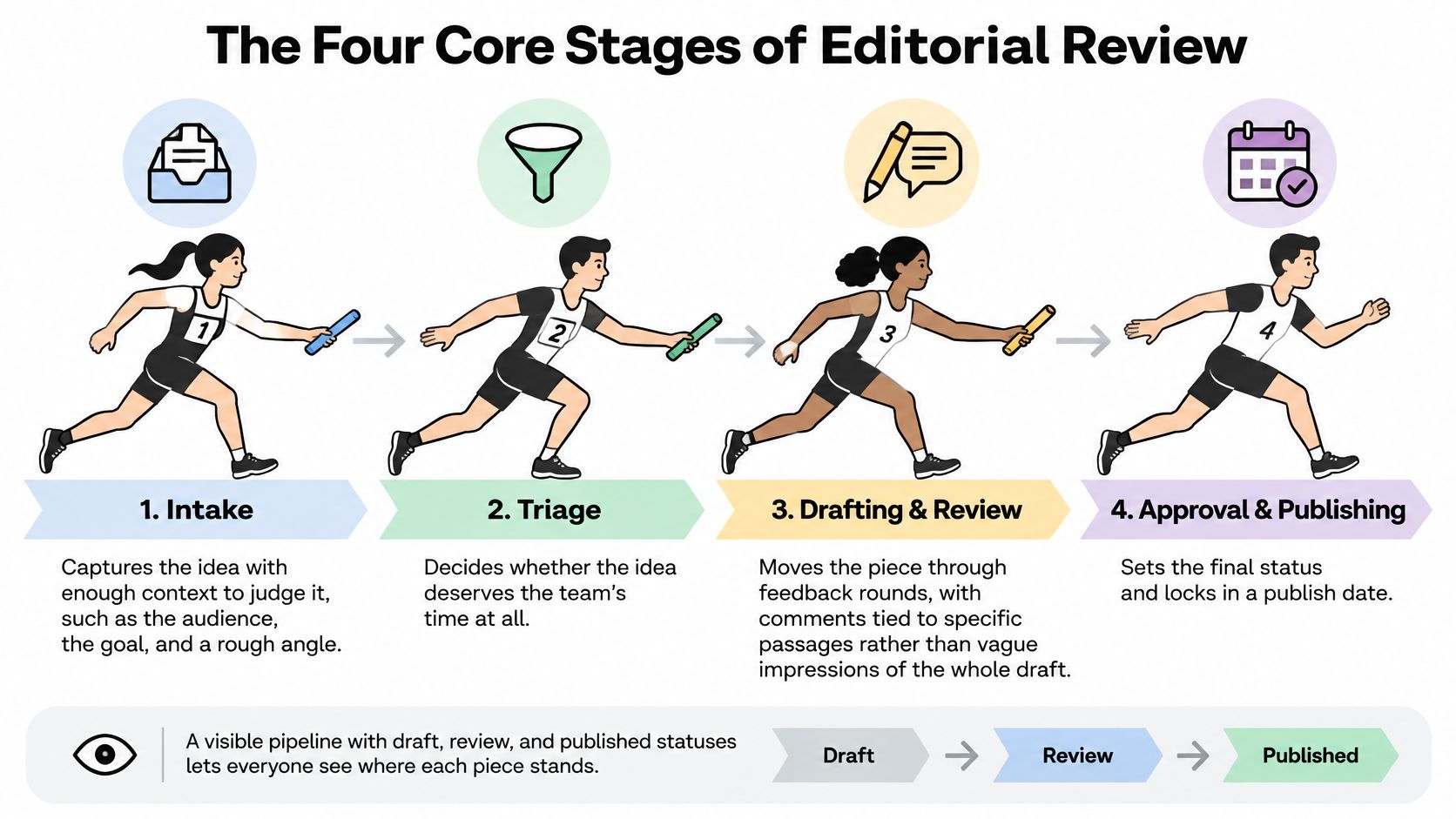
Looked at this way, no stage is a formality. A weak intake quietly drags down every step that follows.
Intake Captures the Idea
Intake turns a loose thought into a proposal someone can actually judge. It's the pitch scribbled on the back of an envelope before anyone commits time or budget. The aim is to capture enough context to decide quickly, including:
- Audience: who the piece is written for
- Goal: what the piece should achieve
- Angle: a rough sense of the approach
A good intake answers one question: Is this worth a closer look?
Triage Decides Whether an Idea Earns Time
Triage works like a sieve. Most ideas should be turned away here, before they consume a full review cycle.
Editors tend to ask three things. Does it fit the audience and the standards? Is there a clear owner and a realistic slot? Does it repeat something already published?
At one large journal group, around half of submissions get rejected at initial screening. Early filtering matters more than most teams expect.
Turning down a weak idea at triage protects the time your strongest pieces need.
Drafting and Review Tie Feedback to Passages
Drafting produces the piece. Review then sharpens it, one feedback round at a time. Precision is what makes review useful. "This feels off" gives a writer nothing to work with, but a reviewer who points to a specific paragraph and explains the problem gives them a clear next step.
Passage-level comments keep revisions focused. For teams building a repeatable review chain, a newsroom-style verification workflow makes a useful comparison, since it depends on staged checks and sign-offs. See how desks vet unknown footage for one example.
Approval and Publishing Lock in the Date
Approval sets the final status. Once a piece is signed off, its publish date gets locked in, so it stops drifting around the calendar.
This last handoff is where many plans quietly fall apart. Approved work still needs a confirmed slot, or it sits in a folder waiting for someone to notice.
Core Stages of an Editorial Review Process
Use this table as a checklist for your own pipeline. It shows what each stage is for, who usually owns it, and what has to be true before the piece moves on.
| Stage | Main Purpose | Typical Owner | Exit Criteria |
|---|---|---|---|
| Intake | Capture the idea with context | Writer or content planner | Audience, goal, and angle recorded |
| Triage | Decide if the idea earns time | Managing editor | Fit confirmed, owner and slot assigned |
| Drafting and Review | Refine the piece through feedback | Writer and editor | Comments resolved at passage level |
| Approval and Publishing | Set final status and date | Editor-in-chief or managing editor | Status approved, publish date locked |
When every stage has clear exit criteria, the work moves like a relay with no dropped batons. Read also: how to leave feedback that actually helps, which applies to every review round.
A visible pipeline with draft, review, and published statuses lets everyone see where each piece stands, which saves a surprising amount of back-and-forth.

An editorial review process usually falls apart without anyone noticing. The problem is rarely the quality of the writing. It's that nobody is sure who gets to make the final call. Think of a film crew. The director decides how the shot should look, but every department has its own job, and the whole production depends on those jobs getting done on time.
Who Does What in the Chain
Every piece needs a named owner, since each role carries a different kind of accountability. In most teams, the roles break down like this:
- Writers produce drafts and revise them based on feedback they can explain and defend.
- Editors check accuracy, structure, and fit with publication standards.
- Managing editors own the calendar and settle disputes when two pieces compete for the same slot.
- Stakeholders, such as product or sales leads, comment on messaging without turning into bottlenecks.
- Freelancers need one clear brief and a single point of contact.
Why Named Owners Keep the Editorial Review Process Moving
A named owner turns a shared responsibility into a personal one. When one person is accountable for a piece's next move, questions get answered the same day instead of drifting through group threads for a week.
Feedback needs a clear address, too. Comments attached to the exact passage they concern keep revisions focused. A writer shouldn't have to guess which sentence a note is about.
One owner per piece beats ten reviewers with equal say.
Avoiding the Equal Authority Trap
A common mistake is giving every reviewer equal authority. It sounds fair, but it slows decisions and blurs accountability. When five people can veto a headline, nobody really owns it.
A better approach separates input from decisions. Reviewers advise, and one editor makes the call and records the reasoning. Say a legal reviewer flags a risky claim. The reviewer's job is to point out the problem, and the managing editor decides how to rewrite it.
Read also: what a managing editor actually does day to day before you assign that role.
Matching Authority to Responsibility
Authority works best when it's written down. Many teams agree on a short decision map before the first piece goes live. It doesn't need to be long. It just needs to be clear.
- Name the decision owner for each stage.
- List who may comment but cannot approve.
- Agree on a deadline for each round of feedback.
Once everyone knows who decides, the process holds up even when the schedule gets tight. That clarity is what keeps each piece moving toward a confirmed publish date.
Not every idea earns a place in the full editorial review. Learning to filter early will save your team more time than almost any other change.
Three Questions Every Idea Must Answer
Think of triage as a bouncer at the door. Before anyone spends an hour on a draft, the idea gets a quick check with a few simple questions:
- Audience fit: Does the idea serve the audience, campaign, channel, and editorial standards?
- Ownership: Is there a clear owner and a realistic slot on the calendar?
- Originality: Does it repeat something already published?
Tags Make Duplicates Easy to Spot
Tags do a lot of quiet work here. A simple label for each topic, campaign, and channel makes repeats visible before a writer ever opens a blank document.
Say two pitches share the same campaign and topic tags. That should prompt a quick comparison. More often than you'd expect, one of them turns out to be a near copy of last quarter's guide.
Rejections Deserve a Paper Trail
Turning down an idea without saying why is an easy way to end up having the same argument next month. Written comments capture the reasoning, so the next editor can see what was decided and why.
Every rejection recorded with its reasoning is a debate that never has to happen twice.
Archive Ideas Instead of Losing Them
A rejected idea isn't always a dead one. It may just be early. Archiving it keeps the thinking available for a later season, a new campaign, or a fresh angle.
Publishing has seen this pattern before. Some publishing groups found that 16% of manuscripts rejected without a transfer offer were later published elsewhere. That's a lot of good work slipping away.
Archived ideas are also easy to find again. Searching by tag means a rejected topic can resurface when its moment finally arrives.
Protecting Capacity and Credibility
Looked at this way, rejection isn't a failure of the process. It protects the two things that matter most: your production capacity and the publication's credibility.
Teams that screen well spend their review hours on pieces that have a real chance of going live. That focus keeps quality high even as the volume of ideas grows.
Over time, the team also learns which ideas tend to succeed and which keep stalling. Tracking that pattern each quarter is well worth the effort.
Read also: how to build a stronger idea list before triage
Clean, tagged lists make triage faster.
As output grows, a process that lives in people's heads and a few scattered spreadsheets tends to fall apart. Picture a busy airport. Planes take off on schedule only because every handoff, from gate to runway to tower, has a visible owner.

In most growing teams, the real problem isn't the amount of work. It's the lack of shared visibility into where each piece currently sits.
Where Bottlenecks Appear First
Usually, four bottlenecks show up before anything else. They rarely announce themselves. They just make work feel slower than it should.
Here's how they tend to look in practice, along with a fix for each one.
Common Review Bottlenecks and Practical Fixes
| Bottleneck | What It Looks Like | Practical Fix |
|---|---|---|
| Missed handoffs | Feedback is sent but nobody picks up the draft | Assign a named owner to every stage |
| Unclear decision-makers | Two editors rewrite the same headline | Name one decision owner per piece |
| Approval pile-ups | Too many pieces reach approval in one week | Use a calendar view to spread approvals |
| Forgotten deadlines | Dates slip without anyone noticing | Turn on publish-date reminders |
Most of these fixes are small. The hard part is making them routine.
Making Date Changes Visible
Moving a publish date should never be a quiet edit. Every change needs to be explicit and written down.
A logged date change means the latest plan is always the one people find.
Otherwise, the new date lives in a chat message while the old one stays in a document everyone still opens. Two people end up working from two different calendars, and nobody realizes it until the launch slips.
Spotting Your Own Weak Points
You don't need a big overhaul to find the problems. Start with a quick audit of last month's published pieces, and note where each one sat the longest.
- Check which stage holds the most pieces.
- Confirm that every piece has one named owner.
- Scan the calendar for weeks with too many approvals.
TheContentMap's editorial calendar lets you drag pieces between dates, and publish reminders keep deadlines in view. The whole plan sits in one place instead of across a pile of spreadsheets.
Keeping Standards Consistent as Teams Grow
Review standards are easy to keep when five people share the same habits. They get harder once ten people and three freelancers are involved. Written rules, shared templates, and a clear escalation path carry the standard when no one can keep it in their head.
For a related look at repeatable rules, read how Wecomeet builds design systems.
A Simple Rule for Growing Teams
Visibility is the cheapest improvement you can make. Before adding more writers or titles, make sure every piece shows its owner, status, and date. Those details take seconds to add and save hours of chasing people later.
If a team cannot say where a piece is in under ten seconds, the process is already too fragile to scale.
Once that visibility holds, growth becomes a planning problem instead of a rescue mission. Review the list each quarter so small leaks don't turn into missed launches.
Theory only starts to earn its keep when it runs into a real desk on a busy Tuesday. The three teams below each found their own way to make it work.
The In-House Marketing Newsroom
Picture a marketing team that sends a weekly newsletter. Drafts kept disappearing into a legal queue, and nobody could say which ones were stuck.
The fix turned out to be simpler than anyone expected. Every draft now has a named owner, and the calendar flags any piece that has sat in review for more than two days.
Their editorial review process now runs through all four stages in order. Triage happens every Monday morning, and reminders go out two days before any legal check can threaten a send date.
Agency Work with Different Approvers
An agency handling client articles has a different problem. Every client brings its own approvers, deadlines, and tone rules, and those rules rarely line up.
The team keeps a separate pipeline for each client, so one account's approvals never hold up another's. Each handoff also names the person who signs off, which removes the guessing game.
Freelance Writers and a Single Editor
A freelancer working with one editor on a monthly series doesn't need much machinery. Still, the underlying logic is the same.
Both sides agree on one shared pipeline with draft, review, and published statuses. The editor logs every decision in that same place, so nothing lives only in someone's inbox.
Mistakes That Quietly Stall Review
Three missteps come up again and again:
- Skipping triage to save time, which pushes weak ideas into full review cycles.
- Leaving feedback in private messages, where nobody else can see or act on it.
- Publishing without recording a decision, so the next editor ends up repeating the same debate.
A decision that is never written down will be made again.
None of these mistakes looks dangerous on its own. Together, though, they turn a clear process into guesswork, and guesswork is what pushes publish dates back.
Your Practical Starting Point
- Map your current workflow from first idea to publish date.
- Name an owner for every piece, even if the owner is you.
- Define exit criteria for each stage so handoffs are clear.
- Review performance data every quarter and adjust the calendar.
Most teams find that a few hours of mapping their editorial review process saves days of chasing people down. The same steps work whether you manage a team of twelve or work alone. Start small, then add stages as your output grows.
How TheContentMap Supports the Workflow
TheContentMap follows the same three-step flow. You capture ideas in a pipeline, plan them on an editorial calendar with owners and publish dates, and then review what worked.
The free Starter plan includes an editorial calendar, up to three projects, and one editor seat.
TheContentMap helps editors move every piece from idea to publication with clear owners and dates. Start planning your workflow at TheContentMap today.
Related Articles
Editorial Calendar Management: Setup, Stages and Metrics
Your calendar says an article will publish on Thursday. The writer says the draft is finished, the e...
Software7 Editorial Calendar Example Layouts for Teams
Your spreadsheet is full of publication dates, but the team still can't agree on what belongs in...
SoftwareDeadlines for Writers: How to Set Realistic Dates
Roughly 25% to 60% of forthcoming titles miss their original submission date, according to estimates...
Comments (0)
No comments yet. Be the first to share your thoughts.