Content Marketing Workflow for Editorial Teams
Build a content marketing workflow with five stages, clear owners, approval rules, and a measurement loop editorial teams can run.

83% of marketing leaders wanted to streamline workflows and reduce the number of technology solutions they used, according to Bynder's 2024 Marketing Trends Survey. That's a useful starting point for editorial teams: a better content marketing workflow shouldn't mean adding another place to chase approvals. It should mean knowing exactly what can move forward, who decides, and what must happen next.
Table of Contents
- Why Editorial Teams Need a Content Marketing Workflow
- Five Stages from Idea Intake to a Measured Result
- Who Decides at Each Handoff
- Approval Stalls and the Rules That Clear Them
- One Asset Measured Back into the Next Brief
- Where AI Fits Without Skipping Human Gates
- Stand Up Your Workflow in the Next Thirty Days
Why Editorial Teams Need a Content Marketing Workflow
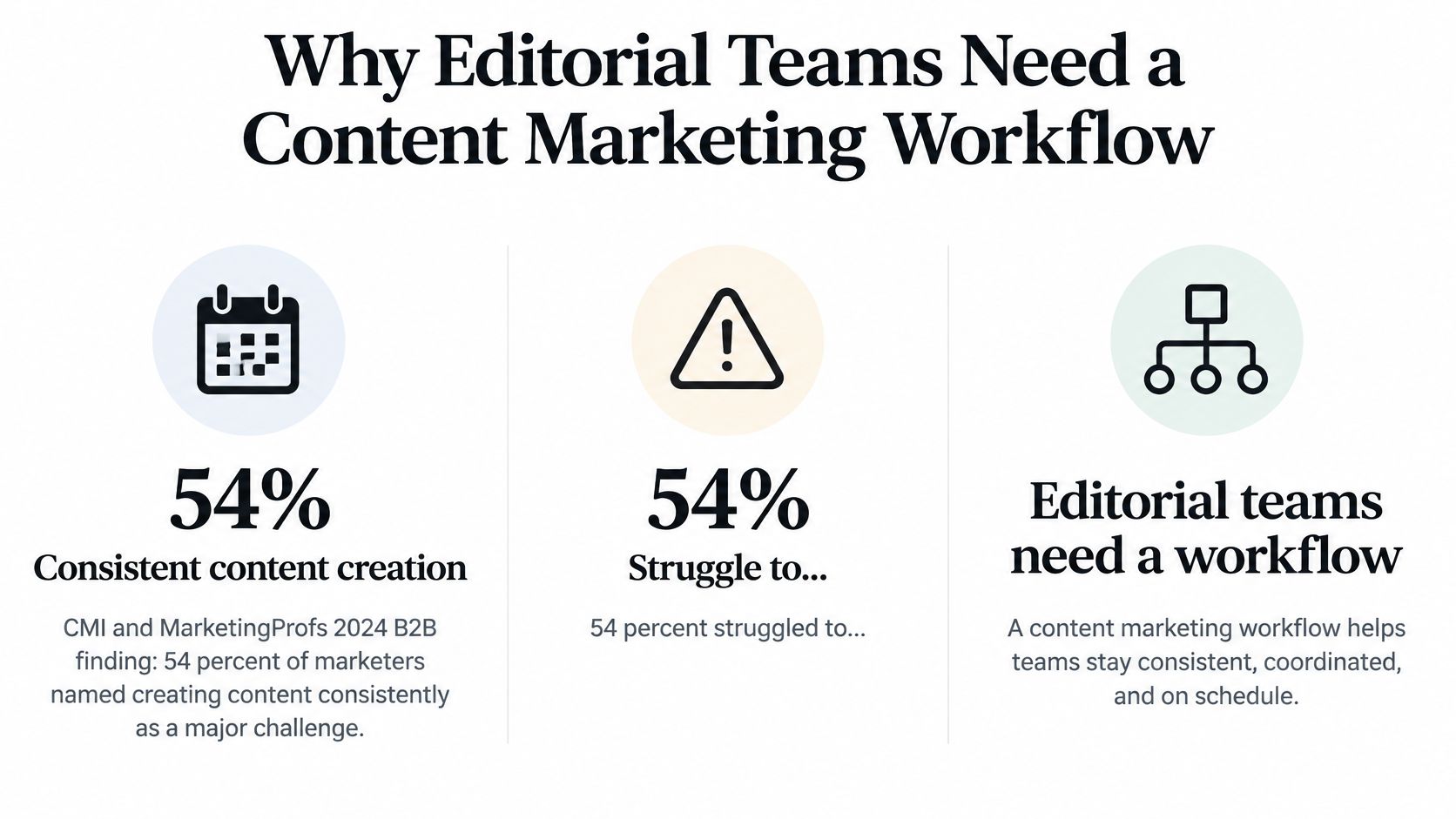
54% identified creating content consistently as a major challenge, while 57% struggled to create content suited to their audience, in Content Marketing Institute and MarketingProfs' 2024 B2B research, whose report primarily reflects responses from 894 marketers, mostly in the United States.
Consistency and relevance belong in the same conversation. Publishing on time doesn't help much if the writer never received a clear audience question. Equally, a promising idea won't help readers if it sits in a document awaiting an unnamed approver.
A content marketing workflow is the agreed path an asset follows from captured idea to published content whose results inform the next plan. It covers the work, the decisions, and the evidence needed to move between them.
Think like a newsroom assignment desk
Say a software company wants a customer story about improving warehouse operations. Sales has suggested the customer, a writer has opened a document, and the editor expects to publish soon. But nobody has confirmed customer permission, booked the interview, or decided whether the story belongs on the blog or a campaign landing page.
At a newsroom assignment desk, a strong story idea still needs an owner, a deadline, and a publication slot. Apply that discipline here: the editor first names the audience, confirms the available evidence, and assigns the next action. Writing begins when the assignment is ready, not merely when someone is available.
These editorial challenges are a useful reminder of what the operating process must address.
A backlog isn't a production system
A customer story might need an interview, permission, design, and offer review. A practical article may need technical verification and search-intent checks. A visual explainer needs a designer who knows which claims are settled before laying out the graphic.
A title and a publish date don't describe those dependencies. The workflow must make them visible before the deadline becomes a problem.
- Capture the reader need: State the question the asset should answer.
- Identify dependencies: List the people, permissions, and source materials needed.
- Connect production to distribution: Choose the destination and intended reader action before drafting.
For teams coordinating organic content and advertising, LLMrefs' guide to improve SEO and paid ad performance offers a useful companion resource for that planning conversation. Keep those channel decisions attached to the assignment rather than leaving them in a separate strategy document.
The operating test is simple: can an editor inspect an asset and understand its current state without asking its writer for an update?
Five Stages from Idea Intake to a Measured Result
| Stage | Accountable owner | Entry rule | Exit rule | Output |
|---|---|---|---|---|
| Ideation | Managing editor | Audience, channel, and need are named | Brief locked with format, KPI, and owner | Scoped brief |
| Production | Assigned writer | Brief accepted and expert question listed | Draft matches outline and cites sources | Complete draft |
| Review | Accountable editor | Draft is complete | Comments resolved and version locked | Approved asset |
| Publish | Editor or producer | Final file locked and date set | Live on the planned channel | Published URL |
| Measure | Content owner | Campaign, audience, format, and KPI were captured before publish | Checkpoint compared with the target KPI | Note for the next brief |
Copy this content marketing workflow stages table into your tracker before adding tools or reviewers. Then give each asset a current state, a named person, a due date for that state, and a route for escalation.
Treat the asset as a state machine: it can move only when the conditions for its next state are satisfied. The term sounds technical, but the rule is practical. A writer can't hand an incomplete draft to an editor by changing its label.
Make the hidden states visible
The broad stages help people understand the process. More precise states help them run it:
- Ideation: Intake, then scoped.
- Production: Assigned, then drafting.
- Review: Subject-matter review, editorial review, then any required legal or brand approval.
- Publish: Scheduled, then published.
- Measure: Checkpoint due, then measured.
Among B2B marketers in Content Marketing Institute's 2025 benchmarks, 33% reported workflow or content-approval challenges, and 33% reported difficulty accessing subject-matter experts. A label such as in progress doesn't reveal which problem an editor needs to solve.
Keep blocked as a separate flag, not a replacement state. An asset can remain in subject-matter review while blocked because the reviewer is unavailable. Record when the blockage began and what will clear it.
Walk a customer story through the gates
For the warehouse customer story, the managing editor accepts the idea only after identifying the intended operations reader and publication channel. The scoped brief specifies the format, target action, available customer evidence, and the question the technical expert must answer.
The writer accepts the assignment and drafting deadline. If an interview hasn't been confirmed, the writer highlights the dependency instead of absorbing the delay unnoticed.
Subject-matter review begins with a complete draft and an explicit question about the operational explanation. The expert checks that domain; the editor handles structure and reader clarity. Review ends only when required comments are resolved and the approved version is locked.
The producer then schedules that version, checks the live page, and records the URL. The content owner receives a dated measurement task as part of publication, not as a reminder someone might create later.
Practical rule: Every state needs an owner, a due date, an entry condition, an exit condition, and a named escalation recipient.
For ideation delays, escalate to the managing editor to scope or park the idea. For production delays, the writer raises missing inputs with the editor. Review delays go to the accountable editor; publishing problems go to the production lead; overdue measurement goes to the content lead.
The everyday rhythm remains manageable: capture ideas in a pipeline, plan them on an editorial calendar with owners and publish dates, then publish and review what worked. The finer states explain what must happen inside that rhythm.
Who Decides at Each Handoff
Give each gate a single decider, not every asset a single contributor. A technical expert, designer, sales representative, and editor can all improve the same piece. They don't all need authority to return it to production.
Separate accountability for moving the asset from authority over a specific decision. The accountable editor coordinates review, while a required legal approver can still withhold clearance on an unsupported claim.
| Role | Decides | Consulted on | Does not decide |
|---|---|---|---|
| Managing editor | Priority, final publish call, escalation | Channel mix | Line-level wording |
| Writer | Draft approach inside the brief | Sources and examples | Publish date or kill decision |
| Subject-matter expert | Accuracy in their domain | Whether the expert question is fair | Brand voice or go-live |
| Brand or legal | Claims, trademark, and risk | Timing when risk is high | Topic selection |
| Sales or executive stakeholder | Nothing by default | Offer and customer-story accuracy | Final wording |
This decision-rights table is a starting agreement, not a claim that every organization has identical roles. In a small team, the managing editor may also perform the copy edit. Record which role they're acting in so a preference about wording doesn't become an unexplained strategic veto.
Distinguish advice from a stop decision
Suppose sales asks the writer to make the warehouse story more product-focused. The editor believes the reader needs a clearer explanation of the operational problem first. Sales should provide evidence about the offer and customer context; the editor decides how that evidence fits the agreed reader promise.
The writer shouldn't have to resolve that disagreement through separate conversations. Put the decision rule in the assignment:
The accountable editor consolidates conflicting feedback, and only the named approver for the current gate can return the asset for revision.
Required domain clearance still matters. An editor can't override an unresolved legal issue just because the publish date is close. Instead, the managing editor can narrow the claim, remove it, postpone publication, or escalate to the designated authority.
Set review windows before assigning work
Choose response windows according to the task and risk. A factual check against supplied documentation needs a different agreement from a review involving customer permission or regulated claims.
Record the accepted deadline and a backup reviewer when making the request. If the reviewer can't meet it, resolve capacity or scope then, rather than discovering the problem when the deadline passes.
These distinctions also improve staffing decisions. Long drafting time may justify more writing capacity, but first check assignment complexity. Long blocked time awaiting expert access calls for reviewer availability, not another writer.
Attach a compact RACI line to the next assignment: Responsible, named writer; Accountable, gate owner; Consulted, named specialists; Informed, distribution stakeholders. Replace roles with actual names before work begins.
Approval Stalls and the Rules That Clear Them
61% of enterprise marketers struggle to communicate across organizational silos, and 47% identify workflow or approval processes as a challenge, according to Content Marketing Institute's enterprise content marketing findings. Review therefore needs governance, not just another checkbox.
Adding reviewers can improve risk control while making the final decision less clear. Diagnose the specific stall before changing the process.
| Stall | What it looks like | Rule that clears it |
|---|---|---|
| Unclear decision rights | Several people rewrite the same piece | One approver; everyone else consults |
| Late brand or legal | Notes arrive after the publish date | Response-time agreement and a named backup |
| Conflicting feedback | Sales, executive, and editor change the angle | One review form and a disagreement rule |
| Silent reviewer | The date passes with no comment | No-response rule the same day |
| Vague-brief rework | Extra rounds after the draft exists | Count rounds caused by a missing brief field |
Diagnose the calendar symptom
When several people rewrite the opening, don't ask the writer to combine every version. Ask which change corrects an error, addresses risk, or better delivers the agreed reader promise. The accountable editor resolves the rest.
Late brand or legal notes require a different intervention. Bring the reviewer into scoping when sensitive claims are foreseeable, confirm the review window, and assign a backup with equivalent authority. An earlier invitation is more useful than repeated urgent messages.
For conflicting feedback, use a shared review form attached to the asset. Require reviewers to identify the passage, the problem, the reason it matters, and the requested correction. That makes a factual objection distinguishable from a personal preference.
Decide what silence means
A no-response rule must state whether silence permits progress or triggers escalation. For required legal clearance, customer permission, and unresolved factual questions, silence shouldn't count as approval.
For optional consultation, the editor may proceed after the agreed window if the assignment explicitly allows it. Record that decision so nobody later mistakes missing feedback for missing process.
- Track decision latency: Measure elapsed time from review request to a usable decision.
- Track revision rounds: Distinguish required corrections from preference changes.
- Tag avoidable rework: Record missing audience, offer, evidence, or expert-question details.
Use the content approval workflow guide to turn those rules into an approval path the team can follow. Keep the agreement beside the work, not buried in an onboarding folder.
Audit a recent batch of completed assets from draft-complete to version-locked. Separate active review time from waiting time, then fix the state with the longest blocked period first. Publishing volume alone won't tell you whether reviewers reached decisions promptly or writers repeatedly repaired unclear assignments.
One Asset Measured Back into the Next Brief
Say the warehouse customer story is intended to help operations leaders evaluate a solution. Before drafting, the content owner records its campaign ID, funnel stage, primary audience, topic, format, intended conversion, owner, target KPI, and measurement window.
Those fields should travel with the asset into publishing and reporting. This illustration connects the customer story to the planning decisions around it.
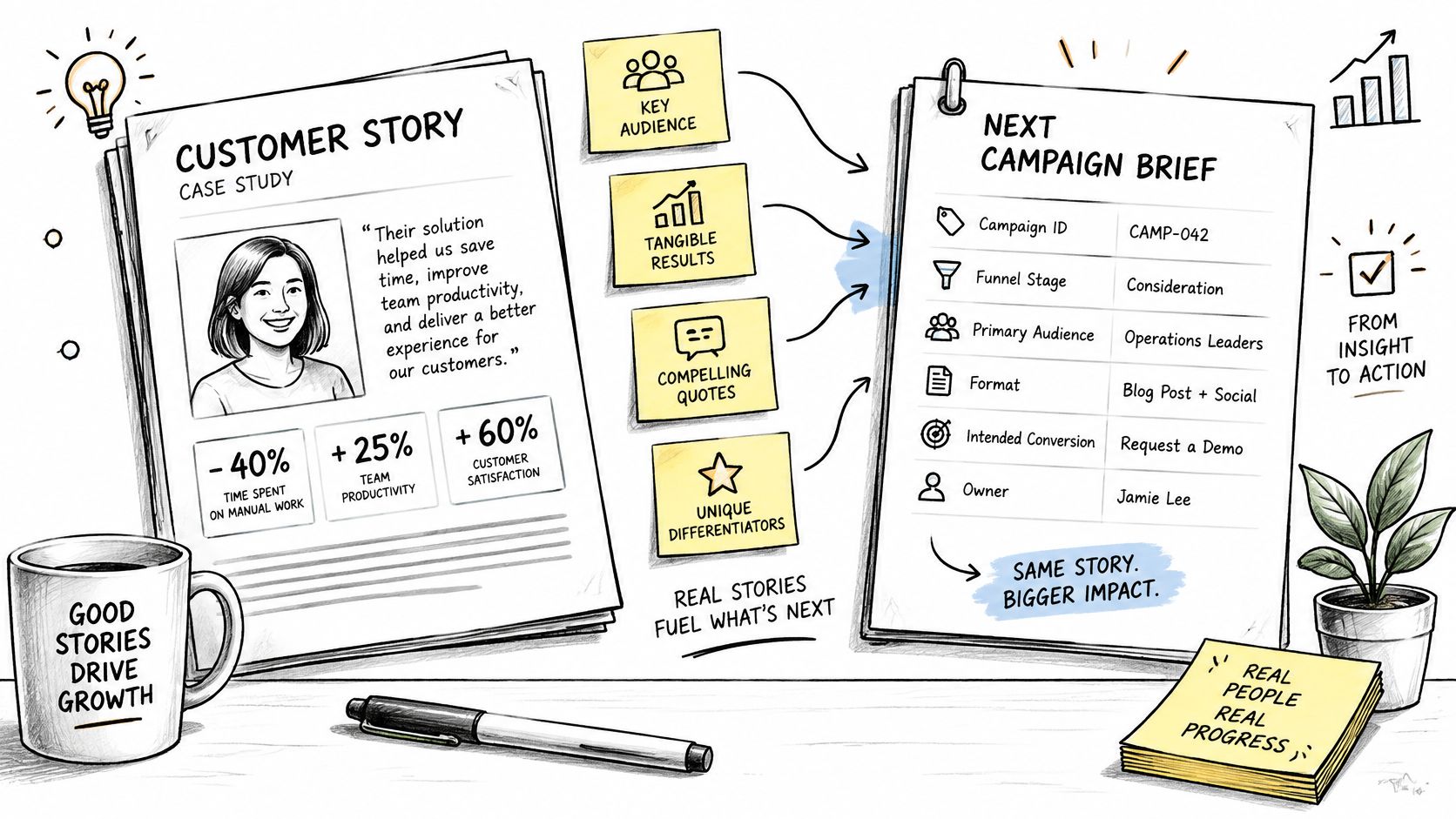
In Content Marketing Institute's 2025 technology-marketer survey of 274 respondents, 62% identified attributing return on investment as a difficulty, and 58% cited difficulty tracking customer journeys. To make your own reporting usable, establish the connection between assignment, distribution, and intended outcome before the URL exists.
Read the result in the right order
At the scheduled checkpoint, begin with the signals closest to publication: reach, qualified traffic, engagement, and the lead or subscriber action. Check whether the planned distribution happened before judging the content.
Then examine outcomes that need more time, such as pipeline, revenue, retention, or assisted conversion. Don't treat an early checkpoint as proof that an asset has no commercial value. Equally, don't label traffic as revenue impact when you haven't established that connection.
A practical content performance metrics framework helps the owner distinguish those measures. The checkpoint should answer a decision question, not produce a screenshot of an analytics dashboard.
Use the accompanying video as a separate discussion prompt when reviewing how planning connects to execution.
Turn the finding into an assignment change
In this hypothetical customer-story campaign, the page misses its intended lead-action target, but the newsletter brings engaged operations readers who continue to related product content. The owner checks tracking and distribution, then documents a testable interpretation: the story may fit the audience, while its placement or call to action needs adjustment.
The next assignment keeps the customer-story format but plans newsletter distribution earlier and offers a more relevant next step. It doesn't abandon the topic solely because direct lead actions were weak.
Write the checkpoint note as a decision:
- Keep: The reader problem and customer evidence.
- Change: The distribution plan and next-step offer.
- Test: Whether the revised journey produces the intended action.
- Revisit: Commercial outcomes when the measurement window allows.
A brand essay without a conversion target still needs a window and a meaningful leading indicator, such as qualified readership or engaged visits. Otherwise, the owner has no agreed basis for evaluating it.
The editorial calendar becomes a closed learning loop when the checkpoint note is required before a similar idea can be scoped. Measurement then changes an assignment rather than merely documenting a finished page.
Where AI Fits Without Skipping Human Gates
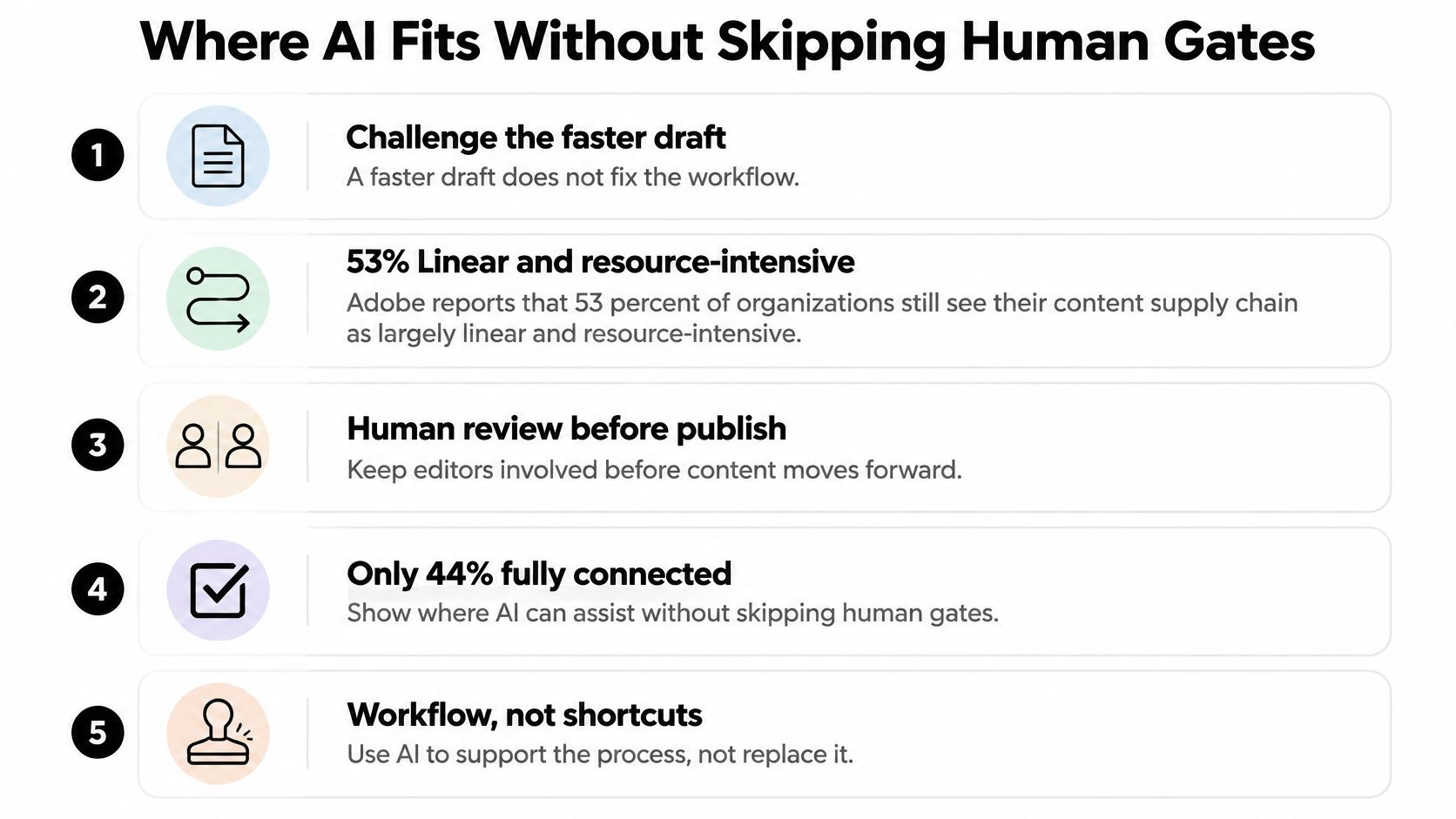
A faster draft can make the review queue worse. If writers generate more material while experts remain unavailable, editors inherit more unfinished decisions rather than more publishable content.
53% of organizations still view their content supply chain as largely linear and resource-intensive, while only 44% consider their data quality and accessibility adequate for AI, according to Adobe's content management digital trends report. Start with a defined assignment and decision rights, not a generation target.
Give AI a bounded assignment
Use AI where the input is settled and a human can evaluate the output against clear criteria.
- Outline from an accepted brief: Ask for a proposed structure using the approved audience question and source materials.
- Titles within that structure: Generate alternatives that preserve the reader promise and avoid unsupported claims.
- Repurposing from an approved asset: Adapt established material to a named channel format, then review the adaptation.
For a paid-video adaptation, the ShortGenius AI ad creative tool is an option to evaluate within that repurposing step. Supply approved source material and require human checks on claims, customer permissions, visuals, and the destination offer.
Keep the model away from authority it hasn't been assigned. It shouldn't choose the editorial priority, approve factual claims, or move an asset to scheduled.
Use this checklist to keep assistance inside the workflow.
Preserve a usable record
Attach a short provenance record to the asset: where AI was used, which source materials grounded the output, who verified factual claims, and whether the published asset reached its measurement checkpoint. Record the checkpoint result when it becomes available.
If source material is thin or usage rights are unclear, keep the drafting gate closed. Generation isn't a substitute for permission, evidence, or access to a knowledgeable reviewer.
Faster production is useful only when the team can review, publish, and learn from the additional work.
Pilot a narrowly defined assisted step on a small batch of comparable assignments. Compare revision rounds and blocked review time with a recent unassisted batch before expanding its use.
Bring the performance finding into the next prioritization meeting as well. If the adaptation reached the wrong audience or weakened the offer, change its input instructions or stop that use case. Evaluate AI by the quality of the completed workflow, not the speed of its first output.
Stand Up Your Workflow in the Next Thirty Days
Use the next month to establish a working process on a single channel. Don't redesign every campaign at once.
- Week one: Put the stages, named approver, and no-response rule on a shared page. Apply them to an actual assignment and resolve ambiguous handoffs.
- Week two: Require the planning and measurement fields on new ideas. Return incomplete assignments to scoping instead of opening drafts.
- Week three: Inspect blocked time across recently completed pieces. Fix the slowest gate, whether that means reviewer access, clearer evidence requirements, or a backup approver.
- Week four: Hold a measurement checkpoint and change an upcoming assignment because of what you learned.
Choose a workspace after agreeing on the rules
A spreadsheet can support the initial trial. Keep state, owner, next deadline, blocker, and checkpoint together, and use the content calendar planning guide to organize the publication schedule.
When maintaining assignments across separate documents becomes cumbersome, our TheContentMap idea pipeline captures ideas and moves them through draft, review, and published stages in a visual workflow. Publish reminders keep deadlines visible; Pro costs $12 per editor per month and includes everything in Starter, plus unlimited projects, content insights, team collaboration, and priority support.
Don't measure setup success by how many statuses you've created. Check whether every active assignment has a responsible person, an achievable next deadline, and a defined decision that will move it forward.
TheContentMap brings idea capture, editorial scheduling, writer assignments, and content insights into a shared planning workspace. Visit TheContentMap to set up your pipeline, assign the next publish dates, and use completed content to inform what your team commissions next.
Related Articles
Tagging Ideas for Editorial Teams: A Practical Guide
You're in a planning meeting, looking for ideas about pricing. One editor used pricing, another...
SoftwareContent Calendar Planning: A Step-by-Step Guide for 2026
Your calendar looks full, but next week's article is still waiting for product approval. A write...
SoftwareContent Collaboration Tools for Editors: 10 Compared
Your shared spreadsheet says the article is ready. The draft still contains unresolved comments, the...
Comments (0)
No comments yet. Be the first to share your thoughts.