What Does a Managing Editor Do? Duties, Skills and KPIs
What does a managing editor do? Core duties, daily tasks, workflow ownership, KPIs and how the role differs from editor-in-chief and related jobs.
When three drafts are due, a writer has gone quiet, and a headline is waiting on legal review, the shared calendar may not show who should act next. The team may be working hard, yet work still stalls if nobody owns the publishing system.
A managing editor takes responsibility for that system. They turn editorial strategy into a reliable process by making assignments, deadlines, review stages, and approvals clear. The role is broader than polishing copy: it coordinates people and priorities so that work can move from idea to publication without losing quality.
Missed deadlines and turnaround pressure are common when no one is accountable for the workflow. The managing editor spots gaps early, such as an assignment without an owner or a review that is holding up publication, and helps the team decide what to do. When priorities conflict, they make the trade-off visible: adjust the schedule, reassign work, or revise what can be delivered.
The job also includes setting expectations for how work is reviewed, including when AI has touched the copy. Clear ownership helps the team know who must check the result before publication. The sections ahead explain how this responsibility differs from nearby editorial titles, how the work unfolds through a typical week, and how teams can judge whether their process is reliable.
Table of Contents
- Core Duties of a Managing Editor at a Glance
- How the Role Differs From Editor-in-Chief and Other Titles
- A Typical Week for a Managing Editor
- How Ownership and Approvals Keep Content Moving
- Resolving Conflicting Priorities and Stalled Work
- Metrics That Show Whether the Desk Is Reliable
- Who Is Accountable When AI Touches the Copy
- Skills a Managing Editor Needs
- Decide Whether Your Team Needs One Now
Core Duties of a Managing Editor at a Glance
A managing editor works like an air traffic controller for content. They rarely write every piece that lands, but they decide what lands when, who is flying it, and whether it's safe to release. The role converts an editorial strategy into a publishing process that runs on schedule without the quality dropping.
That framing matters because the job is so often described poorly. People hear "editor" and picture someone marking up commas. The actual work sits a level up: coordinating people, priorities, schedules and resources across the entire content pipeline. The U.S. Bureau of Labor Statistics description of editor duties covers the underlying activities, from evaluating submissions and developing story ideas to verifying facts, improving readability, allocating space for text and visuals, and approving final versions for publication.
A managing editor is a gatekeeper and a workflow manager at the same time. As gatekeeper, they decide whether a piece meets the standard. As workflow manager, they decide whether that standard can be met by Thursday at 9am, and what changes if it can't.
The six areas that make up the job
| Responsibility area | What the managing editor does | Typical output |
|---|---|---|
| Planning coverage | Sets the content calendar, priorities and story mix | Editorial calendar |
| Assigning and supervising work | Matches tasks to writers and editors and tracks progress | Assignment log with named owners |
| Setting and enforcing deadlines | Fixes due dates and escalates slips early | Deadline schedule and reminders |
| Coordinating production | Works with design, marketing and external suppliers | Production checkpoint list |
| Approving final copy | Checks accuracy, style and editorial policy before release | Approval record |
| Reviewing performance | Reads results and feeds topic and format findings back into planning | Post-publication review notes |
Every one of those areas produces an artifact. An editorial calendar that nobody can point at is a wish list. An approval that exists only as a thumbs-up in a chat thread isn't a record. If you want to know whether your team really has a managing editor function, look for the outputs rather than the job title.
Working rule: If a task has no name next to it, it has no owner, and it will be the first thing to slip in a busy week.
Take thirty minutes this week and list your team's recurring tasks against those six areas. Mark any area with no named owner. That gap, not the writing quality, is usually where missed deadlines come from.
How the Role Differs From Editor-in-Chief and Other Titles
A managing editor sits between strategy and execution. The editor-in-chief decides what the publication stands for and makes the final call on major coverage. The managing editor builds and runs the system that delivers that coverage on time and to standard. Confuse the two and you get either a leader with no delivery mechanism or a scheduler with no direction.
| Role | Core focus | Decision authority |
|---|---|---|
| Editor-in-chief | Editorial vision and major coverage | Final say on priorities and standards |
| Managing editor | Schedules, people and quality gates | Assignments, deadlines and release approval |
| Section or senior editor | Content within one beat or desk | Story edits within the section |
| Copy chief | Style and copy accuracy | Copy standards and sign-off on language |
| Content operations manager | Tools, workflow and reporting | Process design and system settings |
Section editors work at story level inside a beat. They decide whether the interview supports the angle and whether the second paragraph earns its place. Copy chiefs own the style guide, the house spelling of product names, and the final language pass. Content operations managers own the tooling, the reporting and the shape of the workflow itself. A managing editor borrows from all three but owns the calendar, the escalation path and the release decision.
Small teams blur these lines, and that's fine as long as the blur is deliberate. A five-person marketing team might have one person acting as managing editor, copy chief and content operations lead in the same afternoon. The failure mode isn't the overlap. It's the unspoken overlap, where two people assume the other approved the piece.
Write down three things for each person on your team: their title, the decisions they own, and the decisions they don't own. Keep it to one line per person. When a deadline argument starts, that page ends it faster than any meeting.
A Typical Week for a Managing Editor
Picture a digital publisher with about twelve people: four writers, two section editors, a copy chief, a designer, a social editor, an analyst, and one managing editor holding the system together. The week has a rhythm, and the rhythm is the point.
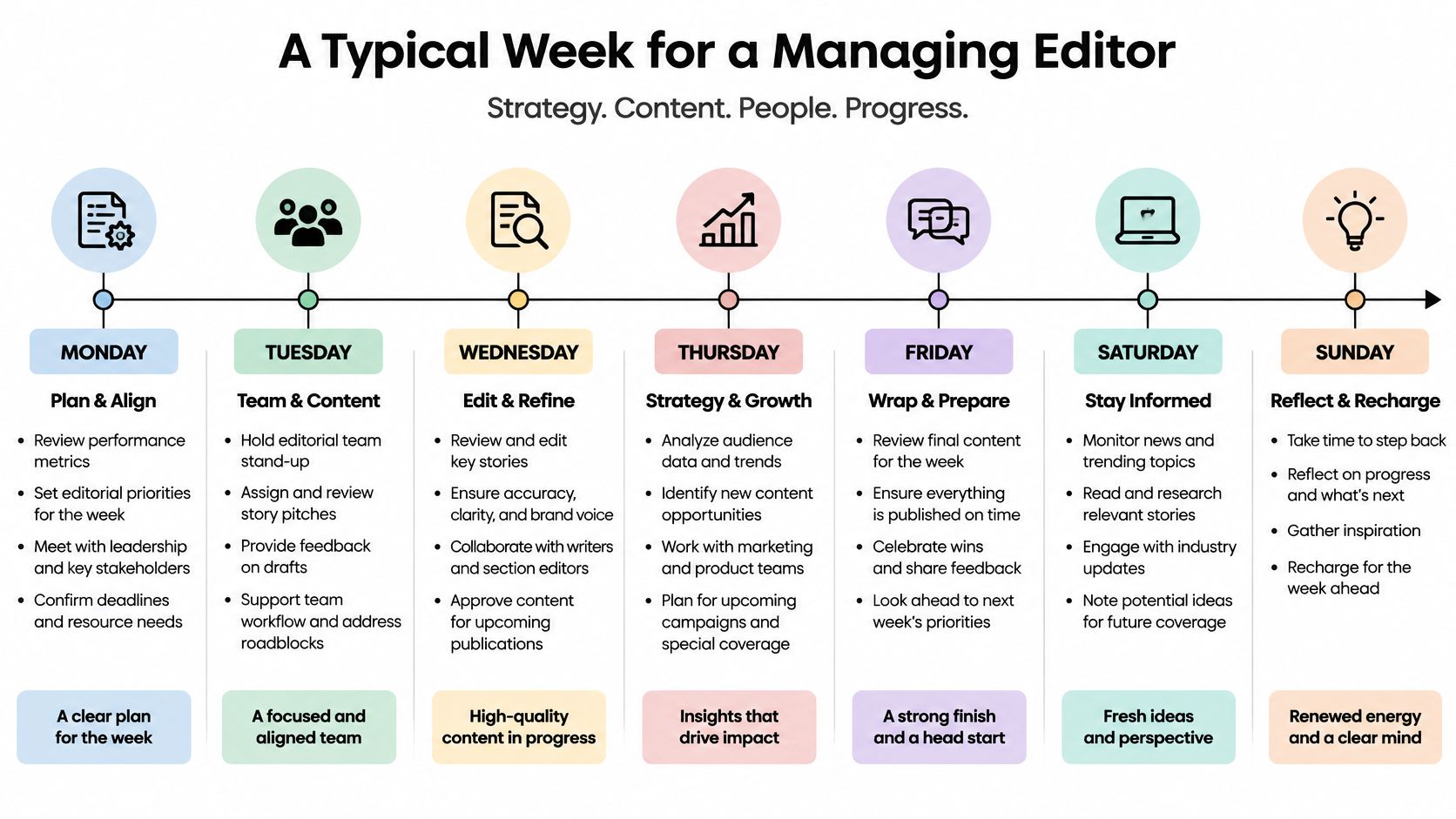
Monday starts with the queue, not with writing. The managing editor reviews everything in flight, confirms this week's publish dates, and reassigns whatever got blocked over the weekend. Twenty minutes here saves a Thursday crisis.
Tuesday is the assignment meeting with the section editors. New ideas get checked against the calendar, and the hard question gets asked out loud: which piece is delayed and which is dropped? A team that never drops anything is really just deferring the decision to Friday afternoon.
Wednesday is protected edit and approval time. Flagged drafts get read in full for accuracy and sourcing, and headlines and metadata get signed off. This is the day the gatekeeper shows up.
Thursday belongs to production coordination. Images, rights clearance, newsletter copy, social cards and the designer's queue all get confirmed against the publish date. Friday runs publish-day checks, reviews open corrections, and closes with a short look at what the week's results suggest for next week's plan.
Where the week actually breaks
The interruption is rarely dramatic. More often a freelancer's draft doesn't arrive on Wednesday, or a breaking story swallows the senior editor for six hours, or a legal question turns a twelve-hundred-word explainer into a three-day negotiation. The managing editor's job in that moment is not to write the missing piece. It's to decide what moves, who's told, and what the reader sees instead.
A daily checklist you can copy:
- Clear the queue first. Anything without a status change since yesterday gets a message, not a mental note.
- Check today's publishes against the calendar. Confirm the owner has confirmed.
- Read one flagged draft in full. Not skimmed. Full read, claims checked against sources.
- Confirm downstream assets. Images, links, tags and channel-specific versions.
- Log the day's decisions. Who moved what, and why.
How Ownership and Approvals Keep Content Moving
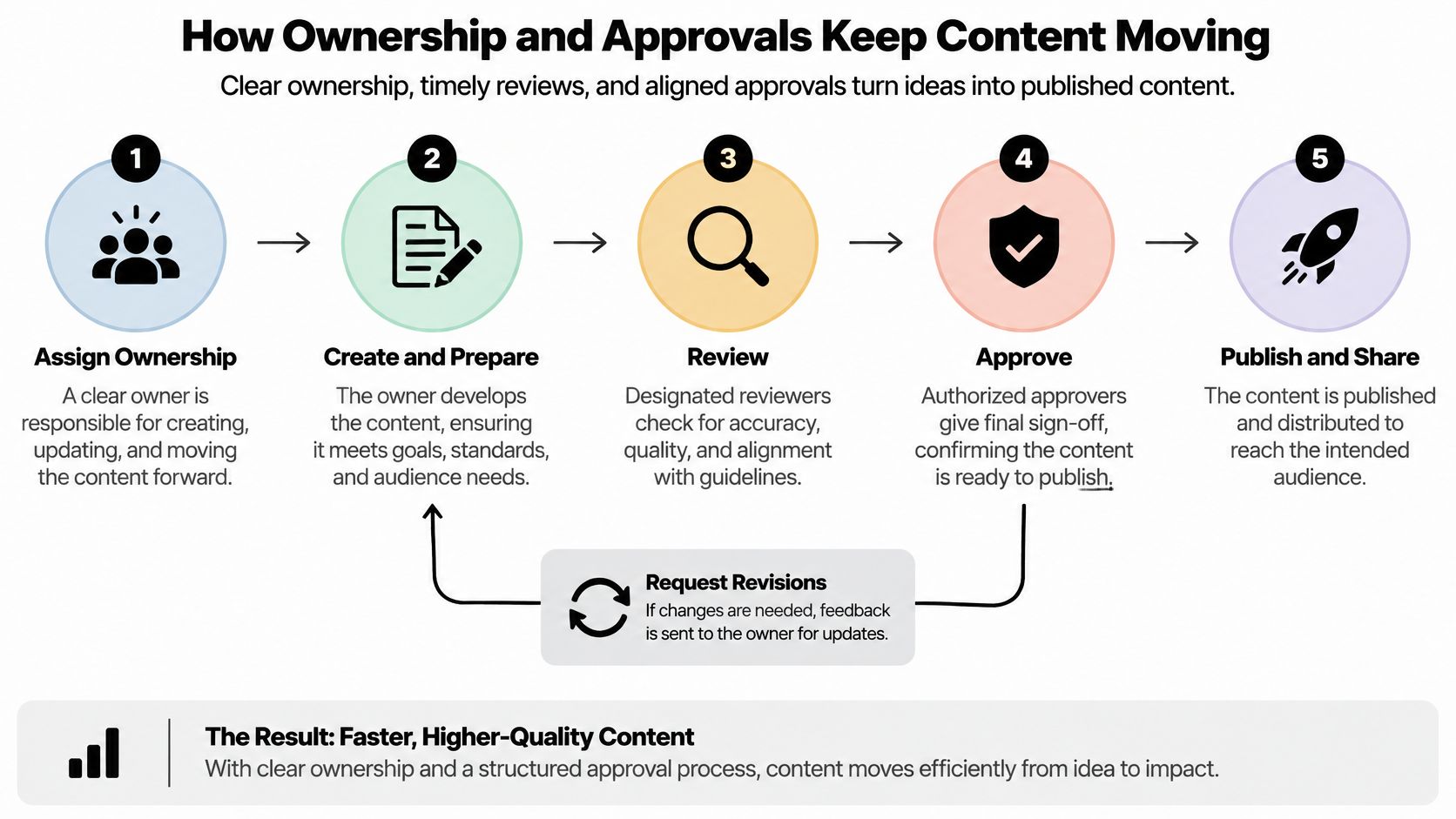
Content moves when every stage has a name on it, a check it must pass, and a trigger that fires when it stalls. Talent helps a draft. It does not replace those conditions. The managing editor owns the system that makes them visible.
Why the calendar is a dependency map, not a list of dates
A publishing calendar looks like a schedule. Operationally it works like a relay. The baton is the draft. A late handoff on Tuesday leaves the fact-check with nothing to check on Wednesday, and the Thursday slot with nothing safe to run. A slipped item is then a system signal, not a personal failure, and it needs a decision.
Publishers have treated managing editorial work this way for years. Penguin Random House's description of editorial roles frames managing editorial as quality control and project management: making sure titles are proofread and copy-edited after the final draft, and coordinating cross-functional delivery to schedule and budget. Digital desks need the same discipline, only faster, and across more channels.
Anyone who touches a piece should be able to see five fields:
- Status: idea, briefed, drafting, in review, approved, scheduled, published.
- Assignee: one named person, never a team or a channel.
- Due date: the date the next stage needs the work, not the date it would be nice to have it.
- Review state: which checks are done and which are still open.
- Channel: where it publishes, because a newsletter version and a site version fail in different ways.
If two of those fields are blank, the piece is not in the workflow. It is in someone's head.
A worked case
A feature is set for Thursday. On Wednesday morning the fact-checker calls in sick, and two claims are still unverified. Slide the publication date by one day, tell the newsletter editor, and hold the piece until the checker can confirm the claims. One day of delay costs less than a public correction on a piece the audience trusted.
| Stage | Owner | Required check | Escalation trigger |
|---|---|---|---|
| Capture idea | Section editor | Angle and source logged | No owner named within 3 days |
| Plan on calendar | Managing editor | Owner and publish date set | Date conflicts with another item |
| Draft | Writer | Draft submitted by due date | Draft missed by one day |
| Edit and copyedit | Section editor and copy chief | Style and clarity review complete | Review still open the day before the publish slot |
| Fact-check | Fact-checker | Claims linked to sources | Checker unavailable or claim unverified |
| Approve | Managing editor | Approval record complete | Any required approval missing |
| Publish | Production lead | Publish-day checks passed | A required asset, rights clearance or approval is missing at the check |
| Review results | Managing editor | Post-publication notes filed | Corrections still open after the next publish day |
The sequence behind most working editorial operations is short: capture ideas in a pipeline, plan them on a calendar by assigning owners and setting publish dates, then publish and review what worked. That is the content approval workflow the managing editor runs. Reliability is the share of pieces that pass each check with the named owner still attached, not the share that merely hit a date.
Resolving Conflicting Priorities and Stalled Work
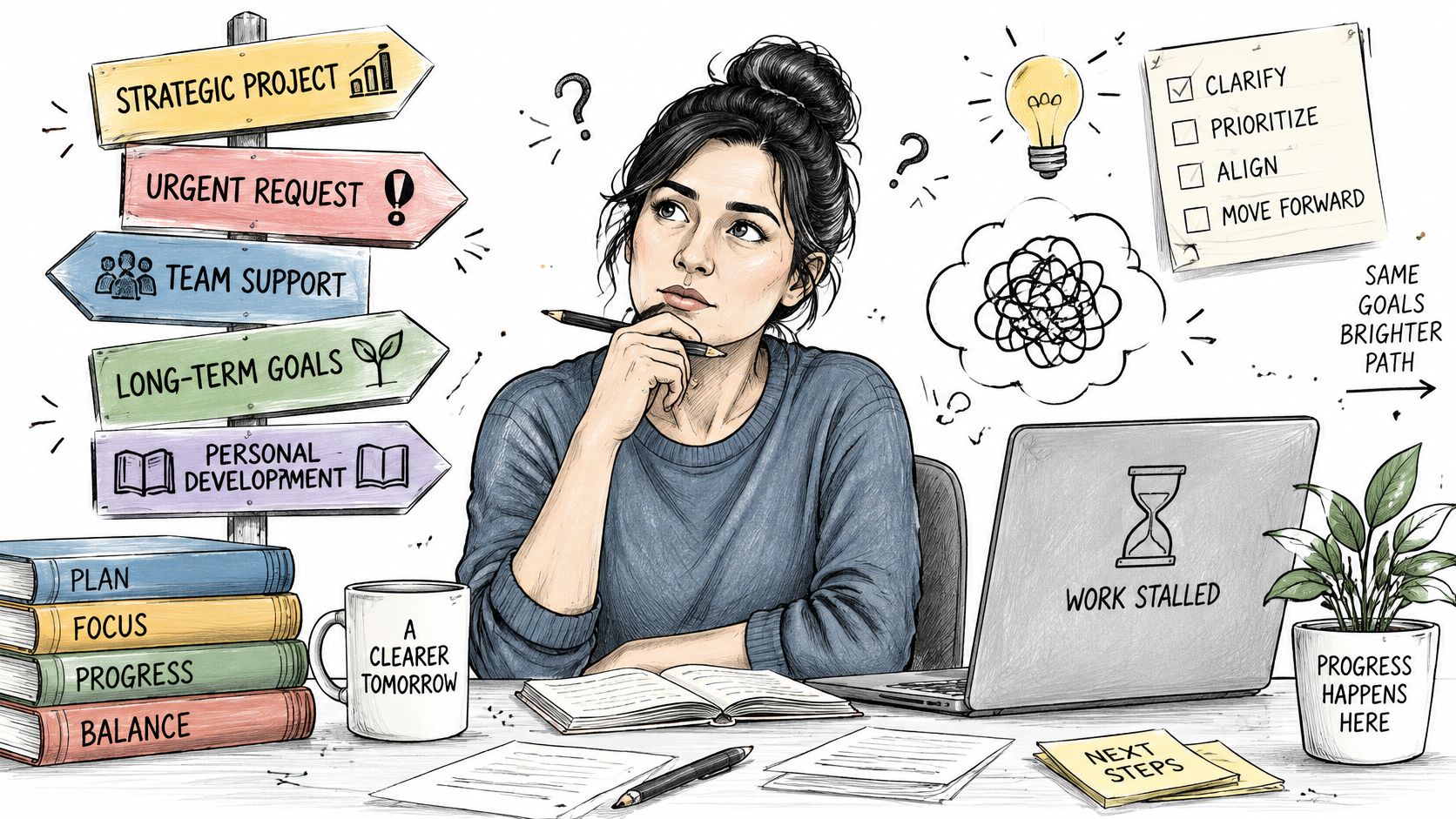
It's Thursday morning. A breaking-news explainer needs the senior editor for two hours, a sponsored piece has a contractual publish date of today, and a long feature is three edits from done. All three want the same editor and the same afternoon slot.
The instinct is to publish everything on time and hope. That instinct is usually wrong, and the cost shows up in quality. Workflow pressure inside newsrooms is measurable: in one survey of broadcast newsrooms, 67% said production problems compromised story quality and 65% reported team strain (Ross Video's newsroom workflow research).
Rank before you reshuffle
Three criteria settle most collisions, and they should be applied in this order.
Audience impact. Which item does the reader need today? A breaking explainer that answers a live question outranks a feature that will read just as well on Monday.
Accuracy and legal risk. Which item carries claims that can't be softened later? Anything touching health, money, litigation or named individuals gets protection, and that protection is time.
Contractual or partner deadlines. A sponsored piece with a fixed date has an obligation attached that a feature doesn't. Honour the obligation, then move the flexible work.
The managing editor often doesn't write the piece that gets rescued. Elsevier's overview of editorial responsibilities describes work built around assessment, oversight of review, informed decisions and communication with authors and reviewers. That's the shape of it: judgement applied to other people's work, at speed, with a record of why the call was made.
Default rule: Speed never removes a verification step. It only changes who approves skipping the nice-to-haves.
That distinction matters. A quality gate can sometimes be shortened, for example compressing a two-editor read into one plus a fact-check, but someone has to own that decision in writing. The managing editor is usually that person, and the approval record is the evidence.
Stalls have a fixed response
Define a stall concretely: no status change within an agreed window, say two working days for a draft, one for a review. Then follow the same three steps every time. Ping the owner with a specific question. Offer help, including taking part of the work off their plate. Reassign if neither resolves it within the window.
The order matters because skipping straight to reassignment punishes people for problems they may not have caused. Here's a short video walkthrough of how these workflow decisions play out in practice.
Escalation rules belong in writing, on one page. Who may move a publish date without asking? What needs the editor-in-chief? What can be killed outright? If the answer lives only in someone's head, every collision becomes a negotiation. For a fuller treatment of the mechanics, see this guide to content workflow management.
Four questions to ask the next time two deadlines collide:
- Which piece loses value if it publishes tomorrow instead of today?
- Which piece carries a claim that can't be corrected after publishing?
- Who outside the team is expecting this, and have they been told?
- What am I willing to drop entirely, and who decides that?
Metrics That Show Whether the Desk Is Reliable
The role carries an accountability that doesn't show up in a job ad: the managing editor is the publication's last line for accuracy, provenance and corrections. The Society of Professional Journalists' code of ethics puts responsibility for accuracy before release, verification of information and sources, use of original sources, ongoing updating and correction, and prompt, prominent acknowledgment of mistakes. That's a release-control job, not a proofreading job.
Which is why output volume is a misleading scoreboard. Publishing more pieces tells you the desk is busy. It doesn't tell you whether the desk is trustworthy. Engagement data can show which topics and formats work, but it can't substitute for verification, fairness or legal review, and it shouldn't feed the next planning cycle until the quality measures are stable.
| KPI | What it measures | How to read a change |
|---|---|---|
| On-time publication rate | Share of items published on their scheduled date | A falling rate points to planning or capacity gaps |
| Average review-cycle duration | Days from draft submission to approval | Rising days signal a review bottleneck |
| Rework rate | Share of items sent back after approval or publication | High rework suggests unclear briefs or weak checks |
| Correction rate | Share of published items that needed a correction | A rising rate means verification is failing |
| Approval completion rate | Share of assets with every required approval recorded | Gaps mean release controls are being skipped |
What the numbers look like when speed gets bought
Suppose a team publishes more pieces this quarter than last, and the correction count goes from two a month to nine. That's not a growth story. That's speed purchased with accuracy, and the invoice arrives as audience trust.
Correction rate is the most honest of the five, because it's the one metric that readers can see. Review-cycle duration is the most actionable, because a rising number usually points to one specific stage, often approval sitting in a single person's inbox. Approval completion rate is the cheapest to fix, since it's a record-keeping habit rather than a capacity problem.
Review all five monthly, in one sitting, with the same people who own the stages. If you want to see how these measures connect to topic and format decisions, this piece on content performance metrics goes further.
Pick two of the five and record a baseline this month. Two numbers you track beat five you admire.
Who Is Accountable When AI Touches the Copy
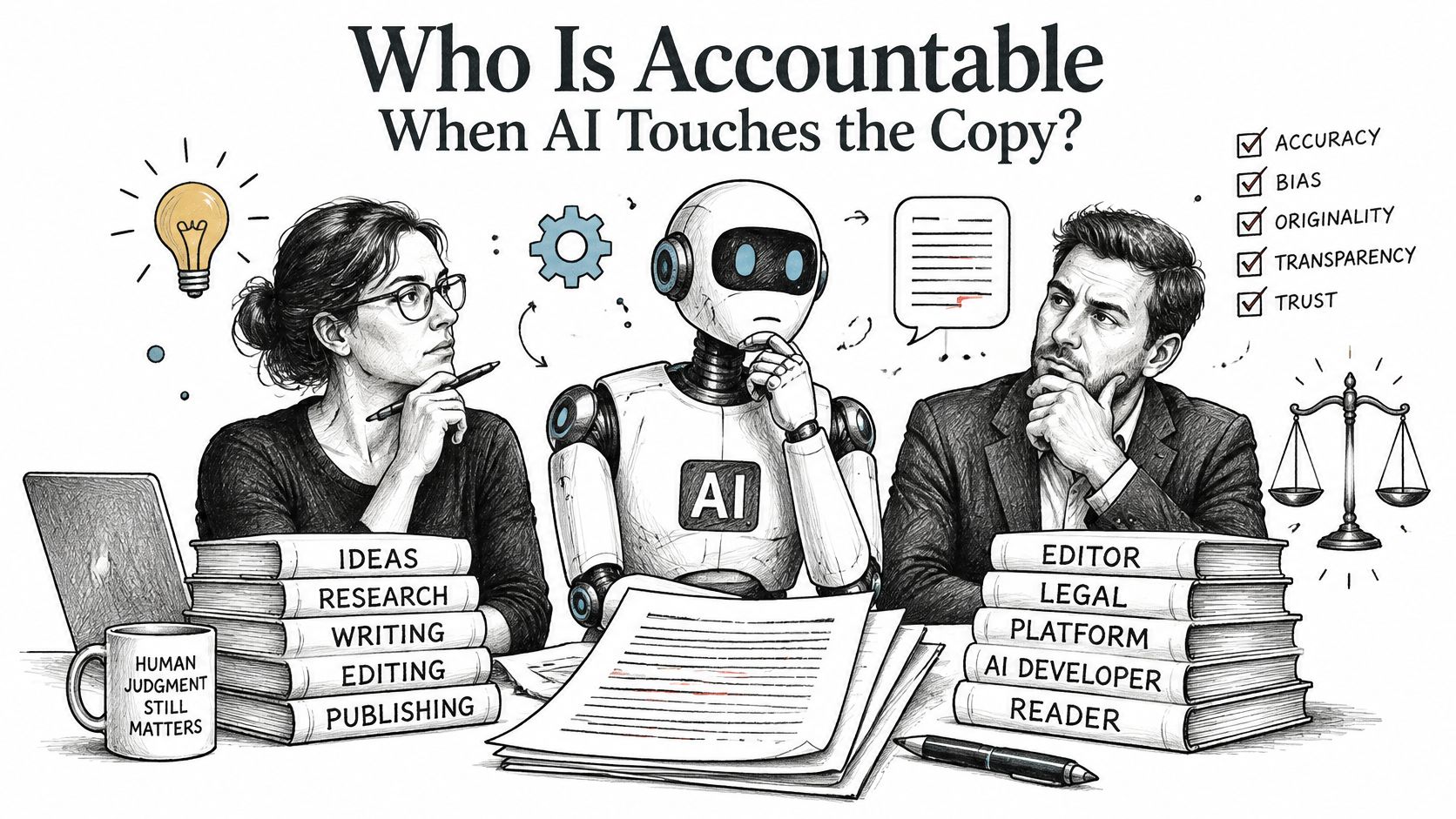
The honest answer is the person whose name is on the byline, and the managing editor who let it publish. That hasn't changed. What has changed is the volume of output passing through review and the number of stages where a machine drafted something a reader will treat as fact.
Adoption is already well ahead of policy. A Thomson Reuters Foundation survey found 81.7% of journalists used AI in their work, including 49.4% daily, while only 13% of surveyed newsrooms had an AI policy. Separate 2025 publisher research reported workflow automation as the leading AI use at 93%, with 97% of publishers planning to increase AI investment (Thomson Reuters Foundation, Journalism in the AI Era).
Split the workflow into low risk and high risk
The useful management move isn't a ban and it isn't a free-for-all. It's a two-column list of every AI task in your workflow.
Low risk, proceed with normal review: tagging and categorisation, transcription, metadata drafts, first-pass outlines, internal summaries for planning meetings.
High risk, requires named human verification: summaries of research or reports, translated copy, generated headlines that carry a factual claim, any number, date, quote or attribution that will appear in public.
For the high-risk column, the reviewer checks the underlying source rather than the AI output. An AI summary of a study goes through review, and the editor opens the study itself, not the summary, before signing off.
The managing editor's duties here are concrete: write a one-page policy on acceptable use, require human verification of every public factual claim, protect confidential source and client material, record which items were AI-assisted, and redesign review stages so the time saved upstream isn't spent downstream on rework.
A byline is a promise that a named person checked the claim. AI can draft the sentence. It can't take the promise.
Start with the one-page policy. Given how few newsrooms have one, writing it puts your team ahead of most of the field, and it takes less time than the first correction it prevents.
Skills a Managing Editor Needs
Six skills do most of the work in this role, and each one is testable in an interview or a trial month.
Triage judgement is the ability to rank three competing items in minutes and defend the order. Test it with a scenario: give a candidate three items, one editor, one afternoon, and ask what moves.
Clear written briefs mean a writer knows the angle, sources, length, deadline and success criteria from one page. Ask for a sample brief and check whether a stranger could draft from it.
People management shows up in direct feedback, freelancer handling, and defusing friction between a writer and an editor without losing the schedule.
Verification standards are the judgement to know which claims need a source, which need a second read, and which need legal review. Give a candidate a flawed draft and time the response.
Planning tool fluency matters more than any single tool: keeping a calendar, status fields and a dashboard the team updates. Look for someone who has opinions about why trackers fail.
Calm escalation is raising a problem early with the facts and a proposed fix, rather than waiting for a missed deadline to force the conversation.
No managing editor on staff? Rotate the triage role among senior editors for one month and record every escalation decision in writing. The written record is what turns a rotation into a process.
Decide Whether Your Team Needs One Now
Five signals tell you the role is missing: deadlines slip in most weeks, nobody owns final approval, corrections are rising, freelancer drafts go untracked, and assignments live in scattered documents. Any two of them means you have the problem this article describes.
There are two honest paths. Hire for the role, building the job description from the six responsibility areas and the skills above. Or assign it internally with written authority, naming what that person may approve, move or kill without asking anyone. The second path works only if the authority is real, because a managing editor who must ask permission for every schedule change is a coordinator, not an owner. If you're scaling a distributed team and need extra editorial capacity rather than a full-time hire, working with remote staffing agencies is one route worth comparing against the cost of a senior internal appointment.
Then run one month of setup:
- Assign a named owner to every stage in the pipeline.
- Choose two reliability KPIs and record a baseline this month.
- Write one page of escalation rules, plus the title and decisions owned by each person.
- Review the results at month end before judging whether the setup works.
Set the first review date this week and put all four steps on the calendar. Structure beats intention, and a dated review is what turns a good plan into a working desk.
TheContentMap is built for exactly the system described here: capturing ideas in a pipeline, planning them on an editorial calendar with owners and publish dates, then publishing and reviewing what worked so the next cycle starts from evidence. The Starter plan is free and includes an editorial calendar, up to 3 projects, 1 editor seat and community support, which is enough to run the month of setup above. Put your first publish date on the calendar at TheContentMap and give the role a system to run.
Related Articles
9 Examples of Branding Strategies to Try in 2026
The publishing schedule is full. Three posts a week, a newsletter, a podcast every other Thursday, a...
SoftwareContent Brief Template: 10 Options That Work in 2026
Why does a writer still need a clarification call after receiving a completed content brief template...
SoftwareContent Calendar Platforms Compared: How to Choose
83% of marketing leaders said they wanted to streamline workflows and reduce the number of technolog...
Comments (0)
No comments yet. Be the first to share your thoughts.