Content Approval Workflow Design Guide
Design a content approval workflow that eliminates review fatigue. Learn to map roles, set stage-level KPIs, and enforce clear sign-off rules.

Your best draft is sitting in limbo again. The writer thinks it's ready, the editor wants one more pass, legal hasn't replied, and someone in leadership has just asked for a “small” change that will take the whole afternoon. That's what a broken content approval workflow feels like in practice, not a neat sequence of steps, but a trail of half-finished feedback, version confusion, and people trying to rescue the calendar in chat.
The mistake often made in these setups is treating approval as a speed problem. It usually isn't. It's a coordination problem, a role problem, and a review-fatigue problem that gets worse every time another person is added to the chain without a clear reason.
Table of Contents
- The Hidden Cost of Review Fatigue
- Defining Roles and Sign-Off Authority
- Mapping Stages and Measuring Cycle Time
- Choosing the Right Routing and Automation Tools
- Enforcing Rules and Handling Last-Minute Changes
- Executing a High-Stakes Editorial Launch
The Hidden Cost of Review Fatigue
A stalled article rarely stalls because nobody cares. It stalls because too many people care in slightly different ways, and nobody has clean authority to decide what happens next. In a 2026 content-operations benchmark, 74% of content required multiple stakeholder approvals, the average approval chain involved 4.2 people, and assets went through 2.9 approval rounds before publication, with an average cycle of 3.7 days (content approval workflow benchmark).
That's not a lightweight review step. It's a coordination system with built-in drag.
More reviewers can mean less clarity
The hidden cost shows up when a team confuses visibility with decision-making. A subject matter expert flags accuracy issues, a brand lead changes tone, a manager asks for a new headline, and a senior stakeholder adds a preference late in the process. None of those comments are automatically wrong, but they don't all belong in the same approval lane.
Practical rule: if a person can't block publication, they shouldn't be able to behave like a blocker.
Review fatigue starts here. People stop giving crisp feedback because they expect their comments to be reopened, debated, or overwritten by someone higher up. Writers then spend more time reconciling opinions than improving the draft. The result is familiar, a slow, cautious document that has been touched by everyone and sharpened by no one.
A 2025 Adobe survey in Australia found that 46% of marketers said they spend more than 40% of their time on administrative tasks, reviews, and approvals, and many reported content passing through 3 to 6 approval rounds with more than 20 approvers involved (Adobe survey on marketing coordination overhead). That is the cost profile many teams are living with, not just slow publishing, but a workday consumed by chasing, clarifying, and re-chasing the same decision.

Separate sign-off from commentary
The fix starts with a hard distinction. Informational review gives context and expertise. Sign-off authority grants or denies publication. If those two functions live in the same bucket, every comment can delay launch.
A clean audit usually exposes the same patterns. Someone is invited because they “should see it,” not because they can approve it. Another person is copied “just in case.” A manager gets added because the last launch had one. None of those additions make the workflow safer by default. They usually make it noisier.
When a team trims the process, it's not removing control. It's removing duplicate control. That protects the creator's attention and the reviewer's sanity, which matters if you want people to engage with the draft instead of skimming it while juggling three other approvals.
Defining Roles and Sign-Off Authority
A workflow gets stable when roles stop blurring together. The creator writes to the brief, the editor improves structure and clarity, the subject matter expert checks accuracy, and the final approver owns the yes or no. If those jobs are mixed together, the workflow turns into a debate club with deadlines.
The cleanest model is simple: one person writes, one person edits, one person approves. Specialist reviewers can still contribute, but they need a different kind of authority from the person who gives the final green light. That rule matters most when legal, compliance, or executive review enters the chain, because those reviews should be isolated from taste-based feedback.
A useful starting point is a lightweight RACI matrix, even if you never call it that in the room. List the content type, then identify who is responsible for drafting, who is accountable for approval, who should be consulted, and who only needs to be informed. The distinction sounds administrative, but it removes the most common source of delay, people acting like approvers when they're really advisers.
Final authority should be boringly clear. If two people can veto the same piece for different reasons, the workflow needs redesign, not more reminders.
The internal structure matters more than the tool. A polished platform won't fix a chain where the legal team gets asked to weigh in before the draft has stabilized, or where an executive can reopen wording after final approval because “they just had a thought.” That kind of bypass destroys trust in the process and makes every future deadline feel negotiable.
For a more complete view of how roles fit into broader editorial systems, the field notes in what content operations covers are worth comparing against your current setup.
A role map that actually works
Use these labels as a baseline, then sharpen them for your team:
- Creator: drafts to brief, gathers source material, and resolves assigned edits.
- Editor: checks structure, clarity, tone, and completeness, then consolidates feedback.
- Subject matter expert: verifies facts, technical claims, and regulated wording.
- Final approver: owns publication approval and can say yes or no.
- Publisher: schedules or releases the approved version without reopening content.
The rule that protects the whole chain is this. Only the final approver can block publication at the final stage. Everyone else can recommend changes, but they can't convert preferences into vetoes after their review window closes.
Mapping Stages and Measuring Cycle Time
Many teams measure the wrong thing. They track draft-to-publish time and miss the precise handoff where work slows down. A better content approval workflow measures stage-level cycle time, because that is where the signal lies, and it is the only way to determine whether the delay sits in review, stakeholder feedback, or final clearance.
The practical breakdown is straightforward. Track submission-to-first-review, reviewer handoff, stakeholder feedback incorporation, final quality check, and publication clearance separately. Measure each stage in business hours, not raw calendar time, so you can distinguish genuine delay from someone being offline overnight or over a weekend.
Where the clock should start and stop
The first metric to watch is the time from submission to first review. If that drifts, the issue is usually queue discipline, not content quality. If first review is fast but handoff to the next stakeholder is slow, ownership is unclear or the reviewer isn't sure who needs to act next.
Use the same logic for revision loops. If feedback incorporation keeps slipping, the problem may be vague comments, too many approvers, or comments arriving after the draft has already been marked close to final. In that case, the workflow isn't moving slowly because the writer is behind. It's moving slowly because the handoff rules are loose.
A practical baseline is to capture at least 2 weeks, ideally 4, of normal traffic before setting targets, then aim for first-pass review within 24 business hours, stakeholder feedback incorporation within 48 hours, and final checks within 24 hours (stage-level measurement approach). Those targets are useful because they force the team to inspect each step instead of blaming the whole pipeline.
Keep the dashboard stage-specific
A useful dashboard doesn't just show overdue items. It shows which stage each item is stuck in, how long it's been there, and whether it's approaching a publish date. That lets an editor intervene early, before a quiet delay becomes a missed slot.
A small but important habit is to track completion rate and revision-loop count alongside timing. A fast review that sends the draft back three times is not a healthy workflow. The goal is not to make every stage look quick, it's to make the path predictable enough that publishing doesn't depend on memory, Slack pings, or goodwill.
For a practical example of how teams keep stage timing visible in social and campaign environments, the Scheduler.social approval workflow guide is a useful reference point, especially if your process spans multiple channels.
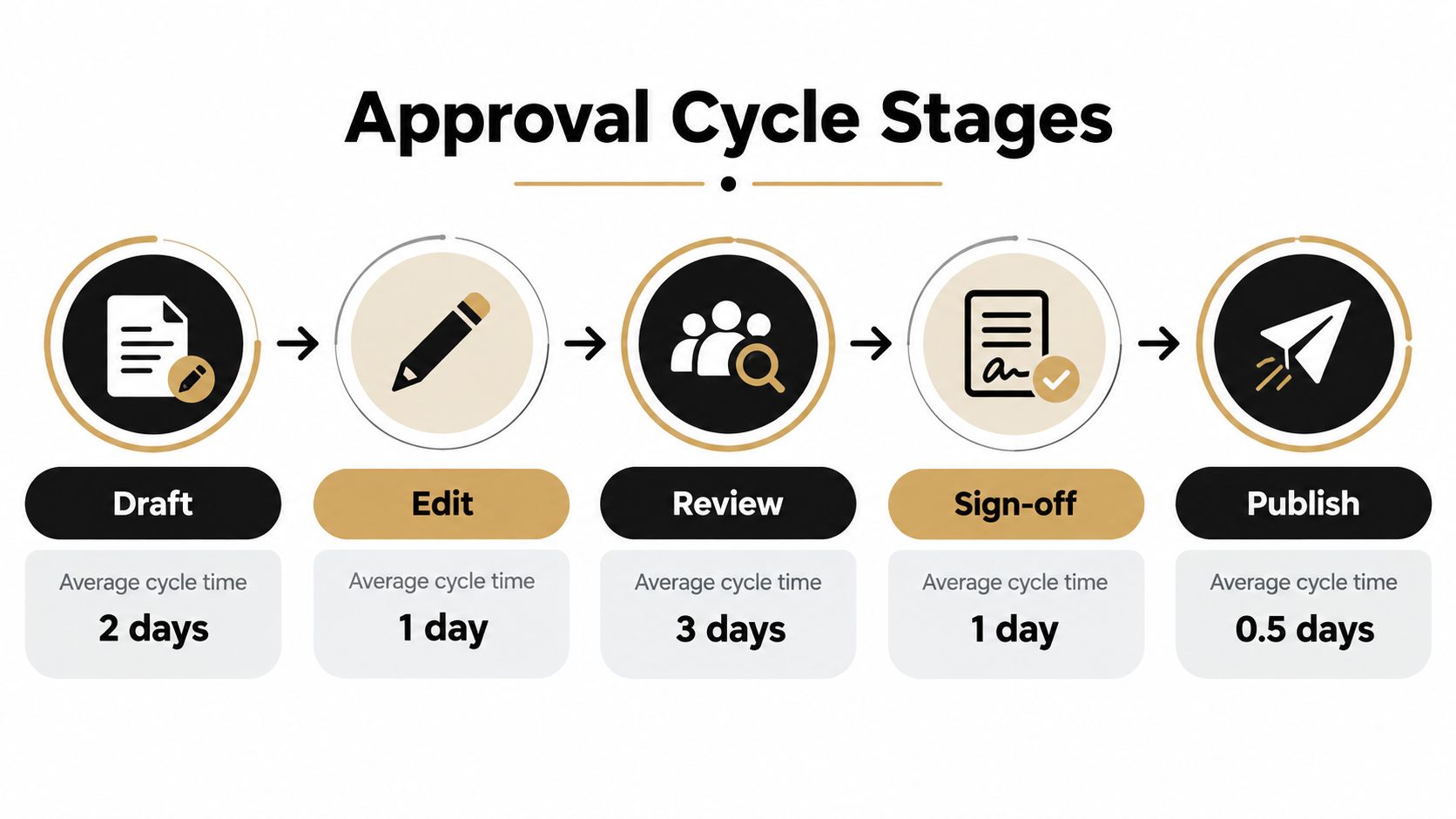
A shared measurement model also prevents one of the oldest editorial arguments, whether the writer is slow or the approval chain is slow. Once you can see the stage data, that argument gets shorter, and the fix gets clearer. For broader operational context, the guidance in content workflow management pairs well with a stage-based dashboard.
Choosing the Right Routing and Automation Tools
Routing breaks down fast when approvals stay tied to inbox habits. A draft gets edited in one place, feedback arrives in another, and the person managing the process spends time stitching together the latest version, the right reviewer, and the final decision.
That overhead is what automation should remove. The goal is not just faster handoffs, it is less coordination work and less review fatigue, especially when informational comments are getting treated like sign-offs. For teams that want a framework for choosing and configuring software, see our overview of editorial workflow management software.
Agentic approval workflows also show why routing matters. In a 2026 workflow comparison, agentic workflows completed in 1.8 days on average, while manual routing took 4.7 days, a 2.6× speed advantage, and for teams shipping 50 long-form pieces per month, the performance gap could translate to about 130 calendar days gained per year (workflow comparison). The point is not that automation fixes governance on its own. It is that a lot of delay comes from moving drafts to the right person, in the right order, without chasing them by hand.
Manual routing vs centralized platforms
| Feature | Manual Routing (Email/Docs) | Centralized Platform (e.g., TheContentMap) |
|---|---|---|
| Ownership visibility | Easy to lose track | Clear assignment and status |
| Review history | Scattered across threads | Stored in one workflow |
| Reminder discipline | Depends on people | Built into the system |
| Approval clarity | Often ambiguous | Decision points are explicit |
| Scalability | Breaks as volume rises | Better fit for multi-project teams |
Manual routing can still work for a small team with a narrow queue. Once the workflow has to survive someone being out, or several content types moving at once, the cracks show. Nobody can tell what is waiting on feedback, what has already been approved, or which comments are informational rather than binding.
A centralized platform helps because it keeps the routing logic in one place. That matters more than speed alone. It reduces the chance that the process depends on memory, private messages, or one overextended editor keeping the whole calendar alive.
You can see the same pattern in step-by-step SEO reporting automation. Repeated work becomes more dependable once ownership, sequence, and status all live in one system. Approval routing works the same way. The deliverable changes, but the coordination problem does not.
What the upgrade point looks like
Move beyond spreadsheets and shared docs when the team keeps asking which version is final, reminders have to be sent manually, or one person is acting as the human router for every draft. Those are process limits, not tool preferences.
A dedicated editorial platform is the right fit when you need a single source of truth, reliable reminders, and clean handoffs across writers, editors, and stakeholders. If the team is still small and the queue is simple, manual routing may be enough. Once review fatigue starts creating rework, a system that separates true sign-offs from informational review can carry the load without daily rescue work.
Enforcing Rules and Handling Last-Minute Changes
A workflow only holds if people can't route around it. The fastest way to break schedule integrity is a direct message to the writer asking for a “quick tweak” after the final review window has already closed. One off-process request doesn't look like much, but it teaches the team that the rules are optional.
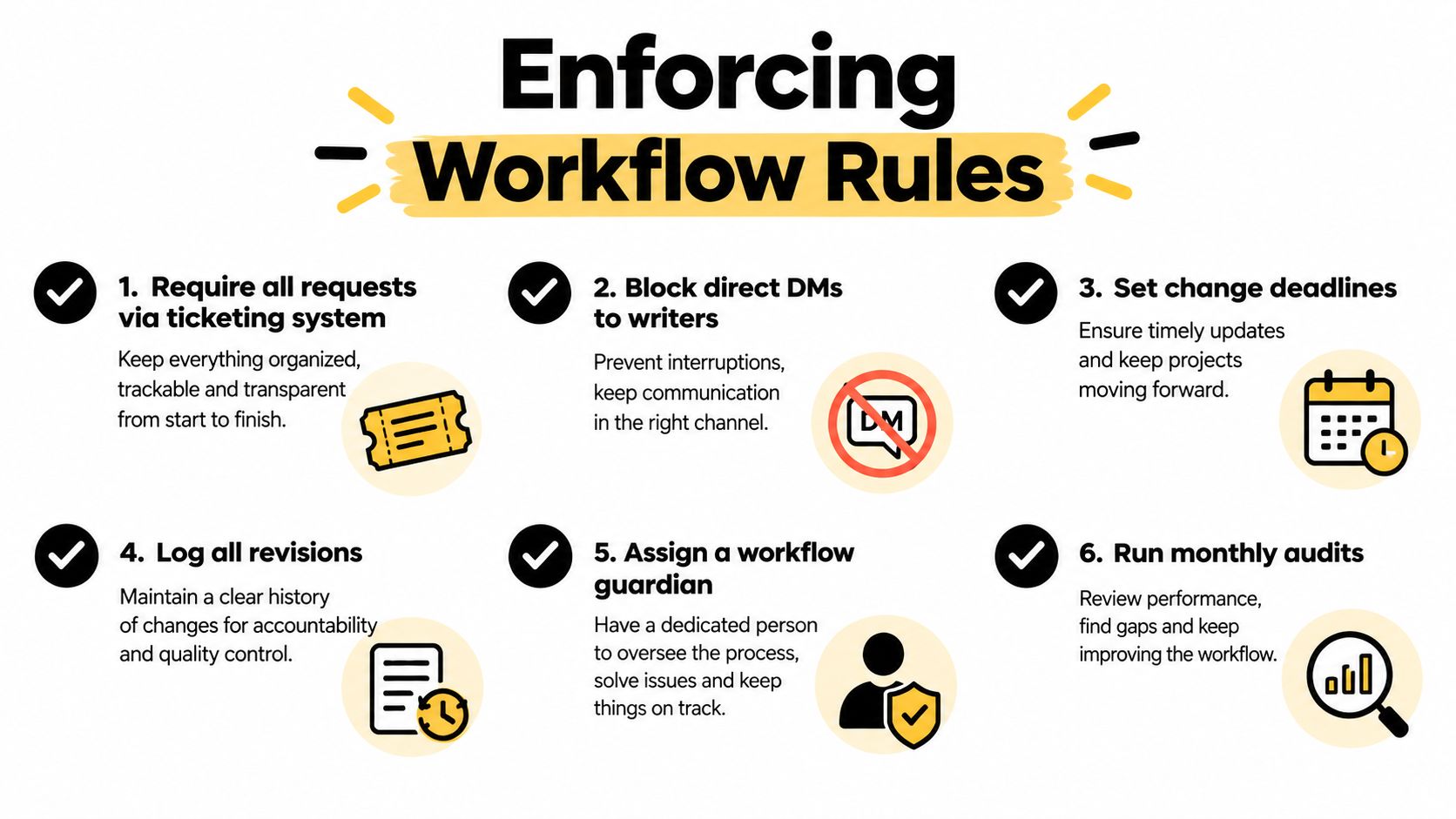
The fix is to make the process harder to bypass than to follow. All requests should come through the approved channel, feedback should have a deadline, and revisions should be logged in the workflow, not scattered across private messages. If someone wants a change after sign-off, it needs to re-enter the process as a formal exception.
Set hard stops, not vague expectations
Deadlines for feedback should be explicit. A reviewer who doesn't respond by the cutoff doesn't get an automatic extension, they trigger the next rule in the chain, whether that's escalation, backup approval, or moving the piece forward if the stage is informational only. Open-ended review windows are where schedules go to die.
If an approver goes silent, the answer isn't endless follow-up. It's a documented backup path. The backup can be a deputy, a designated delegate, or a pre-agreed default for low-risk content. What matters is that the writer and editor don't have to improvise the decision in real time.
Protect the approved version
Last-minute edits after final clearance are especially dangerous because they create version drift. The approved file and the published file need to be the same artifact, or the workflow has failed at the final step. Status locks, publish reminders, and a clear publish handoff prevent that gap from widening.
A strong enforcement model usually includes a workflow guardian, someone who watches the rules instead of just the deadlines. That person doesn't need to be the loudest person in the room. They need enough authority to say, “That feedback came in too late, and it goes into the next cycle.”
A monthly audit is also worth the time. Look for bypasses, late feedback, and revisions that slipped in after approval. Those patterns tell you where the team is still treating the workflow as advice instead of policy.
Executing a High-Stakes Editorial Launch
A major launch exposes every weakness in the approval chain. The draft starts in the idea pipeline, the editor tightens the narrative, the subject matter expert checks accuracy, legal reviews the risky sections, and the final approver greenlights the release. If any of those handoffs is vague, the whole campaign starts slipping while everyone assumes someone else is carrying the baton.
The launch that goes well usually looks calm from the outside because the hard choices were made before the deadline pressure hit. Ownership was set early, each reviewer knew what kind of feedback belonged to them, and the change window closed before the final version was locked. That's what good process buys you, not just speed, but fewer emergencies.
A launch that holds together
The story usually begins with a messy brief and a tight calendar. The team has one flagship article, supporting social copy, and a landing page that all need to go live together. The editor routes the draft through the defined stages, the specialist reviewers keep their comments inside the right lane, and the final approver only sees a resolved version.
Once the content is approved, the publisher schedules the release without reopening the copy. That may sound simple, but it's the step that protects the whole launch. If post-approval changes are still flowing in, the team isn't running a workflow, it's running a series of late negotiations.
A launch succeeds when the calendar is protected from surprise, not when everyone feels heard right up to the minute of publication.
Feedback after publication should feed planning
The strongest teams don't treat approval as the end of the story. They use post-publication results and editorial notes to adjust the next brief, the next role assignment, and the next review path. That feedback loop turns the workflow into a learning system instead of a gatekeeping system.
That's also where a planning platform earns its keep. TheContentMap helps editorial teams centralize idea capture, scheduling, workflow, and performance insights, so content moves more reliably from concept to published across projects and channels. If your team is still fighting with scattered approvals and missed handoffs, visit TheContentMap and see how a structured editorial calendar, clear ownership, and publish reminders can keep the next launch on track.
Related Articles
Content Operations Platform: What It Is and How to Choose
The managing editor starts the morning by checking a spreadsheet for today's deadlines, a chat t...
Software10 Content Tracking Tools for Editorial Teams in 2026
Content rarely stalls while someone is writing. It stalls between an idea in a shared document and a...
SoftwareOperational Plan Template: A Step-by-Step Guide
You're already feeling the drag if the plan lives in a spreadsheet, three people think they own...
Comments (0)
No comments yet. Be the first to share your thoughts.