Project Management Checklist for Editorial Teams: 10 Steps
Use this project management checklist to plan, assign, review, and publish content on time. Ten prioritized checkpoints from goals to post-publish analysis.
The feature is due Friday. The writer never saw the approved angle, the legal reviewer is out, and the editorial calendar still shows the piece as on track. You discover the problem when someone asks whether the social assets are ready.
Nobody deliberately skipped the work. The writer drafted from an old conversation, the editor assumed legal had accepted the deadline, and the person updating the calendar treated a publish date as evidence of progress.
That's why editorial projects can slip before the first draft. Slow writing gets the blame, but missing checkpoints are often the problem: nobody confirms the brief, reviewer availability, or conditions for publication before committing the team.
A useful project management checklist makes those decisions visible. Each checkpoint acts as a gate, with a named owner, a place in the editorial cycle, and evidence that work can move forward.
A deadline tells people when you want the work. A gate tells them whether the work is ready.
The gates below follow content from planning through publication and analysis. Some remain active throughout production, especially backlog management, stakeholder coordination, and risk review. Passing a gate means recording a decision, not just ticking a box. If something changes, reopen the affected gate rather than letting the calendar imply that everything is fine.
Table of Contents
- 1. Define Content Goals and Success Metrics Before Planning
- 2. Build a Schedule with Milestones on a Visual Editorial Calendar
- 3. Assign Clear Ownership Using a RACI Matrix
- 4. Document a Content Brief and Definition of Done
- 5. Map the Editorial Workflow Stages with a Visual Pipeline
- 6. Set Deadline Buffers and Automated Publish Reminders
- 7. Maintain a Centralized Idea Backlog with Clear Prioritization
- 8. Create a Stakeholder Register and Review Cadence
- 9. Build a Content Risk Register
- 10. Track Content Performance and Run Retrospectives to Improve Future Planning
- How each editorial checkpoint compares by stage, output, and review rhythm
- Start With Three Checkpoints This Week
1. Define Content Goals and Success Metrics Before Planning
Before reserving a publishing slot, the commissioning editor must approve the audience, intended outcome, and measurement method. This gate prevents a familiar failure: publishing something polished that nobody can connect to a business or reader need.
PMI's project success report found that projects defining success criteria upfront recorded a Net Promoter-like Project Success Score of 41, compared with 20 among projects without upfront criteria. That's a reason to settle the purpose before discussing production.
Write an outcome, not a topic
A topic such as customer onboarding describes subject matter. A useful objective explains what the content should help a specific reader do and what evidence would indicate success.
For example, a software team might commission an onboarding guide to encourage qualified readers to subscribe to its implementation newsletter. The editor records the signup event, analytics location, target, and review date before approving the assignment.
- Primary outcome: Choose the result that should guide editorial trade-offs.
- Measurement: Record the metric, reporting location, and person responsible for checking it.
- Decision date: Specify when the team will evaluate results.
Keep secondary ambitions subordinate. An article expected to generate leads, rank in search, retain subscribers, and announce a product has no clear priority when those demands conflict. Use TheContentMap's topics and tags to connect the assignment to its campaign, with the approved objective in the project description.
2. Build a Schedule with Milestones on a Visual Editorial Calendar
A publish date without preceding milestones is a reservation, not a schedule. Before the managing editor commits that date, the calendar must show the work needed to reach it and the people available to do it.
Make the sequence visible before assigning work.
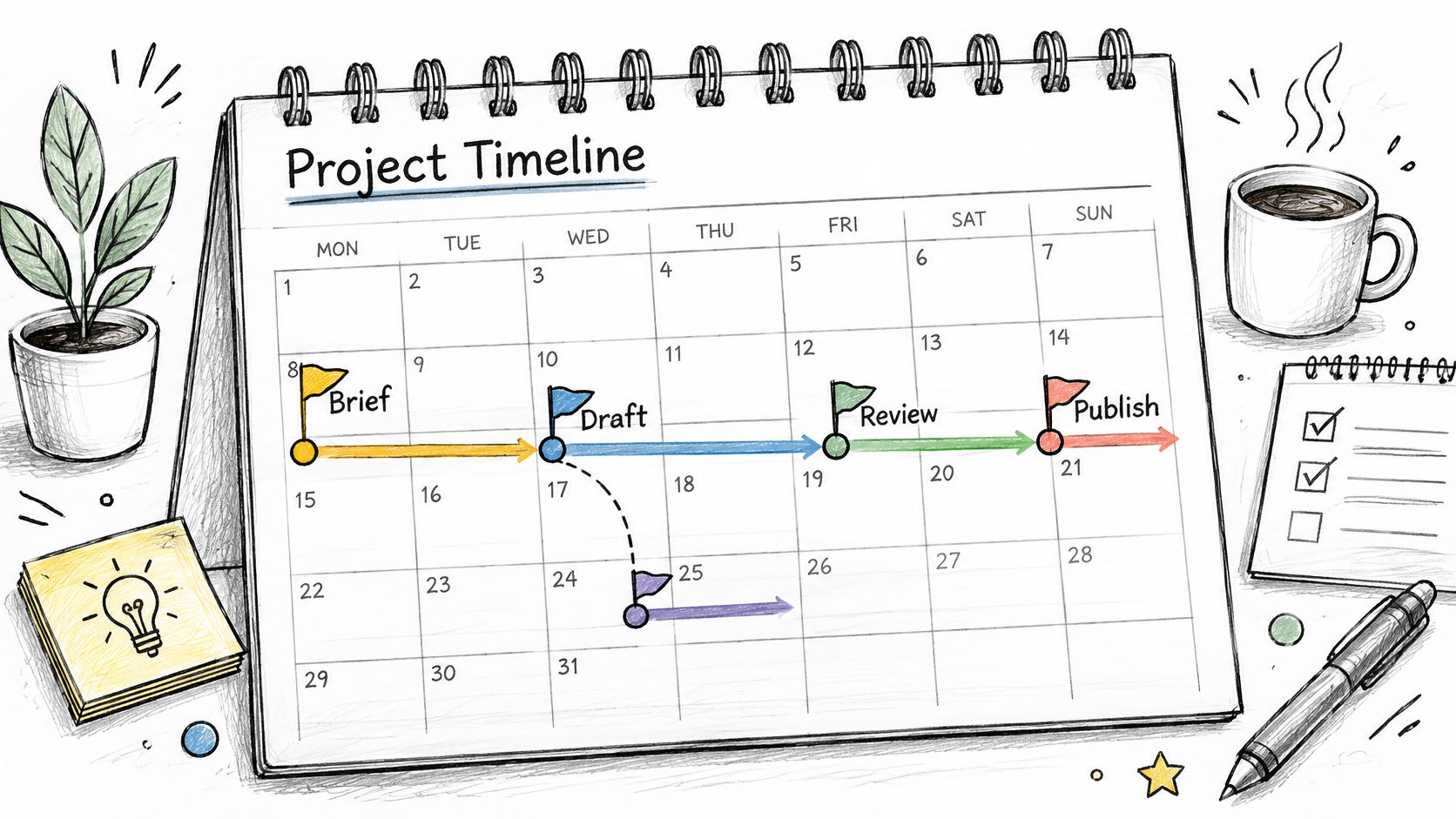
Work backward through publication, production checks, approval, editing, drafting, and briefing. Include dependencies such as interviews, illustrations, and landing-page production. A calendar shows dates; a dependency-based timeline also shows which tasks can't start until another task finishes.
For a report launch, scheduling the article before the underlying analysis is approved creates a false commitment. The managing editor should hold the publishing slot provisionally until the analysis owner confirms delivery.
Pass the capacity check
Check reviewer workload alongside writer availability. Moving a draft deadline doesn't help if the same editor already has a launch package waiting.
Keep the working schedule in one place and update it during the conversation that changes the plan. TheContentMap's drag-and-drop calendar supports that adjustment; this guide to building an editorial calendar that actually gets used explains how to establish the shared working view.
Use the accompanying walkthrough when reviewing the scheduling process with contributors.
3. Assign Clear Ownership Using a RACI Matrix
The writer has finished, the editor thinks marketing owns approval, and marketing assumes the editor has signed off. Clear ownership prevents this particular kind of standstill.
Before assignment, the managing editor should approve a compact RACI matrix. It distinguishes the person doing the work from the person authorized to accept it.
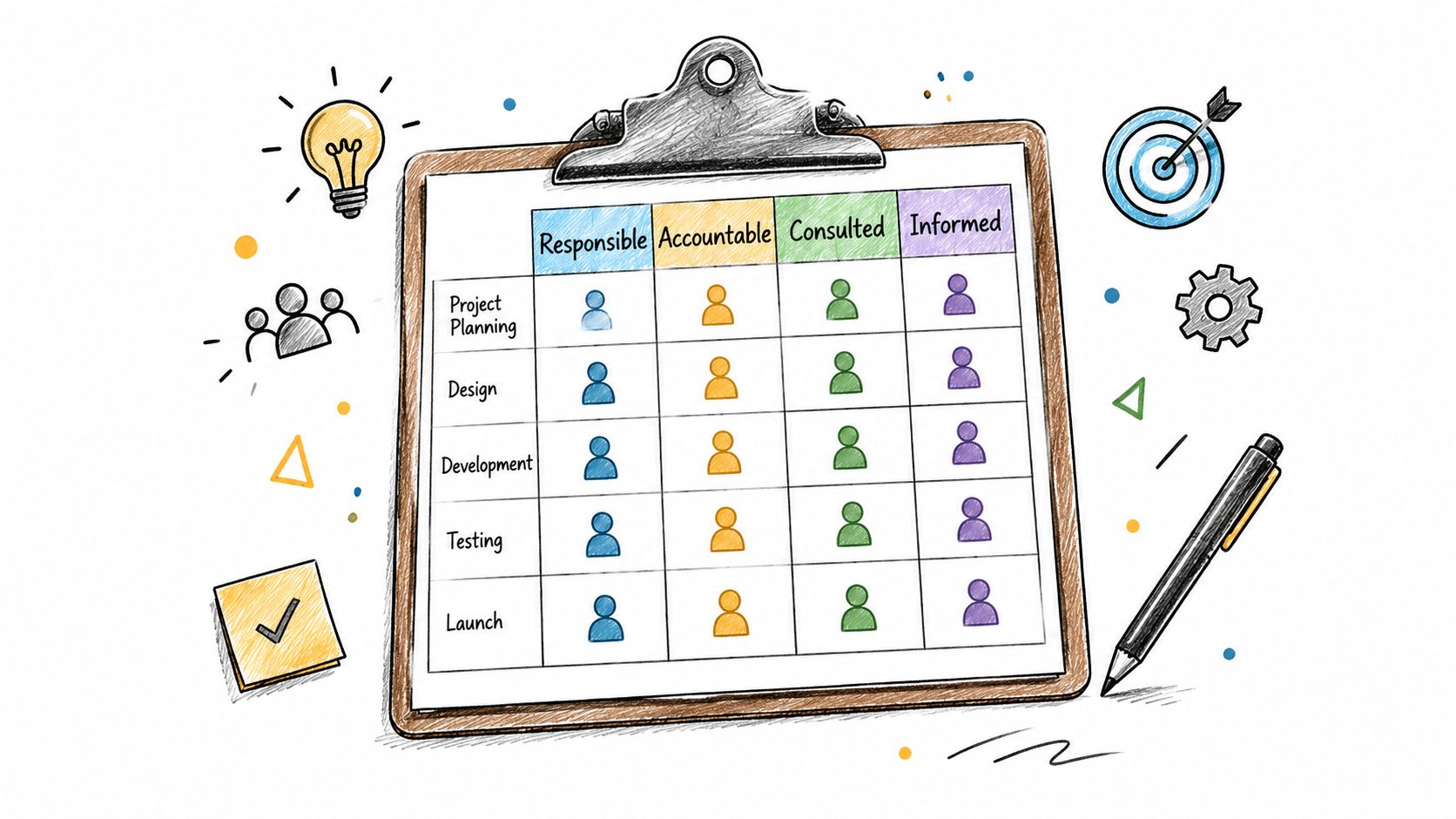
- Responsible: Produces the deliverable or completes the task.
- Accountable: Owns the outcome and accepts the completed work.
- Consulted: Supplies expertise before the decision.
- Informed: Receives the decision without becoming another approval dependency.
For a customer feature, the freelancer might write, the commissioning editor accept the draft, and the customer contact verify attributed statements. The production editor then owns the CMS build.
Assign authority as well as work
Give each deliverable a single accountable person. Multiple people can contribute, but someone must resolve conflicting feedback and authorize the handoff.
Don't automatically classify legal as merely consulted. If publication requires legal clearance, record that approval as a separate deliverable with its own accountable reviewer.
Use TheContentMap's assignment feature to make the operational owner visible on the content item. Keep the role matrix attached for context, and name a substitute where absence could stop publication. This gate passes when contributors understand both their work and their decision rights.
4. Document a Content Brief and Definition of Done
A draft can meet the word count and still miss the assignment. The brief prevents that mismatch before writing; the Definition of Done prevents an incomplete asset from being treated as publishable.
The commissioning editor controls this gate. Drafting starts only after the writer can access the approved brief and has raised any questions about scope, sources, or deliverables.
Separate direction from acceptance
The brief should establish the reader, angle, takeaway, format, evidence requirements, distribution context, and deadline. The Definition of Done should state what reviewers must verify before accepting the finished piece.
PMI's quality-management guidance distinguishes defining standards and process criteria from checking whether deliverables meet them. Editorial teams need both activities, not a vague instruction to produce quality content.
For a comparison article, the brief might specify which buying decision the reader faces and which alternatives belong in scope. Completion requires verified product claims, approved imagery, working links, completed metadata, and recorded editorial approval.
Acceptance rule: If another editor can't verify completion from the record, the requirement is too vague.
Keep the brief short enough to use during drafting. Attach it to the calendar item, and use a content brief template designed for better first drafts rather than scattering instructions across messages.
If a stakeholder changes the angle after drafting begins, record the scope change and revisit the schedule. Don't disguise a new assignment as routine editing.
5. Map the Editorial Workflow Stages with a Visual Pipeline
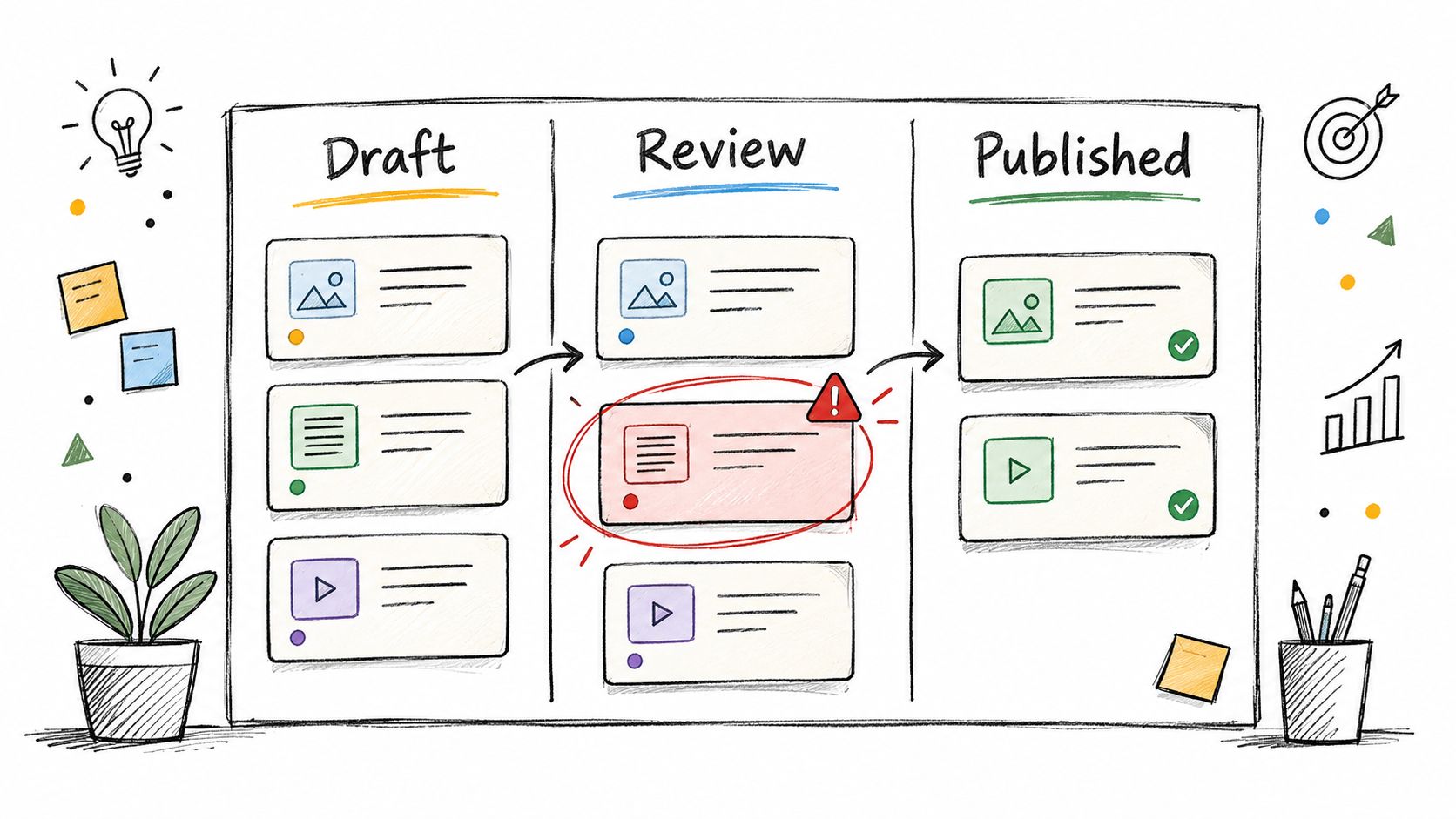
A card marked Review can mean awaiting an editor, receiving legal feedback, or sitting untouched. Those conditions need different responses.
The managing editor owns the workflow design before production begins. Each subsequent handoff passes only when the receiving owner has the required material and knows the next action.
Make stages describe actual conditions
Use recognizable states such as Assigned, Drafting, Editing, Approval, Scheduled, and Published. Define entry requirements for each: Editing requires a complete draft, while Scheduled requires recorded approvals and a checked production build.
Mark blocked work explicitly, with a reason and an owner. Don't move it into an invented status that conceals who needs to act.
For a paid social campaign, the copy, creative, and destination page are related but distinct deliverables. Teams using editable pages for paid social campaigns should include page approval and destination testing in the workflow, rather than assuming the campaign is ready when the ad copy passes.
TheContentMap's idea pipeline gives editors a shared view of work moving through draft, review, and publication. Keep supporting detail on the record rather than adding a stage for every minor action.
Limit active review work to what editors can finish. Starting more drafts may look productive, but it won't clear an overloaded approval queue.
6. Set Deadline Buffers and Automated Publish Reminders
Reminders can notify an unavailable reviewer. They can't create review capacity.
The production editor should validate the critical path before confirming the schedule, then recheck it whenever a dependency slips. This gate prevents small delays from reaching publication unnoticed.
Protect the dependency, not just the date
Identify tasks that directly determine the earliest possible publication: an interview, source verification, legal clearance, or a required illustration. Ask their owners about working time and waiting time, then reserve buffer where uncertainty actually exists.
For a sensitive feature, legal review may depend on a complete, fact-checked draft. Scheduling those activities concurrently only works if the reviewer agrees to assess provisional material and revisit changes.
- Preventive control: Confirm reviewer availability and a backup before committing the date.
- Reminder: Notify the owner while there's still time to complete the action.
- Escalation: Name who decides what changes when the remaining buffer is exhausted.
Use TheContentMap's publish reminders to surface approaching deadlines, but pair each notification with an owner and an expected action. A reminder to everyone often becomes a task for nobody.
For scheduled distribution, balancing automated posting with manual control requires a clear release decision. The production editor should confirm that late edits haven't invalidated approval before content goes live.
Keep buffers visible. Hidden padding invites colleagues to treat contingency time as spare capacity.
7. Maintain a Centralized Idea Backlog with Clear Prioritization
An urgent request in chat shouldn't outrank a stronger idea just because its sponsor is persistent. The backlog gives the commissioning editor a controlled entry point for future work.
This gate sits upstream of assignment and remains active during production. New ideas enter the backlog, not the committed calendar, unless an editor explicitly authorizes a change.
Require enough information to decide
Capture the proposed audience, reader problem, supporting evidence, campaign connection, suggested owner, and any genuine timing constraint. The contributor doesn't need a finished brief, but the editor needs more than a headline.
For example, sales might request an article answering a recurring procurement objection. The editor checks whether existing coverage already answers it, whether customers need a new explanation, and whether an update would be more useful than another article.
- Accept: The idea supports an agreed objective and deserves briefing.
- Defer: The idea has merit but lacks evidence, capacity, or a relevant publishing window.
- Reject or merge: The proposal duplicates coverage or doesn't serve the intended audience.
Organize ideas with TheContentMap's topics and tags so campaign gaps and overlapping proposals are visible. Keep the decision reason attached to the record.
The trade-off is deliberate: central capture creates a triage obligation. If nobody reviews submissions, the backlog becomes another place to lose ideas. Assign the commissioning editor a regular review cadence and use post-publication findings to reorder it.
8. Create a Stakeholder Register and Review Cadence
Late objections often come from someone who should have been involved earlier, not from someone who needed another status meeting.
Before drafting, the managing editor should confirm whose input matters, what they're reviewing, and whether they have approval authority. Reconfirm participation before sending the piece into formal review.
Give reviewers a bounded question
A stakeholder register should record role, review scope, availability, communication channel, and escalation contact. Separate factual verification from editorial preference and mandatory clearance.
For a product announcement, the product manager checks capabilities, legal checks claims, and the editor owns clarity and structure. Sending everyone an unrestricted request for thoughts invites conflicting rewrites.
Ask reviewers to respond against the approved brief. Consolidate feedback before returning it to the writer, and resolve disagreements rather than forwarding contradictory comments.
A missed review deadline is an escalation trigger, not evidence of approval.
Keep feedback attached to the relevant content item through TheContentMap's comments. Summarize decisions in the record so a writer doesn't have to reconstruct approval from a conversation.
For routine work, an asynchronous approval digest may be enough. A sensitive campaign may need a live decision meeting, but that meeting should resolve identified questions, not replace preparation.
This gate passes when required reviewers have accepted their scope and deadline, and the editor knows who can resolve a stalled decision.
9. Build a Content Risk Register
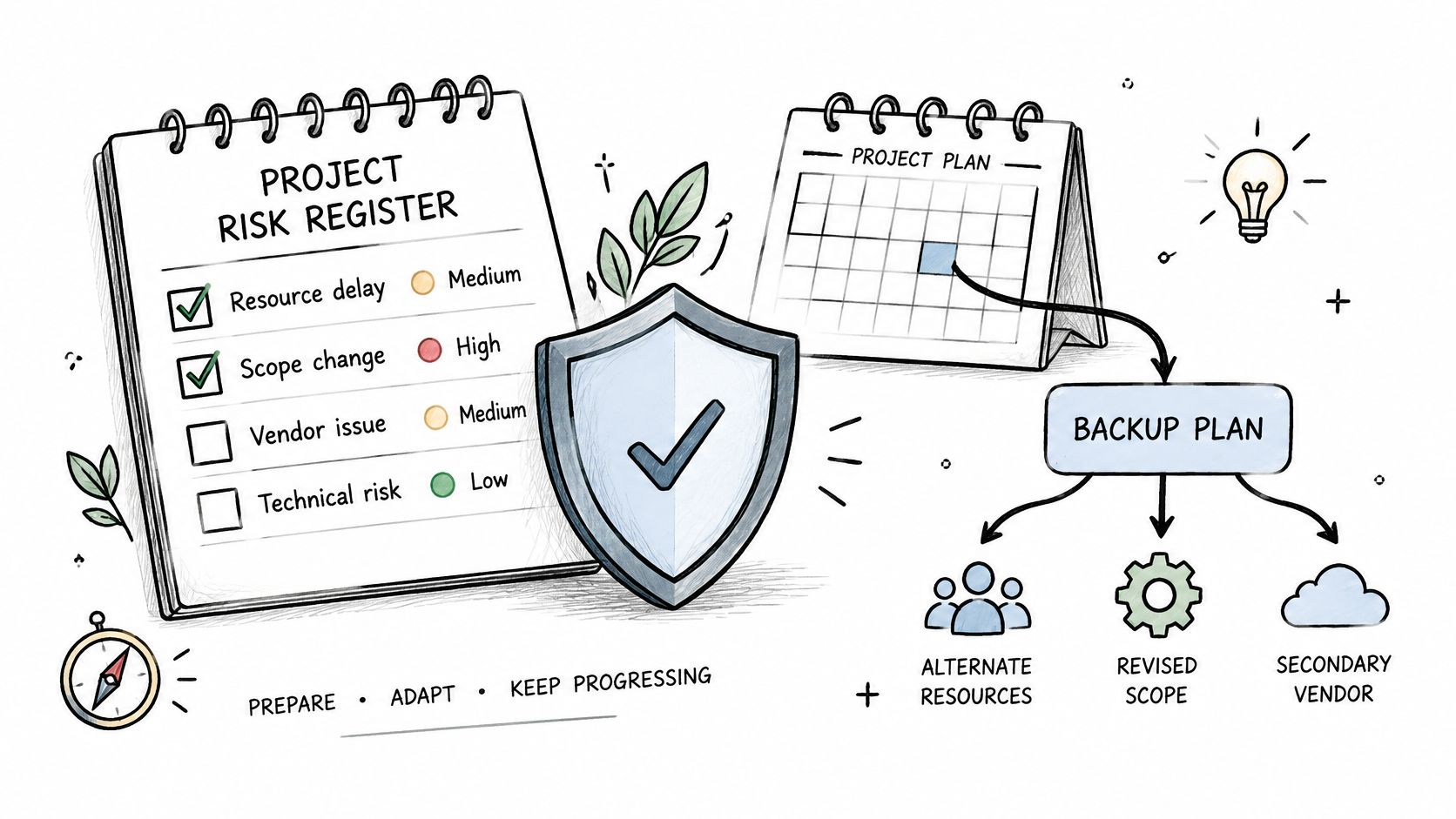
A risk register is useful only if it changes what someone does. Recording that an expert might become unavailable doesn't protect the schedule unless an editor prepares an alternative.
The managing editor owns this gate during planning and revisits it before approval and scheduling. Each material risk needs an owner, a warning sign, a preventive action, and a recovery decision.
Specify when the plan must change
In the State of Project Management survey summarized by Xergy, 41% of respondents cited scope creep or unrealistic deadlines as the most common reason for project failure. A useful editorial register therefore needs change controls, not just a list of things that could go wrong.
For an interview-led feature, the trigger might be the source withdrawing before draft acceptance. The response could be substituting an approved expert, narrowing the angle, or replacing the publishing slot with a ready evergreen piece.
- Change authority: Name who can approve a revised date, scope, or production cost.
- Impact check: Identify affected assets, channels, and dependencies.
- Decision record: Capture the change, rationale, and people notified.
For AI-assisted work, add source verification, sensitive-data handling, human approval, and correction ownership. An automated output isn't cleared merely because someone generated it.
Don't preserve an obsolete deadline by removing necessary checks without notice. Reapprove the plan openly.
10. Track Content Performance and Run Retrospectives to Improve Future Planning
Publication completes delivery, not evaluation. The editor who approved the objective should remain accountable until someone compares the result with that objective and records the next decision.
Set the review date during planning. Search-led content needs a different observation window from an event announcement, so avoid applying the same reporting schedule to every format.
Review the result and the process separately
Use Google Analytics and Search Console where relevant, alongside newsletter, conversion, or channel reporting. Choose content performance metrics that answer the original question rather than assembling every available chart.
Say a guide attracts qualified visitors but produces few newsletter signups. Before rejecting the topic, check the signup placement, relevance of the offer, and tracking configuration. A distribution or conversion problem doesn't automatically justify changing the editorial angle.
Then review production.
- Delivery: Which milestones slipped, and what blocked the responsible owner?
- Quality: Which defects reached publication despite the required checks?
- Improvement: What will change, who owns that change, and when will it be tested?
Use TheContentMap's content insights and topic organization to connect published work with future assignments. Record whether the team should expand, update, redistribute, or retire the content.
Keep retrospective actions concrete. Requiring reviewer confirmation before scheduling is actionable; asking everyone to communicate better isn't. Close the project when the performance decision and process improvements are assigned, then feed those decisions into the backlog.
How each editorial checkpoint compares by stage, output, and review rhythm
| Item | Editorial Stage | Main Artifact | Review Rhythm |
|---|---|---|---|
| Define Content Goals and Success Metrics Before Planning | Goal setting | Goal statements and success metrics | At defined checkpoints; review quarterly where relevant |
| Build a Schedule with Milestones on a Visual Editorial Calendar | Planning and scheduling | Visual editorial calendar with milestones | Ongoing; update when dates or dependencies change |
| Assign Clear Ownership Using a RACI Matrix | Assignment and approvals | RACI responsibility matrix | Quarterly and when team roles change |
| Document a Content Brief and Definition of Done | Pre-drafting | Content brief and completion checklist | For each content piece |
| Map the Editorial Workflow Stages with a Visual Pipeline | Workflow management | Kanban-style editorial pipeline | Ongoing; keep statuses current |
| Set Deadline Buffers and Automated Publish Reminders | Production and scheduling | Buffered schedule with reminders | Weekly during busy launch periods |
| Maintain a Centralized Idea Backlog with Clear Prioritization | Ideation and prioritization | Prioritized idea backlog | Weekly triage; archive stale ideas periodically |
| Create a Stakeholder Register and Review Cadence | Stakeholder coordination and approvals | Stakeholder register and communication plan | Monthly stakeholder review |
| Build a Content Risk Register | Planning and risk management | Content risk register and contingency plans | At each planning meeting |
| Track Content Performance and Run Retrospectives to Improve Future Planning | Post-publication analysis and improvement | Performance dashboard and retrospective actions | Search-led content at 30, 60, and 90 days; event announcements after the campaign closes |
Each row is a gate in the editorial cycle, with an artifact that shows whether the work can move forward. The goal statement prevents assignments without a defined purpose. The calendar and RACI matrix expose schedule conflicts and unclear decision ownership before drafting begins. The brief and completion checklist set the conditions a draft must meet before it enters review.
During production, the pipeline makes stalled work visible, while buffers and reminders reduce the risk of a missed publish date. The backlog keeps new ideas in one place for prioritization, rather than allowing unplanned requests to displace scheduled work. Stakeholder and risk reviews belong in planning and approval cycles, where teams can resolve conflicting feedback or prepare for known dependencies before they block publication.
After publication, the performance dashboard and retrospective actions close the loop. Review timing depends on the format: search-led content needs observation at 30, 60, and 90 days, while an event announcement can be assessed after its campaign closes. Set the rhythm to fit the content, so early results do not drive premature changes and short-lived campaigns are not left waiting for irrelevant review dates.
Start With Three Checkpoints This Week
Don't introduce the entire project management checklist as a new administrative requirement. Start with goals, ownership, and a single visual pipeline. Those controls reveal whether the team knows why a piece exists, who can move it forward, and what condition it's in.
Choose a live project rather than designing an elaborate workspace for hypothetical work. Put its objective in the record, assign the accountable editor, and show its current production stage. Ask the writer and next reviewer to confirm that the record matches their understanding.
Make the first gates enforceable
A workable gate needs an owner, evidence of completion, and a response when it fails. If the objective is unclear, hold the assignment. If approval ownership is missing, resolve it before asking the writer to begin.
Use those decisions consistently, including when a senior stakeholder requests urgent work. Exceptions may be necessary, but record who authorized them and what risk the team accepted.
Rollout advice: Add a control when you can name the failure it prevents and the person who will maintain it.
Once the team uses the basic workflow reliably, add deadline buffers and reminders. Introduce stakeholder registers and more detailed risk controls where approvals, claims, or dependencies justify the extra work. Set a performance-review date from the outset, then expand the reporting routine as publishing volume grows.
Remove friction without removing accountability
Keep routine controls inside the content record. Requiring contributors to update a calendar, spreadsheet, message thread, and separate checklist creates conflicting versions of the same project.
Review the process as well as compliance. A gate that repeatedly blocks work may expose missing capacity, but it may also require information too early or duplicate another approval. Fix the design instead of teaching contributors to bypass it.
The test isn't whether every field is filled. It's whether another editor can identify the next action, its owner, the evidence needed for acceptance, and the decision required if work stalls. Post-publication findings should then change what gets commissioned and how it moves through production.
Pick the next project in your calendar and run it through the checklist before its first draft is assigned.
TheContentMap brings idea capture, drag-and-drop scheduling, assignments, comments, publish reminders, and content insights into an editorial planning workspace. Visit TheContentMap to put these gates alongside the content they control, from the initial idea through publication and performance review.
Related Articles
Content Performance Metrics: What to Track, How, and Why
You've got a folder of published articles, a traffic report that doesn't look bad, and a mee...
SoftwareBest Editorial Calendar: Top 10 Tools for 2026
You opened the sheet this morning and the dates don't match the thread in Slack. A writer still...
SoftwareContent Creation Workflow for Editorial Teams
The calendar says the article publishes tomorrow. The draft is sitting in separate comment threads,...
Comments (0)
No comments yet. Be the first to share your thoughts.