Task and Assignment: How Clear Ownership Moves Content
Task and assignment are not the same job. Get a clear comparison table, real editorial examples, and a simple way to give every piece of content an owner.
A task is the piece of work that needs doing, while an assignment is that same work placed with a named owner, a deadline, and the context to complete it. In editorial work, the difference is whether someone is responsible for the next move.
A promising topic in a meeting isn't yet a commission. A document shared with the team isn't a commitment to review it. Before you put a publication date on the calendar, you need to know who has accepted the work and what they're expected to deliver.
Table of Contents
- Why Editors Confuse Tasks With Assignments
- Task and Assignment at a Glance
- What a Task Really Is
- What an Assignment Adds to the Work
- How Ownership Moves Content Through a Workflow
- Assign Work Without Overloading Owners
- Make Ownership Stick Before Your Next Publish
Why Editors Confuse Tasks With Assignments
In a 2023 study of a large United Kingdom retailer with online operations, workers were, on average, 4.6 times more productive on tasks in the bottom decile of difficulty than on those in the top decile, while workers in the highest decile of permanent productivity were only 1.9 times as productive as those in the lowest decile doing comparable work.
That isn't an editorial productivity benchmark. It's a useful warning against judging people without examining the work they receive.
Say an editor posts a request in the newsroom chat asking whether someone can take the pricing page. Dana assumes the product writer will handle it. The product writer thinks Dana has volunteered, and the editor sees no objection.
A request isn't acceptance
The editor has identified work, but hasn't secured an owner. Nobody has agreed on scope, checked availability, or established whether the page needs a light refresh or a complete rewrite.
That ambiguity makes the eventual delay difficult to diagnose. Was the writer slow, was the work unexpectedly complex, or did nobody accept it?
A useful task and assignment distinction makes those questions answerable. Define the deliverable, place it with someone who can complete it, and make the next handoff visible. The comparison below gives you a practical way to inspect any item in your queue.
Tasks fail without owners, and assignments fail without context.
Task and Assignment at a Glance
A task defines the work; an assignment places that work with a named person, a deadline, and the information needed to complete it.
| Aspect | Task | Assignment |
|---|---|---|
| Core question | What needs to be done? | Who does it, and what do they need to succeed? |
| Unit of work | A specific piece of work with a defined output | That work placed in one person's hands with context |
| Owner | May be unassigned, shared, or vague | One named, accountable person |
| Deadline | Can exist on paper with nobody attached | Tied to the assignee's capacity and calendar |
| Status | Tracks progress, such as to do, in progress, in review, or done | Makes responsibility, reminders, and handoffs visible |
| Output | A draft, edit, approval, or publication action | A completed deliverable plus a clean handoff |
| Editorial example | Write the pricing-page draft | Dana drafts the pricing page by Friday, with the brief and keyword attached |
| Fails when | The action is vague or completion is undefined | There's no named owner, due date, or usable context |
A quick ownership test
Describe the work without naming anyone. If the description still makes sense, you're describing a task: write the pricing-page draft.
Now add Dana, Friday's deadline, the brief, and a completion condition. You have an assignment: Dana delivers the pricing-page draft by Friday, covering the approved package descriptions and flagging any prices that need confirmation.
Notice that adding a name alone isn't enough. Dana still needs to know whether she's drafting new copy, updating existing copy, or checking the page for accuracy.
The deadline also needs a clear meaning. Does Friday mean ready for the editor, approved by product, or live on the website? Those are different commitments, and each may require a different person.
Ownership doesn't mean working alone
Dana can ask a product specialist to verify package details and a designer to check layout constraints. She remains responsible for assembling the draft and identifying anything that prevents her from delivering it.
That's the distinction between contributors and the accountable owner. Contributors provide inputs; the owner makes sure the agreed deliverable reaches the next stage or raises a blocker before the commitment fails.
A task is the what. An assignment names the who and establishes how the work will be judged.
What a Task Really Is
A useful task contains an action, a defined output, and a definition of done. The action tells someone what to do, the output identifies what they should produce, and the completion condition tells them when to stop.
Consider an instruction to review the introduction. Should the editor correct grammar, challenge the argument, check the sources, or rewrite the opening?
A more usable task is to review the introduction against the approved brief and leave inline comments on missing reader questions. The output is a commented draft, not an unspecified improvement.
Break a publication goal into observable work
Say your team is preparing an industry report. Publishing the report is the overall goal, but the work needs smaller checkpoints:
- Research: Gather relevant sources and record where each claim comes from.
- Outline: Arrange the argument and identify missing evidence.
- Draft: Write the report against the approved outline.
- Chart design: Build graphics from the checked source material.
- Search metadata: Prepare the title and description.
- Legal sign-off: Submit relevant claims and record the decision.
- Scheduling: Prepare the approved version for publication.
- Distribution: Create and release the supporting channel copy.
Each task can carry a status such as to do, in progress, in review, or done. Keep those labels observable: in review should mean the work has reached a reviewer, not merely that the writer hopes someone will look at it.
As Microsoft's history of project management explains, Gantt charts made tasks, sequence, duration, and milestones visible, a planning logic that editorial calendars apply to content production.
Think of the task list as a recipe. It describes the steps and their order, but nothing gets cooked until someone takes a station.
A beautifully written task can still sit untouched. Precision describes the work; ownership creates the commitment to perform it.
What an Assignment Adds to the Work
An assignment is the ownership layer around a task. In a relay race, the task is the baton; the assignment identifies the runner, the leg, and the conditions for passing it on.
A topic label such as blog post on onboarding doesn't provide that layer. It leaves the writer to guess the reader, angle, channel, deadline, and approval route.
A usable assignment could read: Maya drafts the onboarding guide for the product blog by Thursday. Jane reviews it. The draft is ready for review when it addresses every required point, includes supporting sources, and has a proposed meta title.
The information an owner needs
Keep these details together on the assignment:
- Deliverable: The actual output, such as a draft, source check, or approval decision.
- Current status: Where the work stands, including whether it's blocked.
- Priority: Its importance relative to the owner's other commitments.
- Deadline: When this deliverable must reach the next person.
- Channel or campaign: Where the content belongs and whom it serves.
- Reviewer: The person who decides whether it meets the standard.
- Completion condition: The observable evidence that this stage is finished.
Use a content brief template to preserve the reader, purpose, scope, and required evidence. The assignment should point to that brief rather than asking the writer to reconstruct it from messages.
Keep decisions with the deliverable
If Jane changes the audience from new customers to experienced administrators, record that decision on the task. Otherwise, Maya may follow an outdated direction while another stakeholder reviews against the new one.
For distributed teams, treat reminders as external memory: include enough task context for the recipient to act. Don't assume the notification itself will improve performance, however; a replication of deadline research found negligible effects from changing deadline structures across several performance measures.
The assignment, rather than the chat thread, should remain the source of truth. Put the approved direction, unresolved questions, and review decisions beside the work.
Apply a single-owner rule at the task level. Several people can contribute, but name the person responsible for delivering the current output and escalating obstacles.
This doesn't make that person responsible for every delay. If Maya is waiting for product confirmation, her job is to expose the dependency, not invent an answer. Clear ownership lets the editor distinguish blocked work from neglected work and arrange the right intervention.
How Ownership Moves Content Through a Workflow
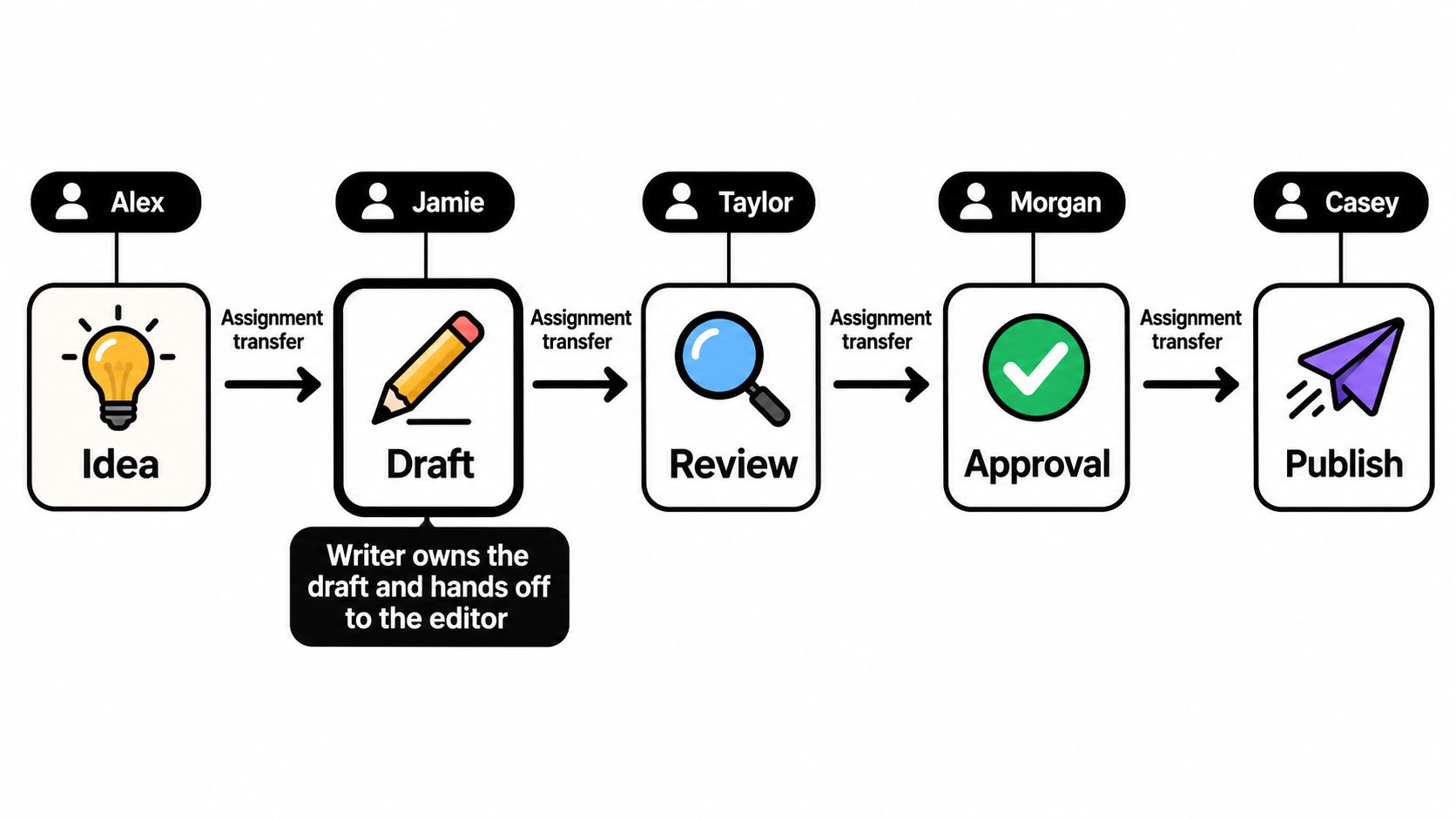
Follow a customer-onboarding guide from proposal to publication. The subject stays the same, but the work and its accountable owner change at each stage.
Use this flow to identify where responsibility passes between teammates.
Make each transfer explicit
| Workflow stage | Task | Assigned to | Done when |
|---|---|---|---|
| Idea | Pitch the topic with target reader and keyword | Writer | A paragraph-length pitch is approved by the editor |
| Draft | Write the full draft from the brief | Writer | Draft is uploaded with every brief point covered |
| Review | Edit for structure, voice, accuracy, and links | Editor | All comments are resolved or escalated |
| Approval | Check claims, sources, and compliance | Reviewer | A sign-off comment is left on the task |
| Publish | Add metadata, schedule the date, and distribute | Editor | Live URL is confirmed and calendar updated |
In practice, replace each role label with a person's name. Maya owns the draft; when Jane accepts it for review, Jane owns the editing task. The designated approver then owns the approval decision, and the publishing editor owns the release.
The writer shouldn't remain the apparent owner while the article waits for legal approval. Keep the writer's completed assignment in the record and create or activate the approver's assignment.
A managing editor's responsibilities include coordinating these transitions. The managing editor may oversee the whole piece without personally owning every stage.
Adapt the handoff to the team
For an in-house feature, separate drafting, editing, legal checking, and scheduling so a delay has an identifiable location. For an agency commission, give the freelancer the brief, style guide, deadline, and named reviewer when they accept the work.
A solo editor coordinating contributors needs the same visibility. If the draft hasn't arrived, the calendar should show that the writer owns the next action rather than leaving the editor to infer it from an empty document.
This accompanying video offers another way to consider the workflow.
Attach reminders to commitments
In a study of team project completion, temporal reminders combined with initiating structure explained 32% of the variance in timely completion, with temporal reminders accounting for 91.8% of the model's predicted variance.
Use reminders before a due date and when a milestone becomes threatened. Include the deliverable, dependency, brief, comments, and linked assets so the recipient can respond without hunting for context.
A reminder should invite action: deliver, report a blocker, or renegotiate the commitment. Repeated alerts without a feasible next step won't repair an overloaded schedule.
A workflow is a chain of tasks. It moves reliably when each active link has a named owner and each recipient accepts the handoff.
Assign Work Without Overloading Owners
A clearly written assignment can still be impossible to complete. If Dana already owes an urgent correction and a launch draft, adding a pricing-page deadline doesn't create another block of writing time.
The editor needs to decide what changes. Move the deadline, reduce the scope, reassign suitable work, or explicitly pause another commitment.
Check capacity before asking for commitment
Start with the owner's current work, not just the empty spaces on the publication calendar. A writer may have no article going live this afternoon but still need uninterrupted time to investigate a difficult claim.
Build that reality into the assignment:
- Limit concurrent work: Agree on a manageable active workload for each person. Keep queued tasks visibly separate from accepted, in-progress commitments.
- Record expected effort: Distinguish a light copy edit from a structural rewrite requiring fresh interviews.
- Expose dependencies: Confirm that the writer has access to the expert, approved product information, and necessary assets.
- Test urgency: Ask what happens if the request waits. A stakeholder's repeated messages don't automatically make their request the most important.
- Inspect recurring delays: Look for late approvals, missing inputs, or unrealistic scopes before attributing the problem to motivation.
Use your publishing schedule to make trade-offs visible. If an urgent correction displaces a planned feature, record the change rather than leaving both deadlines intact.
Judge the work, not the activity
Consider an editor choosing between resolving a factual problem in tomorrow's feature and polishing an internal presentation. The presentation may attract more immediate attention, but the factual check protects the publication.
Assignment priority should reflect that editorial value. Define success in terms of accuracy, usefulness, readiness, and the agreed handoff, not how many updates someone posts.
Capacity rule: When you add an urgent assignment, name the commitment it displaces.
Give owners permission to report a conflict before they accept the work. A teammate who says the deadline isn't feasible is providing planning information, not necessarily refusing responsibility.
For agencies and cross-functional marketing teams, this requires visibility across projects. Don't treat a contributor as available just because their other commitments belong to another client or department.
The practical answer to invisible overload is to make commitments inspectable. Show what's active, what's waiting, what's blocked, and what the editor has deliberately deferred.
Make Ownership Stick Before Your Next Publish
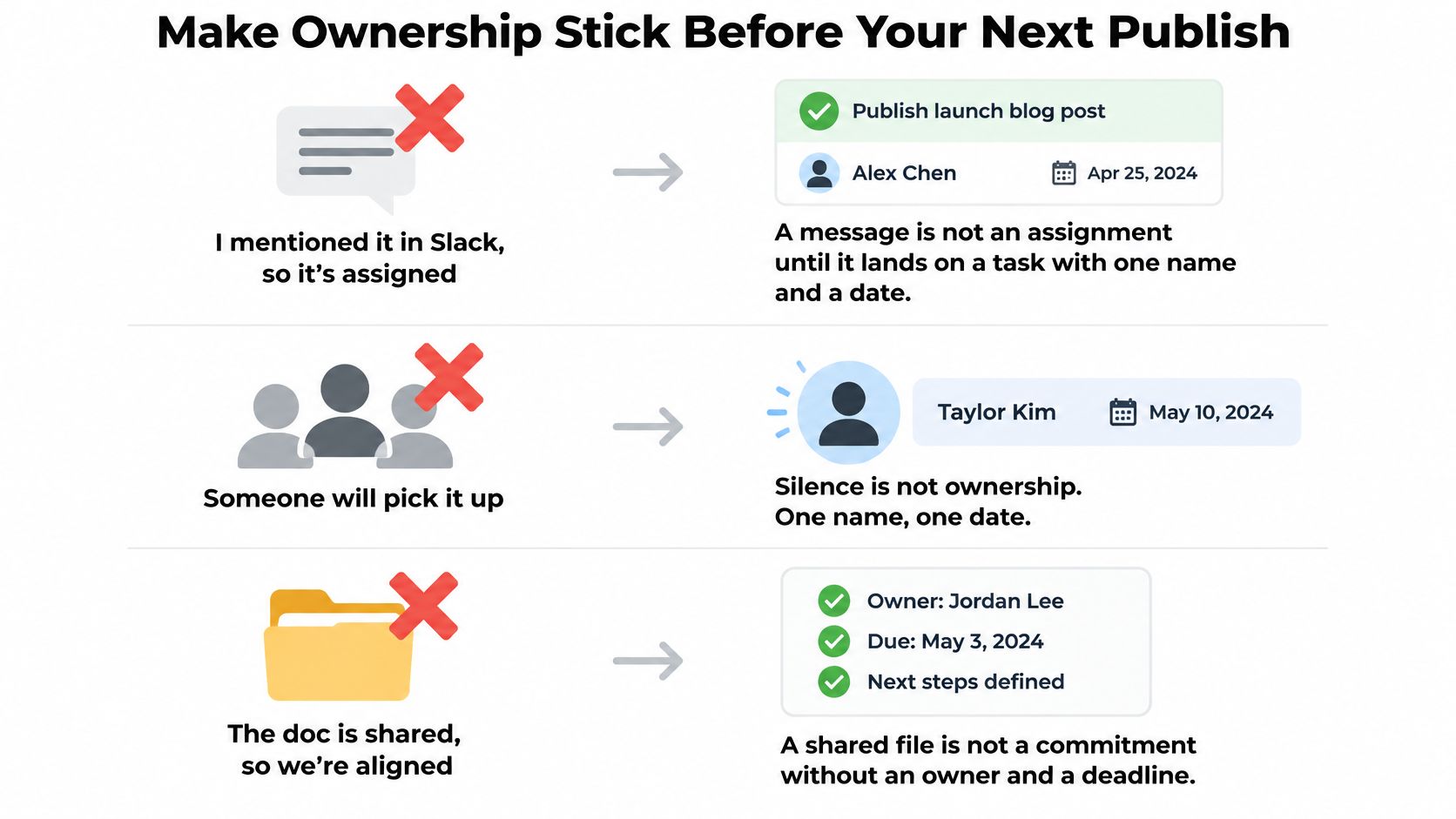
A chat mention isn't proof that someone accepted an assignment. Put the request on a task, name the responsible person, and confirm the delivery commitment.
Waiting for someone to volunteer isn't a dependable staffing method either. If an item matters enough to reserve a publication slot, it needs an explicit owner.
Nor will more reminders necessarily fix slippage: Deloitte reported that 68% of surveyed workers lacked enough uninterrupted focus time and 41% of daily time went to work that didn't contribute to organizational value. Check whether the owner can do the work before adding another nudge.
Audit the live queue
Use this checklist to catch the gap between discussing work and assigning it.
- List every live piece of content. Include revisions, approval requests, and scheduled items, not just drafts.
- Name an owner for each active task. Replace team names and vague shared responsibility with the person accountable for the next deliverable.
- Add a due date and definition of done. Check that the recipient understands both and has the necessary inputs.
- Move decisions onto the task. Preserve changes of direction, approval conditions, and blockers where the next person can find them.
When you find an unowned item, don't assign it to the busiest reliable teammate. Decide whether to staff it properly, postpone it, or remove it from the active queue.
At TheContentMap, our workflow supports capturing ideas in a pipeline, planning them on an editorial calendar with owners and publish dates, then publishing and reviewing what worked. Team collaboration lets you assign writers and leave comments for editors, writers, and stakeholders, while publish reminders keep deadlines visible.
The editor's final check is simple: can everyone identify who must act next, what they owe, and when it's due? Name the owner, and the work moves.
Visit TheContentMap to put your next content idea into a pipeline and plan it on an editorial calendar with an owner and publish date. Use comments to keep the assignment's context together and publish reminders to keep the deadline visible.
Related Articles
What Does a Managing Editor Do? Duties, Skills and KPIs
When three drafts are due, a writer has gone quiet, and a headline is waiting on legal review, the s...
Software9 Examples of Branding Strategies to Try in 2026
The publishing schedule is full. Three posts a week, a newsletter, a podcast every other Thursday, a...
SoftwareContent Brief Template: 10 Options That Work in 2026
Why does a writer still need a clarification call after receiving a completed content brief template...
Comments (0)
No comments yet. Be the first to share your thoughts.