Deadlines for Writers: How to Set Realistic Dates
Deadlines for writers are shared dates, not personal goals. See milestone timing, how to set a realistic due date, and when editors should move it.
Roughly 25% to 60% of forthcoming titles miss their original submission date, according to estimates discussed in a 2025 Bookseller industry analysis. The range varies by publisher, genre, and author, but it reframes deadlines for writers: this isn't a problem of people needing more discipline. It's a problem of making commitments across a shared workflow.
The safest deadline isn't the earliest plausible delivery date. It's a date that accounts for uneven workloads, coordination, revisions, and the cost of keeping capacity available.
Table of Contents
- Why a Writer Deadline Is a Shared Date
- How to Set a Date You Can Keep
- Staged Milestones That Replace One Due Date
- Pressure That Speeds Output and Hurts Ideas
- Two Assignments With Dates That Hold
- When a Deadline Should Move
- Put the Next Deadline Where the Team Can See It
Why a Writer Deadline Is a Shared Date
Say a writer promises a draft for Monday. The editor reserves Tuesday for review, the designer expects approved copy afterward, and the marketing manager schedules the campaign. When the draft arrives late, everyone must decide whether to rearrange work, shorten a review, or postpone publication.
A private goal works differently. Finishing a chapter on Sunday might matter a lot to the writer, but moving that goal doesn't automatically disrupt someone else's working day. A submission deadline is a date other people have already planned around.
The Bookseller account also relayed an agent's informal claim that only two out of 100 authors delivered on time, while cautioning that this may have been exaggerated. That's not a reliable benchmark for judging an individual writer. It does illustrate why an editor shouldn't build a release plan around optimism alone.
Assign the handoff, not just the writing
The same analysis describes different reputations for lateness across literary and genre publishing, and different levels of predictability across research fields. Those observations aren't grounds for stereotyping writers. They suggest that an interview-led investigation and a familiar service article shouldn't receive identical scheduling assumptions.
A useful task and assignment structure identifies what the writer owns, what the editor supplies, and who accepts the result. Without that distinction, a writer can appear late while waiting for an unanswered approval.
Consider a grant-related article. Before drafting, the writer may need to evaluate prospecting platforms, confirm selection criteria, and agree on which products belong in the comparison. Grantlas's best grant prospecting tools compared can support that preparation, but reviewing it still belongs in the project schedule.
Shared-date rule: A deadline is credible only when the people supplying inputs and accepting outputs have agreed to their part.
The editor's job isn't to demand identical speed from every contributor. It's to make the next handoff clear enough that nobody has to guess whether work is ready.
How to Set a Date You Can Keep
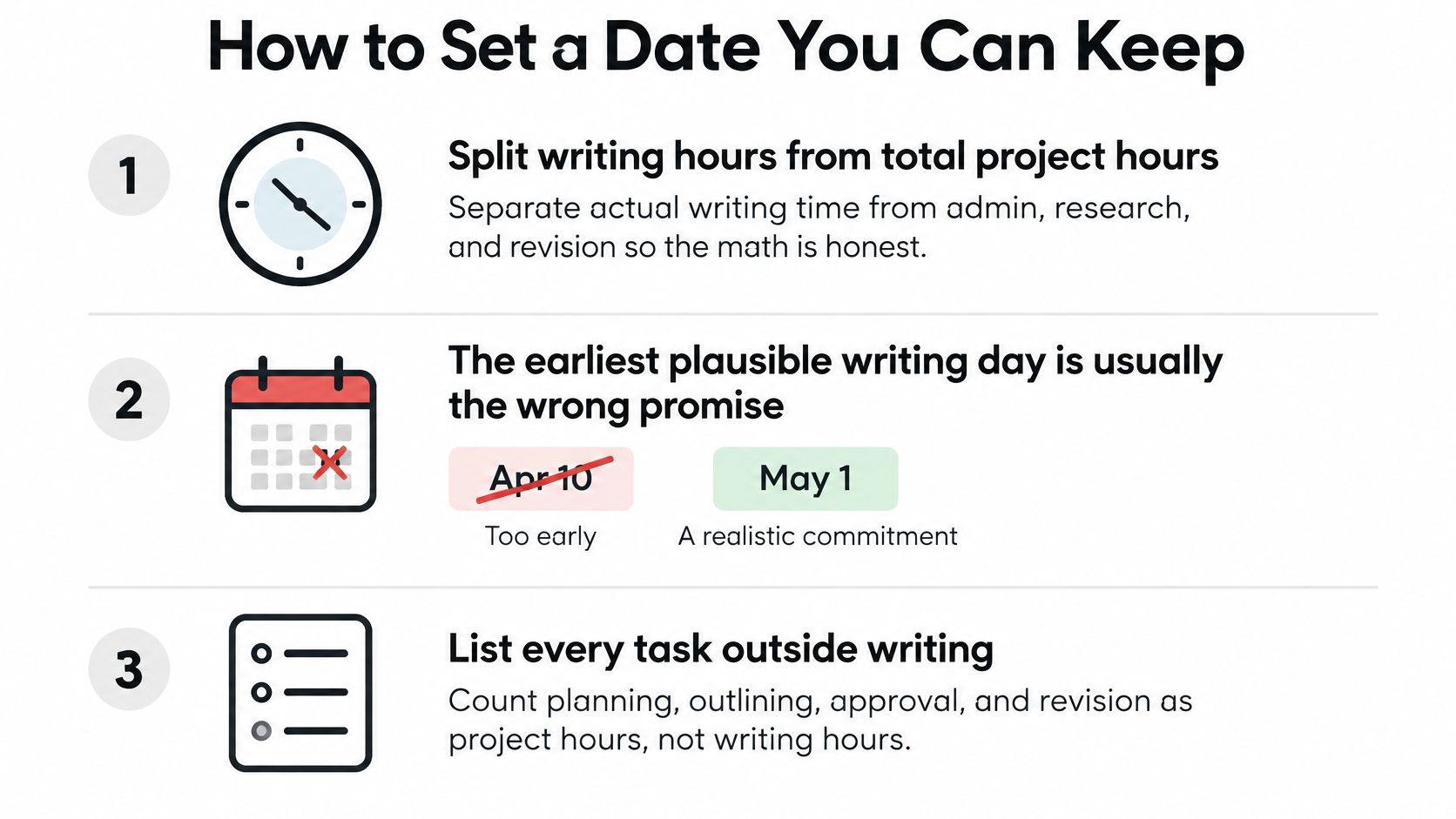
The earliest plausible writing day is usually the wrong promise. It assumes the assignment will proceed without interruption, the brief will remain stable, and every reviewer will respond promptly.
Use a capacity calculation instead. Start with the work, then place it into the calendar available to you.
Calculate the whole commitment
Separate writing from total project time. List research, interviews, client calls, outlining, drafting, revisions, and administration separately. A short article can involve substantial preparation even when the prose comes quickly.
Check comparable completed jobs. Review your last three assignments of the same type as a practical starting sample. Record actual cycle time, including waiting and revisions, rather than the uninterrupted writing time you remember most clearly.
Reserve a review buffer. Give the editor room to read and the writer room to respond. Don't spend that allowance polishing the opening paragraph.
Overlay competing assignments. Put existing commitments on the same calendar before accepting another. A 2025 survey of 350 freelancers found that 75% described their workload as partially or highly inconsistent, which is a strong reason not to assume assignments will arrive neatly spaced.
Price reserved capacity fairly. A quiet stretch isn't automatically free capacity. If a client asks you to remain available while withholding the brief, discuss a firm start date, a revised delivery commitment, or paid reservation terms rather than keeping the week indefinitely open.
Offer a date that includes the likely revision. State what the commitment covers before accepting it. If the requested date excludes necessary work, negotiate the scope or the date now, not after the draft becomes late.
The checklist below makes the distinction between writing time and project time visible.
Test the promise against a real week
Take a hypothetical 1,200-word explainer requested on Monday 4 May 2026 for delivery on Friday 8 May. Suppose it needs eight writing hours, plus four hours of research, two for coordination, and two for a revision. That's a sixteen-hour commitment, not an eight-hour one.
If existing assignments leave only ten available hours that week, Friday isn't a responsible promise. Working faster doesn't resolve the missing capacity, and assuming you'll use the weekend transfers the cost to your personal time.
Offer a complete commitment instead:
I can deliver the explainer on Tuesday 12 May, including research and a revision round, provided the approved brief arrives on Monday 4 May. Additional interviews or delayed feedback would require a revised date.
That message gives the client something useful to accept. It defines the deliverable, the assumption, and the condition that would change the schedule.
Staged Milestones That Replace One Due Date
Use this illustrative web-feature schedule as a starting template, not an industry benchmark. Set the first-draft date only after checking the writer's available capacity, then confirm that the editor and reviewers can support the later handoffs.
Writer milestone schedule before publication
| Milestone | Typical timing before publish | Owner | Done when |
|---|---|---|---|
| Brief or outline approval | Allow 4–6 weeks for this example feature | Editor | Scope, sources, and word target agreed |
| First draft | After a protected 1–2 week drafting window | Writer | Complete draft matches the brief |
| Substantive edit | Within about 1 week of the draft in this plan | Editor | Structure and argument resolved |
| Fact-check | Before copy edit | Writer or researcher | Claims sourced and corrections made |
| Copy edit | Several days before sign-off | Copy editor | Style, clarity, and links clean |
| Final sign-off | Leave a buffer of at least a few days | Editor | No open comments; ready to publish |
These intervals are planning choices. A familiar update might need a shorter sequence, while a reported feature may need more time before drafting can begin.
Make completion observable
A milestone needs an acceptance test, not just a label. Draft complete shouldn't mean that the writer has uploaded whatever exists. It should mean that the agreed sections are present, necessary sources are included, and any unresolved questions are clearly flagged.
The same applies to editing. An editor hasn't completed a substantive edit merely by leaving comments. The structure and argument must be resolved well enough for fact-checking and copy editing to proceed without repeated rebuilding.
Experimental deadline research found that evenly spaced interim deadlines produced the best performance and error detection, while a maximally delayed final deadline produced the worst; self-imposed deadlines helped but were less effective than externally enforced, evenly distributed checkpoints. Editorial milestones apply that principle by making progress visible before publication becomes urgent.
Don't force mathematically equal intervals onto tasks with different requirements. Instead, avoid placing every meaningful check at the end.
Connect requirements to review
For a proposal-writing assignment, the acceptance test may need to track mandatory requirements rather than only editorial quality. BidFunnels's guide to a compliance matrix for federal proposals offers a useful model for connecting requirements with specific responses and review responsibility.
For an article, a simpler equivalent can record:
- Requirement: The reader question or claim the piece must address.
- Location: The section where the writer addresses it.
- Reviewer: The person responsible for accepting that part.
- Status: Accepted, awaiting evidence, or needing revision.
When a draft slips, the editor can then make a precise decision. Reassign a review slot, narrow an agreed requirement, or move publication while recovery is still possible. Don't mark downstream tasks on time when their necessary inputs haven't arrived.
Pressure That Speeds Output and Hurts Ideas
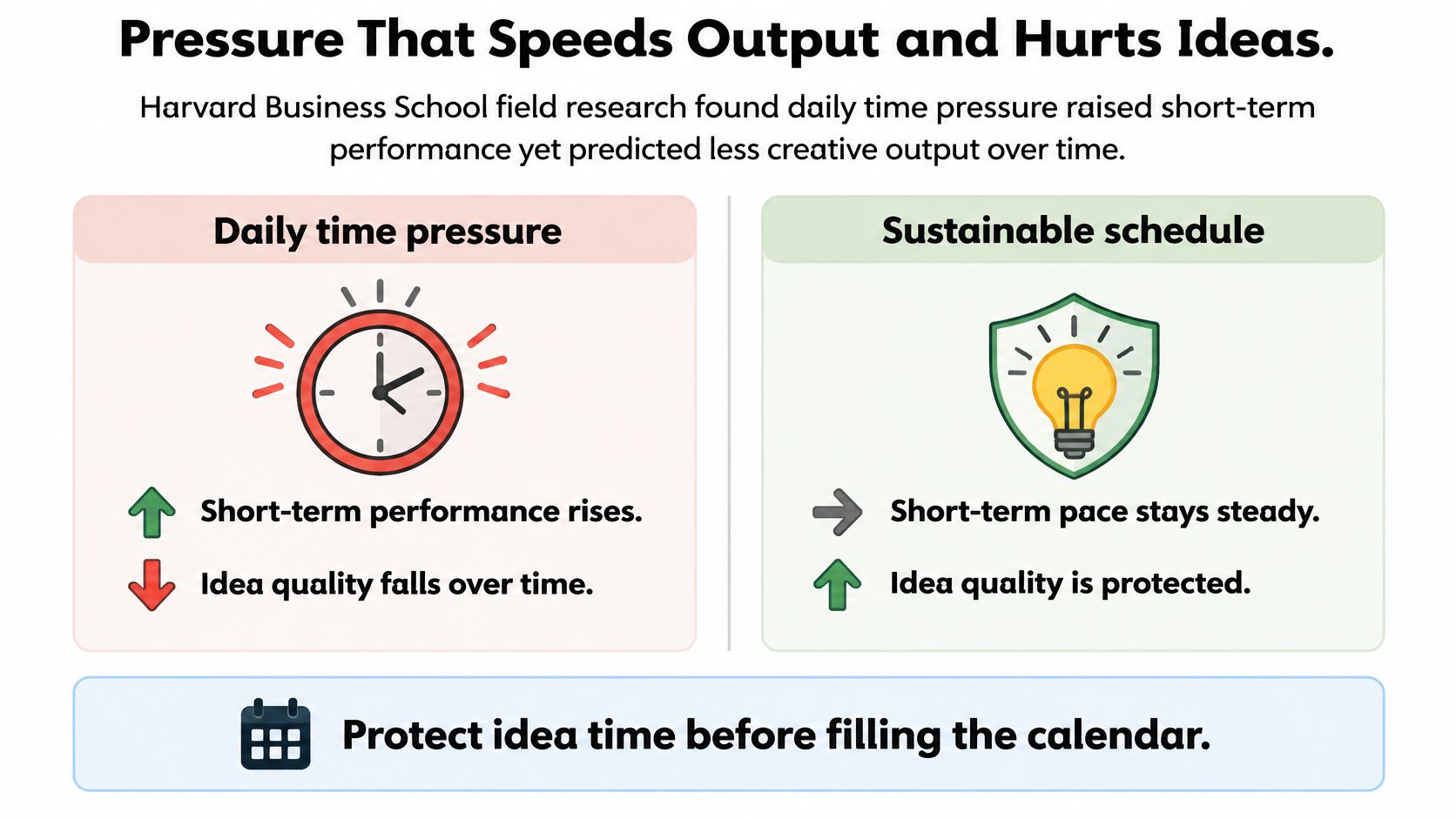
Harvard Business School field research found that daily time pressure increased short-term performance rates but negatively predicted creative cognitive processing on the same day, the following day, two days later, and over longer periods. Completing more work under pressure isn't the same as producing more original thinking.
A writer can clear the assignment queue while relying on the safest angle, the most familiar examples, and the first workable structure. An editor looking only at delivery status may miss that distinction.
This visual summarizes the scheduling trade-off.
Separate exploration from production
Use different expectations for different kinds of work.
- Exploration needs room. Set an early outline or ideation checkpoint, but allow the writer to test alternatives before committing to an argument.
- Drafting needs protection. Reserve an identifiable writing window. Don't fill it with avoidable meetings just because the draft isn't due yet.
- Production needs firm handoffs. Once a usable draft exists, schedule substantive editing, verification, copy editing, and publication against clear acceptance criteria.
A real mission constraint can help a writer choose what matters. Arbitrary urgency is different: asking for an earlier draft without changing scope or explaining the need doesn't give the writer better information.
The useful question isn't whether pressure is always bad. It's which work you're asking the writer to accelerate, and what quality trade-off you're accepting.
Don't transfer every delay to the writer
A common failure starts upstream. The brief arrives late, but the editor leaves publication unchanged and shortens drafting instead.
The writer may still deliver. Yet the lost exploration time can mean a flatter argument or less distinctive examples, even when the copy is clean and accurate.
Show both the due date and the lead time remaining. Flag repeated date changes, and protect review allowances rather than interpreting every unassigned day as spare capacity.
The drafting window is the kiln; the production dates are the shipping dock. Rushing the kiln doesn't make a better pot.
Use the video below as a prompt for a team discussion about how you protect thinking time.
Two Assignments With Dates That Hold
Consider two hypothetical assignments with the same publication date, Monday 1 June 2026. Their calendars differ because their dependencies differ, not because one writer is more committed.
Assignment A uses familiar material
The writer knows the subject of this 1,200-word service article. Existing sources are sufficient, no interviews are needed, and the agreement includes a single revision round.
The editor approves the outline on Monday 11 May. The protected drafting window runs through Friday 22 May, with source verification included before the complete draft is handed over.
The remaining calendar is compact:
- Wednesday 27 May: The editor completes the substantive edit.
- Thursday 28 May: The copy editor checks the revised text and links.
- Friday 29 May: The editor signs off for Monday publication.
The weekend remains a contingency gap, not scheduled writing time. If nobody is available then, it isn't usable review capacity, so Friday's sign-off must mean ready to publish.
If the brief doesn't arrive until 20 May, the agreed drafting window has largely disappeared. Move the publication date or agree on a substantially different deliverable rather than pretending the original plan still holds.
The parallel timelines make the different starting points visible.
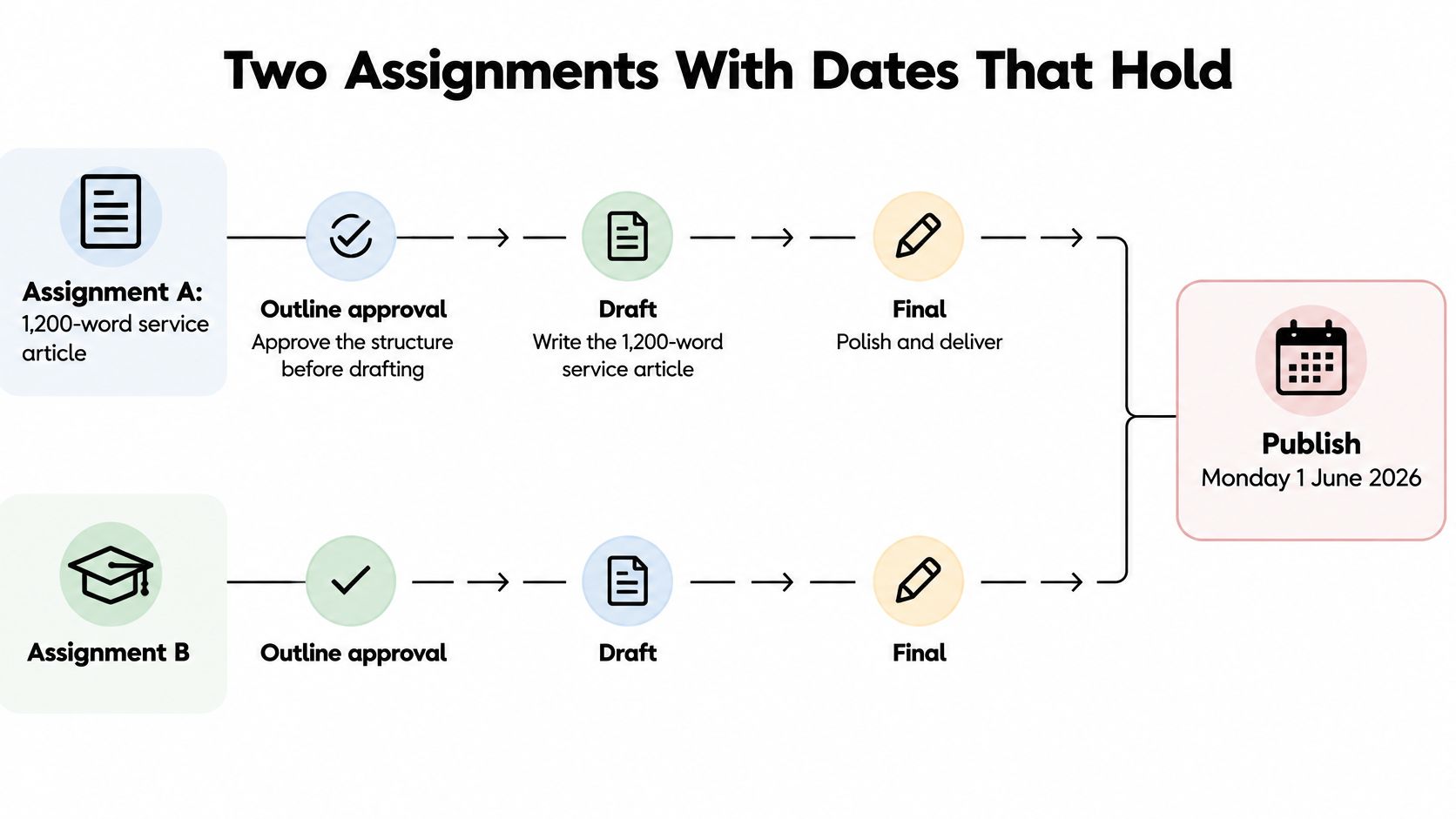
Assignment B needs reporting first
The reported feature requires two interviews and a separate fact-check. Its brief is agreed on Monday 13 April, and interviews close on Friday 1 May.
The draft is due Monday 11 May, followed by substantive editing on Monday 18 May and fact-checking by Friday 22 May. Copy editing takes place on Tuesday 26 May, with final sign-off on Friday 29 May.
If a necessary interview cancels, the editor checks whether the feature can proceed without it. If not, the draft date and affected later stages move together instead of depending on overnight recovery.
Book publishing uses a longer version of this dependency chain. Publishing guidance on nonfiction production places completed-manuscript delivery approximately 6–12 months before publication, allowing editing, design, manufacturing, marketing, and distribution to fit. A late manuscript can therefore threaten the release schedule, not merely inconvenience its author.
When a Deadline Should Move
Move a deadline when the assumptions supporting it are no longer true. The main triggers are late inputs, an overdue approval, expanded scope, and payment uncertainty that makes further reserved capacity unreasonable.
Controlled flexibility isn't an open calendar. It's an explicit decision about what changed and which commitment can still be honored.
A 2025 report on Scotland's creative industries found that 69% of respondents had experienced late-payment problems. Delivering on time doesn't, by itself, protect a freelancer from financial uncertainty, so payment-related pauses deserve a clear place in the working agreement.
Identify the trigger before changing the date
Triggers for moving a writer deadline
| Trigger | Clock restarts when | Record this |
|---|---|---|
| Late brief or source material | Required inputs arrive and a revised start is agreed | New date, missing dependency, who approved |
| Approval past its checkpoint | The overdue decision arrives and the next owner confirms availability | Owner of the wait and the revised milestone |
| Scope expansion | The added work and revised terms are accepted | What was added and which later stages shift |
| Payment uncertainty | The agreed payment condition is met and capacity is reconfirmed | Whether work pauses and the new commitment date |
Notice that an overdue approval doesn't automatically restart work the moment the client replies. The writer may have moved to another committed assignment. Confirm availability before publishing a replacement promise.
Likewise, extra interviews or revision rounds shouldn't disappear into the original scope. Record the request, agree on the additional work, and assess the affected stages.
Keep a decision trail
Put the essential fields in the same change note:
- New date: The revised milestone and any affected publication commitment.
- Dependency owner: The person responsible for supplying the missing input or decision.
- Change: What happened, including any added scope.
- Approval: Who accepted the revised plan.
Distinguish writer delay from workflow delay. If the writer had the agreed inputs and missed the draft date, record that plainly. If the writer was waiting for approval, record the waiting dependency instead of leaving the assignment marked drafting.
A practical contingency planning example can help teams decide in advance which disruptions require escalation and who can authorize a change.
Use a message that states the event, revised milestone, and remaining commitment:
The source documents arrived after the agreed start. The draft will move to the revised date shown in the assignment note, and the editor has approved the corresponding publication change. The agreed scope remains unchanged.
If publication cannot move, the decision must name an alternative: reduce scope, replace the piece, or assign additional qualified help. Don't leave the writer to infer that every lost day must become evening work.
The trust test is simple. A stakeholder should be able to read the history, understand the constraint, and see why the team made that decision.
Put the Next Deadline Where the Team Can See It
Choose the assignment already in motion, not an ideal future project. Copy its commitment out of a buried email or isolated calendar entry into a shared note that the writer and editor both use.
Put the publication date and protected buffer on the first line. Then list only the milestones still ahead, with an owner and a done-when test beside each.
Make the next action unmistakable
- Name the handoff: State what the next owner will receive and what makes it complete.
- Set the reminder: Prompt the next transition, rather than relying only on a publication-day alert.
- Preserve the history: If the date changed, add the trigger, revised commitment, approver, and delay category.
- Send the agreement: Summarize what is due, what it includes, and what would move it.
A content calendar for marketing should help people coordinate these commitments, not just display a crowded month. For proposal teams deciding whether a specialist tool fits their process, Bidwell's bid writing software explained provides relevant context before choosing how to organize the work.
At TheContentMap, our workflow is to capture ideas in a pipeline, plan them on an editorial calendar with owners and publish dates, then publish and review what worked. Our calendar shows the whole plan at a glance and lets users drag pieces between dates; publish reminders send nudges that keep deadlines visible.
The immediate action doesn't depend on adopting another tool. Leave the review allowance intact, send the shared note, and stop once the next owner knows exactly what is due and when.
TheContentMap brings idea capture, writer assignments, editorial scheduling, and publish reminders into a shared workflow. Visit TheContentMap to organize your next assignment around visible owners and realistic dates, with room for the work between drafting and publication.
Related Articles
How to Book a Demo: What to Prepare and Expect
Deals where buyers had demo access closed 46% of the time, compared with 38% for deals without it, i...
SoftwareHow to Comment on Drafts Writers Can Act On
The review lands at 4:40pm with eleven comments on a 1,800-word guide that publishes tomorrow. Three...
SoftwareCase Studies Example: 8 Real Content Operations Breakdowns
You're a managing editor, and three stories have slipped past their publish dates this week. The...
Comments (0)
No comments yet. Be the first to share your thoughts.