How to Comment on Drafts Writers Can Act On
Learn how to comment on drafts with clear, prioritized feedback: a five-part comment structure, a review workflow and fixes for common mistakes.
The review lands at 4:40pm with eleven comments on a 1,800-word guide that publishes tomorrow. Three of them say "tighten this." One says "not sure about this bit." None names the sentence. The writer opens the doc, guesses, and rewrites the paragraph you liked.
That gap between what a reviewer meant and what a writer can act on is the whole job. Commenting looks like an etiquette question and behaves like a workflow question: what gets flagged, in what order, with what label, and what happens to the thread afterward. Get those four things right and one reviewer can clear a draft's real problems in a single pass. Get them wrong and you get a comment volume problem dressed up as thoroughness.
Here's how to comment so the next version of the draft changes.
Table of Contents
- Anatomy of a Comment Writers Can Act On
- How to Review a Draft Step by Step
- Ranking Issues So Blockers Come First
- Common Commenting Mistakes and Fixes
- Resolving Threads and Settling Disagreements
- Set Up Your Next Review Round
Anatomy of a Comment Writers Can Act On
Say you type "tighten this" on paragraph nine of a 1,800-word product guide. The writer now has three options and no information: cut the paragraph, cut the sentence, or trim forty words and hope. They'll pick whichever feels safest, usually the smallest edit, and the genuine problem in paragraph four ships untouched.
Rebuild the same note and it starts working, because a comment that gets implemented carries five things, in the order a writer reads them.
The Five Parts in Reading Order
The criterion. Name the standard you're applying: the brief, the editorial rubric, or the promise the introduction already made. Without it, the writer reads your note as taste.
The passage. Paragraph and sentence, with the words quoted. "The opening claims that the workflow saves time" beats "the intro feels vague" every time.
The diagnosis and its cost. Say what breaks and for whom. A reader who can't verify a claim stops trusting the next one. A page that overstates performance hands the problem to whoever fields support requests.
One revision or decision. One. If you want two changes, leave two comments. Bundled requests are where writers implement half of what you asked and report the thread as done.
The test. State how you'll both confirm the fix. "Figure matches the cited report" is a test. "Looks better" isn't.
This structure isn't a matter of style. In a study of 440 drafts and 5,606 implementable feedback units from 110 students, feedback accuracy was only moderate and revision potential was low, and accuracy turned out to be the stronger predictor of whether feedback was implemented at all (research on implementable written feedback).
The opening claims that the workflow saves time, but provides no evidence. Add one quantified example or remove the claim, and confirm the source supports the exact number.
Three sentences, five parts. Praise and summary fail for the same reason. "Strong intro, really compelling" feels generous and changes nothing, because the writer can't infer what to preserve. Summary comments ("this section covers pricing") prove you read the draft and give the writer nothing to act on. Neither can produce a revision, and a revision is the only output that counts.
The habit that makes all five parts cheap to write is opening the brief before you open the draft. Skim the objective, the audience and the promised outcome, then comment. You're now checking against a shared document instead of inventing a standard as you type, and the writer can argue with the brief rather than with you.
How to Review a Draft Step by Step
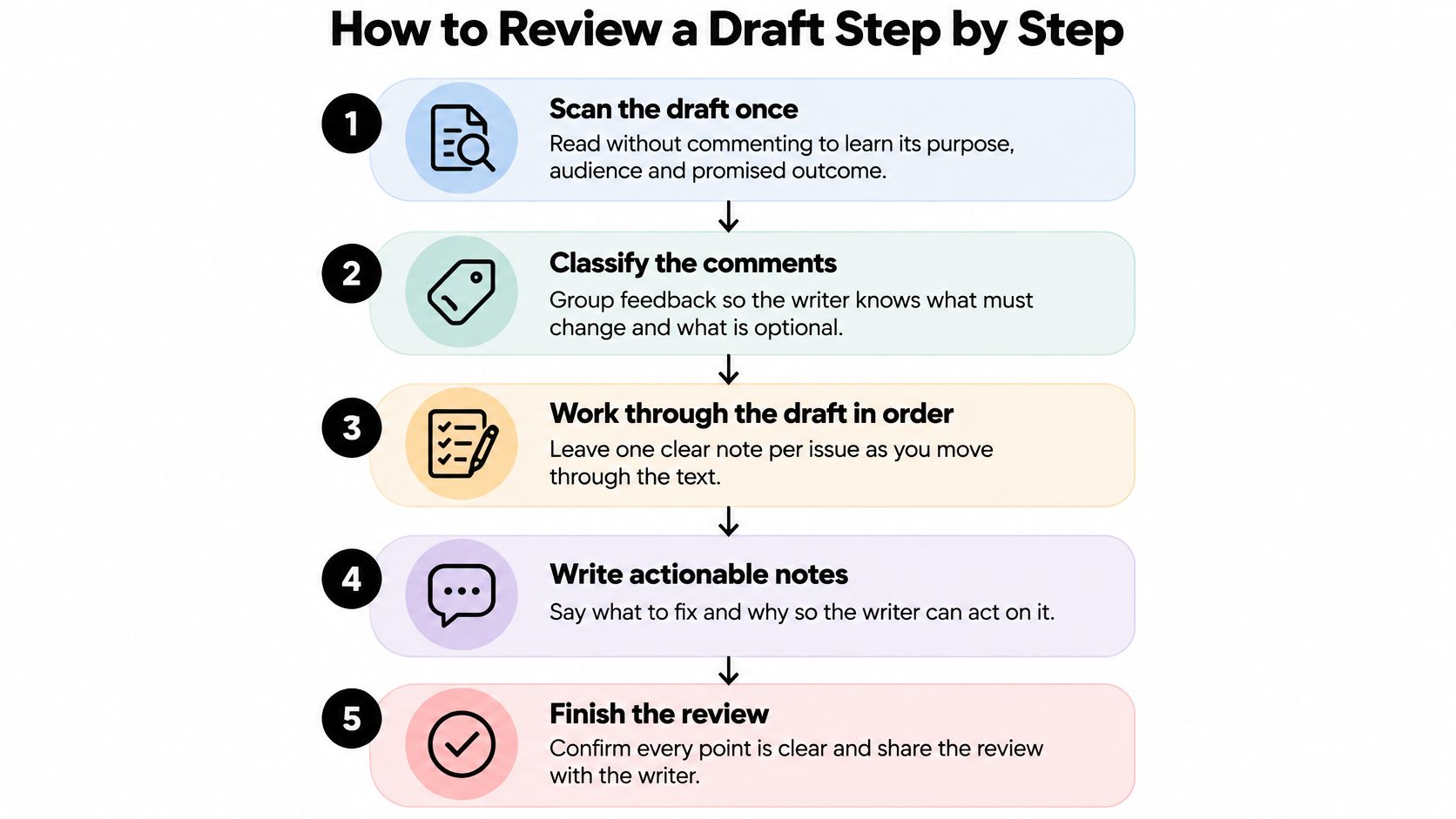
A draft can collect comments quickly and still miss the argument that blocks publication. Separate reading, diagnosis, and resolution into stages, then give each comment a severity and a clear state. That order keeps line edits from crowding out decisions that affect the whole piece.
Use the sequence below as a working review process.
Read once without commenting. Identify the purpose, audience, and outcome the draft promises. Hold initial reactions until you reach the end. A point that looks like a gap near the beginning may be explained later, and commenting before you have the full argument can create work the writer does not need.
Classify issues by severity and recurrence. Group repeated symptoms when they share a cause. If several claims lack support, address the sourcing problem rather than leaving a separate note on each sentence. This keeps the review focused on decisions that will improve the draft, not on a long inventory of similar defects.
Write one self-contained comment per decision. Make each note understandable to someone who joins the thread later. Keep separate issues in separate comments so each can be resolved, rejected, or deferred independently. A large bundle of unrelated instructions is harder to answer and harder to close.
Give the reason and a next step. State why the passage needs work, then offer an actionable direction. “This is unsupported” identifies a problem; “Add a measured example or cut the claim” gives the writer a choice they can act on.
Set a verification question or acceptance test. Make the check answerable, such as, “Does the revised figure match the cited report?” Record the answer before the draft moves on. Clear approval gates and human quality control make the check part of the workflow rather than a suggestion that disappears in the thread.
Resolve, reject, or defer every comment after revision. Give each thread one of these states. For a deferred item, record when it should be revisited. Leaving a comment open without a decision obscures whether the draft is ready and can hold up the review round.
Consider a buyer's guide whose introduction promises a comparison table that never appears. Rather than scatter notes across the promise, the missing table, a vague transition after section three, and related line edits, write one comment that identifies the mismatch and proposes a decision: add the table after section three or remove the claim from the introduction. Set the acceptance test as, “The promise and delivered content match on re-read.” The writer can then make one clear decision in one place.
Comment location affects the effort required to consolidate feedback. Content collaboration tools can keep comments attached to the draft instead of scattered across email and chat, making duplicate notes easier to spot and combine.
The stages compress into the sequence below.
A review is finished when no blocking comment remains open and every other comment is resolved, rejected with a reason, or deferred with a date. If a thread has no clear state, the review is still in progress.
Ranking Issues So Blockers Come First
There's a moment in every review when you have twenty notes and the writer has one afternoon. Sending all twenty in the order you noticed them guarantees the writer spends the afternoon on comma splices and discovers the legal risk at 6pm.
Priority runs in one direction. Accuracy and legal risk block publication. Audience fit and structure come next, because a correct article nobody finishes reading is still a failed article. Conversion intent follows, then line edits, which are last and often optional. If you only have time for one tier, work the first.
Three labels carry that ranking in the thread.
- must fix: a blocker the piece cannot publish without. An unsourced statistic is the classic case.
- recommendation: an improvement the writer may decline, provided they state a reason. A benefit buried in paragraph six belongs here.
- question: you lack context, so you're asking rather than directing. "Is this claim approved for the UK market?" is a question, not a verdict.
| Issue Type | Priority Tier | Label | Example |
|---|---|---|---|
| Accuracy | 1 (blocker) | must fix | Statistic with no source |
| Legal risk | 1 (blocker) | must fix | Health or financial claim without approval |
| Audience fit | 2 | recommendation, or must fix if the reader cannot follow | Jargon the target reader won't know |
| Structure | 3 | recommendation | Key benefit buried in paragraph six |
| Conversion intent | 4 | recommendation | Missing call to action on a product page |
| Line edits | 5 | optional | Repeated word in one sentence |
The cost of skipping labels shows up in mixed comments. A note that pairs a legal risk with a stylistic preference forces the writer to guess which half blocks the draft. They'll fix the easy half, ask about the hard half, and the thread eats a day. Split it into two comments with two labels and the ambiguity disappears.
Common Commenting Mistakes and Fixes
The instinct on a weak draft is to mark everything, as if thoroughness were measured in annotations. It isn't. A cross-course study of 2,421 students across 13 courses, seven universities and six disciplines found that longer comments, and comments the writer perceived as helpful for revision, were more strongly linked to later task-performance growth than posting more comments (study on comment quality and writing performance).
The follow-up finding is the one that changes behavior. In a separate study of 186 graduate writers, researchers found no direct relationship between the number of comments received or implemented and writing performance, and a high total volume of comments weakened the link between implementing feedback and improving.
That argues for a review budget: the five highest-impact comments per section, duplicates consolidated into one. If you have twelve notes for a section, five of them are the same note. Ambiguous wording is a style disagreement as often as it is a tone problem, and a shared writing styles guide gives reviewers a neutral reference point instead of a personal preference.
| Mistake | Why It Backfires | Fix |
|---|---|---|
| Vague directive | "Tighten this" leaves the writer guessing | Name the sentence and a target length |
| Commenting on symptoms | Repeated typo flags hide a broken structure | Name the root cause in one comment |
| Mixing blockers with options | Writers cannot tell what blocks publication | Split comments by label |
| Rewrite without reader need | The writer rewrites well but misses the audience | State who the reader is and what they need |
| Sarcasm or ambiguous punctuation | Tone reads as hostile or unclear | Write plain, specific statements |
| Too many comments | Writers implement fewer, and the revision gains weaken | Set a budget of the five highest-impact comments per section |
Before you close the file, run one self-check on each comment: does it concern a single decision, and would a competent writer know exactly what to do after reading it without asking you a follow-up question? If either answer is no, the comment isn't finished.
Resolving Threads and Settling Disagreements
Reviews stall at the same point every time: the writer disagrees. That isn't a failure of the process, it's the process working, provided the disagreement resolves somewhere other than the comment thread.
A review thread is a negotiation with a deadline, which is why the handoff between reviewer and writer needs as much structure as the draft itself.
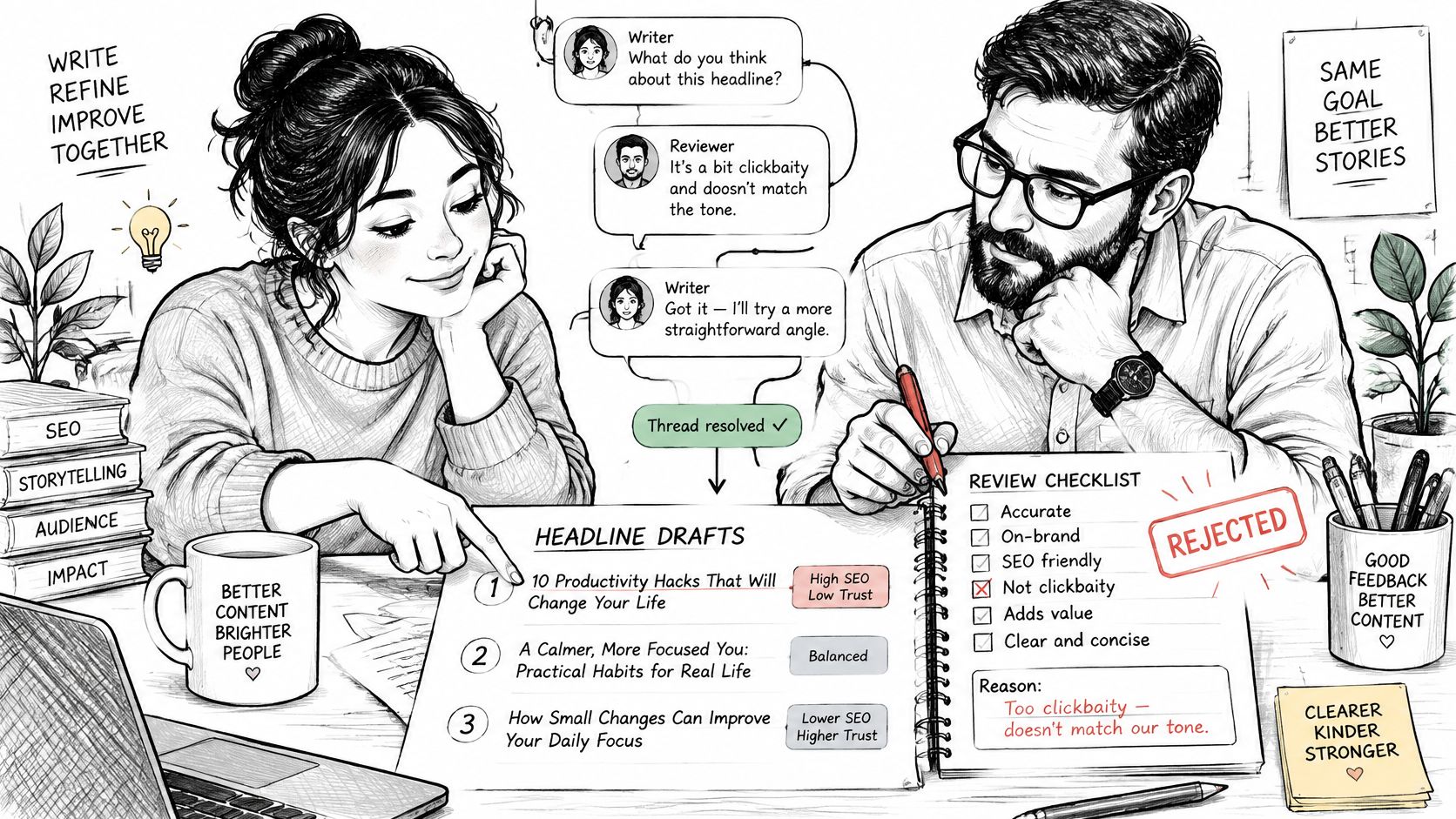
A declined recommendation is fine. A writer may reject a suggested headline change because it drops the keyword the page is built around, and that's a legitimate trade-off they understand better than you do. Mark it rejected, record the reason in one line, move on. Don't relitigate it next round.
A declined must-fix is not fine. If a writer rejects a comment about accuracy or legal risk, escalate to the owner of the brief the same day. Don't argue it in the thread, and don't let it sit unresolved while the publication date approaches. Take a realistic case: a legal reviewer blocks a health claim, the writer asks for softer wording, and the brief owner approves a version with a source attached to it. That's the correct sequence. The thread documents it; the brief owner decides it.
If the same disagreement keeps reopening, write the content approval workflow down so escalation is a rule rather than a favor you ask of whoever is online.
Sign-off needs criteria the whole team can apply, not a feeling that the draft is ready.
- No open must-fix comments. Not one, regardless of how small it looks at 5pm.
- Every recommendation resolved or declined in writing, with the reason attached to the thread.
- Every question answered, even when the answer is "not this round."
- The final version checked against the original brief, not against the last round of comments, which drift.
Set a review window too, such as a 48-hour turnaround per pass. A window with a named owner beats an open thread that everyone assumes someone else is watching.
Set Up Your Next Review Round
The method only holds if the next draft starts with the pieces already in place. Five setup steps do that.
- Attach the brief or rubric before anyone comments. Every note then points at the same criterion, and the writer can trace each one back to the objective it serves.
- Name one owner per thread and one reviewer per criterion. Nothing sits without someone responsible for closing it.
- Write the label set and the review budget at the top of the draft. Reviewers see must fix, recommendation and question before they type the first note.
- Agree the turnaround window. Forty-eight hours per pass, and state who decides when it's missed: the owner of the brief.
- Schedule the review date on the editorial calendar, so the pass can't slip past the publication date.
A plain document with labels and a budget will get you better revisions than an elaborate platform full of unlabeled notes. Method beats tooling. That said, keeping the review next to the schedule removes a whole category of lost threads. Our team collaboration features let editors assign writers and leave comments for editors, writers and stakeholders in the same place the publishing date lives, which is where the label set belongs anyway.
Permissions matter once more than one person can comment and close a thread. WordPress roles and permissions is a useful reference for which role should be able to resolve a comment versus only reply to one, and the same logic transfers to any editorial system with more than two people in it.
Pick one draft due this week. Run the five-part comment, the six-step routine and the sign-off criteria on it, then record which comments the writer implemented and which stayed open. That record tells you more about your commenting than any review of your tone ever will.
TheContentMap keeps the comment, the label and the publish date in one place, so a review round closes before the deadline instead of after it. Editors can plan drafts on a drag-and-drop calendar, move topics through a visible pipeline and leave comments where the writer will see them. Start on the free Starter plan and run your next review round inside TheContentMap.
Related Articles
Case Studies Example: 8 Real Content Operations Breakdowns
You're a managing editor, and three stories have slipped past their publish dates this week. The...
SoftwareContent Calendar for Marketing: How to Plan and Publish
Content rarely stalls because nobody can write. It stalls at the handoffs, and the handoff most like...
SoftwareTask and Assignment: How Clear Ownership Moves Content
A task is the piece of work that needs doing, while an assignment is that same work placed with a na...
Comments (0)
No comments yet. Be the first to share your thoughts.