What Is Content Operations and Why It Matters in 2026
Learn what is content operations, how it differs from production, the roles and KPIs that drive it, and why teams are rebuilding it around AI in 2026.
Content operations is the cross-functional operating system that turns content strategy into repeatable planning, creation, approval, distribution, and measurement. This system is essential now, not later, because the work is already too shared, too fast, and too visible to survive on memory and goodwill alone.
The odd part is that many editorial teams still act like content is a stack of individual tasks. One person writes, another comments in Slack, someone else updates a calendar, and a fourth person assumes approval happened somewhere in the blur. That's where content operations starts to matter, because it gives the work a structure that doesn't depend on everyone remembering the same version of reality.
Table of Contents
- The Spreadsheet Spiral Most Editorial Teams Recognize
- Content Operations Explained Through a Familiar Analogy
- The Seven Stages of the Content Operations Lifecycle
- Roles and Responsibilities Inside a Content Operations Team
- Content Operations Versus Content Production
- The KPIs That Tell You If Content Operations Is Working
- Where Content Operations Stands in 2026 and What's Changing
- Practical First Steps to Stand Up Content Operations Today
The Spreadsheet Spiral Most Editorial Teams Recognize
A content lead opens a Google Sheet with 60 drafts, a Slack thread full of approval pings, and a CMS calendar nobody trusts. Two editors each think the other one approved a post, so the piece goes live half-edited and the team spends the afternoon cleaning up a mistake that never should've escaped draft. That isn't a personal failure, it's what happens when the work has no operating layer underneath it.
The symptoms usually look different on the surface, but they come from the same missing system. Handoffs get dropped. Versions drift apart. Publish dates slip. Then the post goes live and nobody can say what happened after publication, because there's no reliable learning loop feeding the next brief.
If that sounds familiar, the problem isn't that the team needs more hustle. It needs a way to stop treating spreadsheets as the control room for editorial work. For a useful contrast on why ad hoc reporting breaks down, find better ways than spreadsheet reporting is a helpful read because it shows how quickly manual tracking stops matching real work.
Practical rule: if the team can't answer “who owns this right now?” without opening three tools, the operating model is already leaking.
The rest of the discipline sits underneath that question. Who requested the asset, who shaped the brief, who reviewed it, who published it, and who learned from the result all need to be visible in the same system. Once you see those gaps as process failures instead of people failures, content operations becomes easier to understand and much harder to ignore.
Content Operations Explained Through a Familiar Analogy
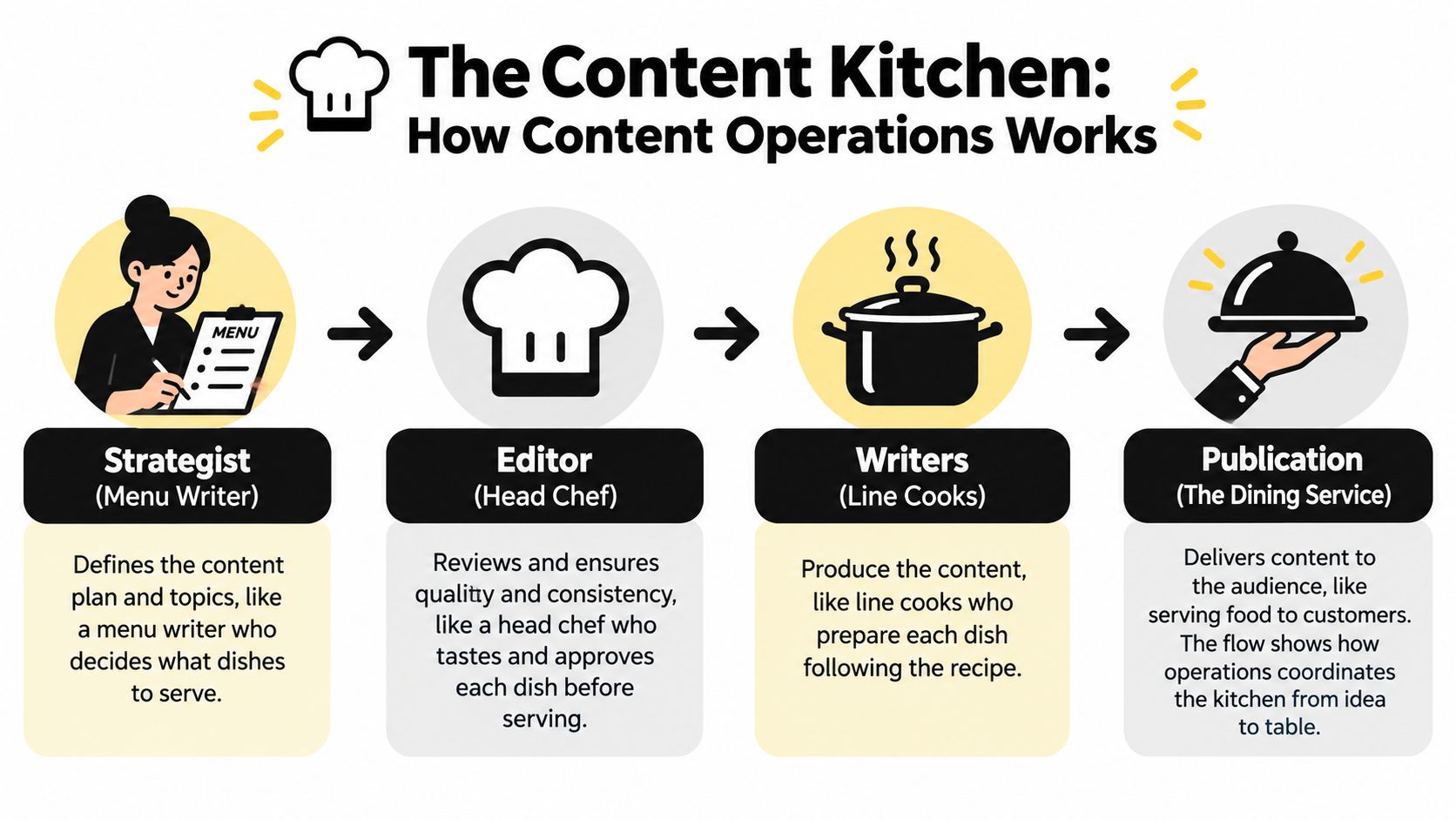
Think of content operations like a restaurant kitchen that has to serve lunch every day without chaos. The menu writer is the strategist, deciding what should be served. The head chef is the editor, checking quality before anything leaves the pass. The line cooks are the writers, turning ingredients into the finished dish.
Raw ingredients and prep
The ingredients are your audience research, brand voice, briefs, and topic plans. In a disciplined kitchen, nobody starts cooking before the ingredients are portioned and the recipe is clear. In content work, that means the request has to become a usable brief before anyone opens a draft.
The same idea holds in an assembly line. Every station needs a defined input and a defined output, or the whole line slows down while people guess what comes next. Content operations is the design of those stations, not the act of stirring the pot.
Cooking, plating, and service
Drafting is the cooking stage, review is the pass, and publishing is the moment the dish reaches the table. If the chef sends out unfinished plates, diners notice immediately. If an editor ships unfinished content, readers notice just as fast.
That's why the lifecycle matters. A good kitchen doesn't just make food, it makes food predictably, with the right handoff at each station and the right person accountable for each move. The same is true for content, where planning, editing, approval, distribution, and measurement all need to behave like connected steps rather than separate chores.
A strong content operation is the system that keeps the kitchen moving, even when the menu changes and the line gets busy.
The working definition is simple. Content operations is the system of people, process, and tooling that makes content teams produce reliably at scale. It's not the cooking itself, it's the structure that lets the cooking happen without constant confusion.
The Seven Stages of the Content Operations Lifecycle
The cleanest way to understand the lifecycle is to follow the work as it changes state. A request becomes a brief, a brief becomes a draft, a draft becomes a scheduled asset, and a scheduled asset becomes published content that should still be measured and refreshed. When one stage is rushed, the next stage absorbs the mess.
For readers who want a workflow reference, the publishing workflow model is useful because it shows how handoffs matter more than isolated tasks. The same logic appears in guide to content approval roles and tools, where approval only works when ownership is explicit.
| Stage | Owner | Work State | Failure When Skipped |
|---|---|---|---|
| Intake | Ops manager | Request | Backlog of off-strategy ideas |
| Analysis | Strategist or analyst | Brief | Poor targeting and keyword overlap |
| Create | Writer | Draft | Rework and inconsistent output |
| Manage | Editor | Review | Version-control chaos |
| Distribute | Channel owner | Scheduled | Missed channel timing |
| Repurpose | Editor or strategist | Refreshed | Traffic left on the table |
| Measure | Analyst | Published and reviewed | The next cycle repeats the same mistakes |
Where teams usually break the chain
Skipping intake seems harmless until the queue fills with vague requests that nobody can prioritize. Skipping analysis creates content that may sound good but competes with itself or misses the audience's intent. Skipping manage is where version control falls apart, especially when comments live in one place and the approved draft lives in another.
The later stages matter just as much. Repurposing is where a lot of teams leave value behind, because one good asset can support multiple channels if someone owns adaptation instead of starting over. Measurement closes the loop, and without it, the next round of planning is just another guess dressed up as a calendar.
The seven stages are connected by state changes, not by optimism. If one stage is weak, the weak spot leaks into every stage after it. That's why content operations is an operating model, not a checklist.
Roles and Responsibilities Inside a Content Operations Team
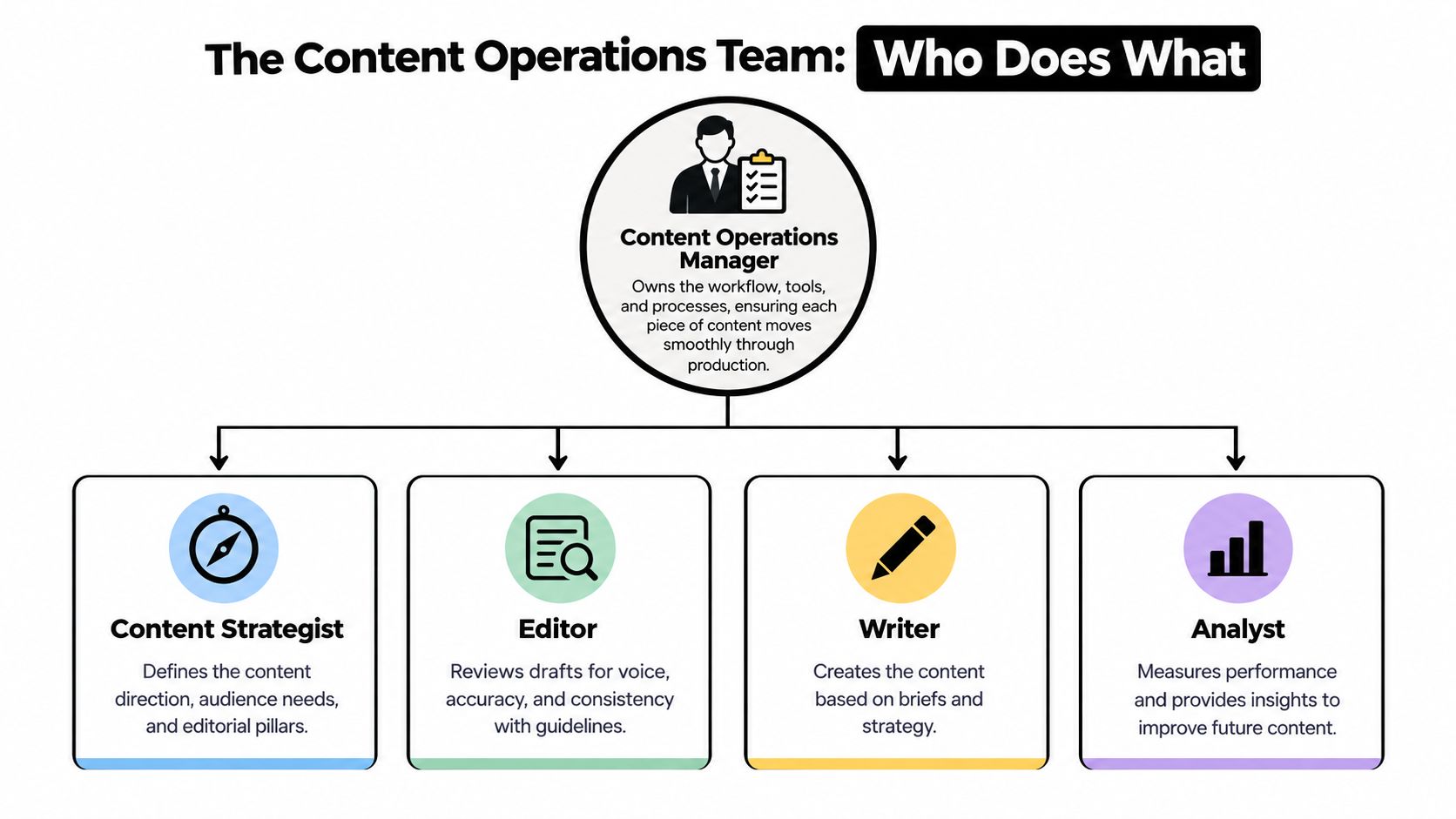
The team roles exist to keep the lifecycle from turning into a free-for-all. A content operations manager owns the workflow, tools, and blocker removal. A content strategist sets the audience and topic direction. The editor protects voice and quality at handoff. The writer produces the draft. The analyst translates performance into the next decision.
What each role actually does
The ops manager is the person who notices that briefs are piling up and asks why they're stuck. The strategist defines what belongs in the pipeline in the first place, so the team doesn't keep chasing random ideas. The editor checks whether the work matches the brief, the standards, and the brand voice before publication.
The writer turns the brief into a usable asset. The analyst looks at what shipped and turns that into guidance for the next planning cycle. On a small team, one person may carry two or three of these hats. On a newsroom with thirty people, the cast expands to include specialist producers, SEO leads, and localization coordinators.
The most common ownership gap isn't writing capacity, it's intake triage. If nobody formally owns the front door, writers end up waiting on decisions they shouldn't have to make.
That gap grows fast because it feels invisible at first. The team still looks busy, but the actual queue becomes harder to see, and the people producing the work spend too much time untangling it. Good role design keeps each person close to the decisions they can make.
Content Operations Versus Content Production
Production is the visible work of writing, editing, and shipping individual assets. Operations is the system that decides which assets get made, by whom, on what cadence, against what standards, and with what reporting. That distinction sounds subtle until a team starts confusing output volume with operational health.
| Dimension | Content Production | Content Operations |
|---|---|---|
| Main focus | Drafts and assets | Workflow and governance |
| Core ownership | Writing, editing, shipping | Intake, cadence, tooling, reporting |
| What it tends to ignore | Measurement and long-term reuse | The prose itself |
| Success signal | More pieces moved through | Better decisions, fewer stalls, clearer ownership |
Why the distinction matters
A production-heavy team can ship a lot and still miss the mark. The calendar fills, the writers stay busy, and the team feels productive, but the wrong topics keep getting approved and the same bottlenecks keep returning. Operations exists to make those blind spots harder to ignore.
The reverse problem shows up too. A team can get obsessed with governance and process, then forget that the content still has to be strong enough to matter. Mature operations protects the work without smothering it, while production keeps the actual asset moving forward.
When teams mistake busyness for health, the usual pattern is predictable. Output rises. Goal attainment doesn't. Writers burn out. That's not a content problem alone, it's an operating model problem.
The KPIs That Tell You If Content Operations Is Working
A healthy content operation should be visible in three buckets: efficiency, quality, and impact. Efficiency shows whether the workflow moves on time. Quality shows whether the review system catches problems without dragging everything into endless revisions. Impact shows whether the work is helping the business, not just filling the calendar.
Efficiency metrics
Time-to-publish tells you how long work stays in the system. If that average climbs above the team's agreed service level, the bottleneck is usually intake or review, not the writer. On-time delivery rate shows whether the calendar is trustworthy. Cost per asset helps reveal whether the team is spending too much effort on avoidable coordination.
Quality metrics
Edit-cycle count is the clearest sign of how much rework a draft needs. Factual accuracy sample checks show whether the process is catching errors before publication. Brand-voice compliance tells you whether the team is producing content that sounds like the same organization, even when different people touch the draft.
Impact metrics
Organic traffic matters, but only when it connects to a useful outcome. Pipeline-attributed traffic, content-influenced revenue, and engagement per asset help show whether the work is reaching the right people and moving them forward. A post can attract attention and still fail if the targeting is weak or the asset doesn't fit the audience's intent.
The point of the KPI set is diagnosis, not decoration. Efficiency problems usually point to intake or review. Quality problems usually point to editing or governance. Impact problems usually point to strategy or distribution.
For a more detailed look at measurement patterns, the metrics that matter are the ones that connect production behavior to business outcomes instead of stopping at vanity numbers.
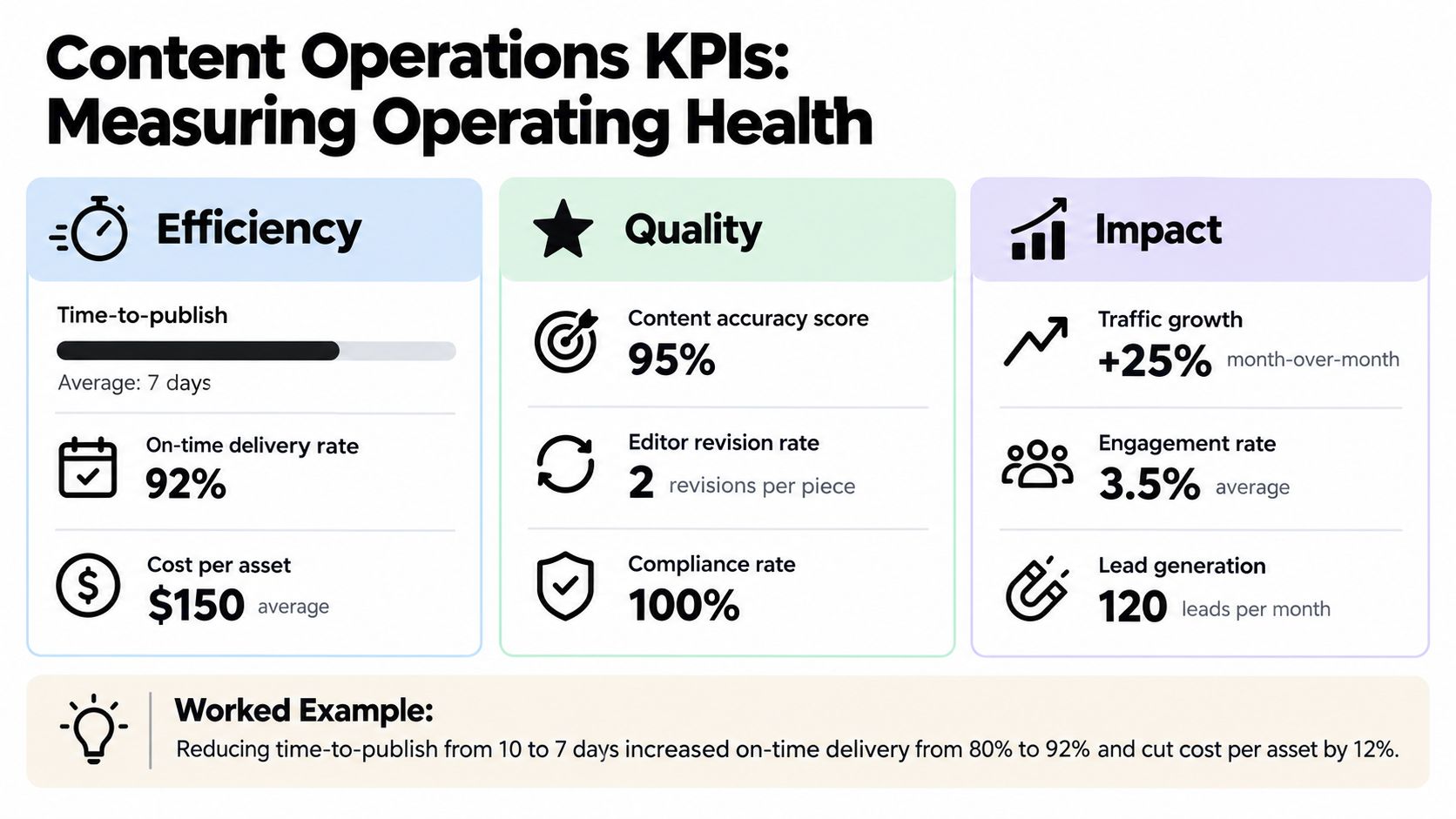
A useful read on the numbers might look like this. If the team ships on time but factual accuracy slips, the review layer is too weak. If quality is strong but impact is flat, the brief or channel choice is probably off.
Where Content Operations Stands in 2026 and What's Changing
A content team can look organized on the surface and still run on memory, slack messages, and whoever happens to be available. The maturity ladder helps separate that mess from a real operating system. At the lowest level, work is ad hoc and person-dependent. In the middle, steps are documented and owned. At the top, the process is stable enough to improve itself.
The market is still climbing that ladder. In the GrowthX content operations maturity review, 58% of organizations were at the earliest maturity levels, levels 1 and 2. A separate update reported a much clearer spread toward the mature end, with 5% at level 1 and 25% at level 4, showing that more teams are moving from improvised coordination to defined workflows.
| Maturity Level | Workflow | Intake Quality | Governance | Measurement |
|---|---|---|---|---|
| Chaotic | Ad hoc and person-dependent | Inconsistent | Minimal | Sporadic |
| Defined | Documented steps, uneven adoption | Better, but uneven | Basic rules | Occasional reviews |
| Managed | Repeatable and assigned | Tighter screening | Clear checkpoints | Regular reporting |
| Optimized | Codified and scalable | Strong gating | Embedded controls | Continuous feedback |
What the newer operational shifts are really answering
AI has not removed bottlenecks, it has exposed them. In the AIrops state of content teams report, 65% of surveyed content teams say research and ideation take the most time, and 40% say outlining and first drafts are a major bottleneck. That points to a familiar failure pattern. If the brief is vague, the draft will be vague. If review rules are loose, faster production only creates faster confusion.
So the pressure is on intake, briefs, and review. Freshness dashboards help teams spot stale content before rankings slip. Governance reviews help editors catch weak claims before they go live. Embedded guidance does the same job a production checklist does in a print room, it keeps each handoff honest and each output traceable.
Machine-assisted drafting raises the bar, because speed without control is just noise at a higher volume. The teams that handle this well do not treat AI as a way around operations. They use it as a reason to tighten operations, make review rules clearer, and keep the final result trustworthy to a reader who did not see the work behind it.
Practical First Steps to Stand Up Content Operations Today
Start with the work you already have, not with a fantasy org chart. First, document how content moves through the team, including the handoffs and the places where things stall. Second, assign one operations owner, even if that person only has part-time responsibility at first.
Third, write a one-page editorial charter that covers voice, approval rights, and refresh rules. Fourth, pick an editorial planning platform that centralizes briefs, calendars, and status so the team can see the queue in one place. Fifth, run a weekly stand-up that checks shipped pieces against the charter and calls out blockers early.
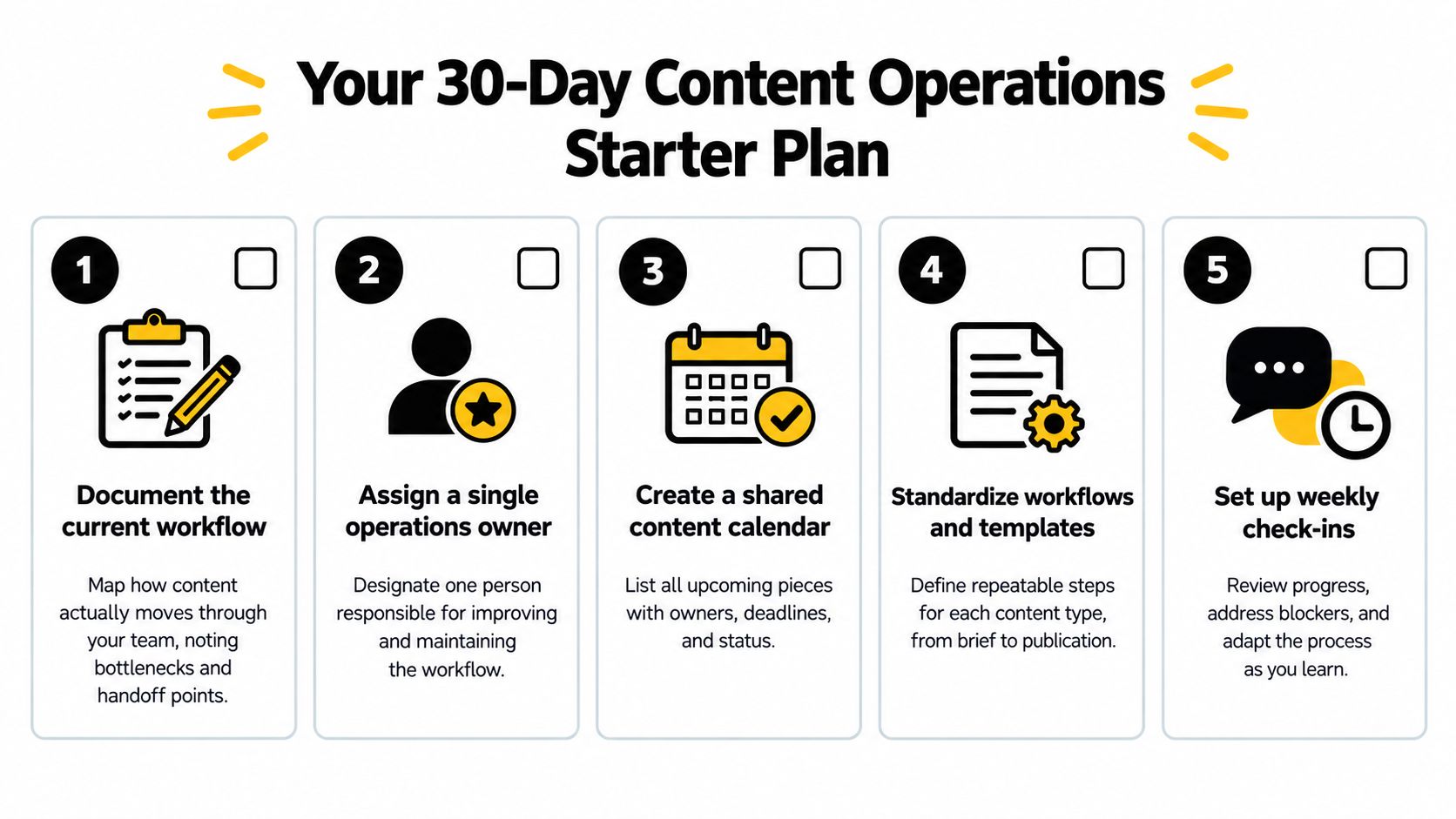
For a small team, that's enough to replace guesswork with a system. For a bigger team, those same habits create the foundation for better governance later, especially when you need a cleaner workflow environment like editorial workflow management software.
TheContentMap helps editorial teams turn scattered planning into a structured workflow, with calendars, ownership, and performance insight in one place. If you're ready to move from spreadsheet chaos to a calmer operating model, visit TheContentMap and see how it supports content teams that need clarity, not more clutter.
Related Articles
7 Best Content Management Tools Ranked for 2026
Your content calendar lives in a shared spreadsheet, drafts are scattered across email threads, and...
Software24 Hour Schedule Template: Build a Full-Day Plan
A 24-hour schedule works when every shift has an owner, a status, and a next action. A paper calenda...
SoftwareChange Control Process for Content Teams
The calendar looked fine at 9 a.m. By lunch, one untracked date move had become an ownership dispute...
Comments (0)
No comments yet. Be the first to share your thoughts.