Content Publishing Workflow How to Map and Automate It
Build a reliable content publishing workflow from draft to distribution. Map stages, assign owners, automate handoffs and track KPIs that keep publishing
You had the draft. The writer filed on time. The editor turned comments quickly. Still, the article missed its publish date by three days because marketing wanted one more pass, the subject matter expert hadn't checked a claim, the CMS upload sat with no owner, and nobody noticed the featured image was the wrong size until the morning it was supposed to go live.
That's a content workflow problem, not a writing problem.
The pain in the calendar is often felt first. Posts slip. Launches bunch up at the end of the week. Slack fills with “who's got this?” and “is this approved yet?” questions. Then the usual reaction kicks in: push writers harder, shorten draft deadlines, ask for faster turnaround. That rarely fixes the issue. The draft is only one step in a chain. If the chain has weak handoffs, unclear owners, and fuzzy approval rules, speed at the keyboard won't save you.
A content publishing workflow is the operating system behind your editorial calendar. It controls how an idea enters the pipeline, who shapes the brief, when experts review for accuracy, how approval happens, who formats the final asset, what gets checked before publish, and how the piece gets distributed after it's live. If those steps aren't visible and assigned, the calendar is just a list of hoped-for dates.
Table of Contents
- Why Your Content Publishing Workflow Matters More Than Writing Speed
- Mapping Your End to End Publishing Workflow With Clear Ownership
- Where Publishing Workflows Stall and How to Diagnose Bottlenecks
- How to Optimize and Automate Without Losing Control
- Roles Tools and Editorial Calendar Setup That Keep Teams Aligned
- Measure Improve and Sustain Your Publishing Workflow
Why Your Content Publishing Workflow Matters More Than Writing Speed
Monday starts with a clean calendar. By Thursday, a finished draft is still sitting in review, legal wants changes no one budgeted time for, the CMS entry has no owner, and the launch date slips again. The writer did their job. The system did not.
That distinction matters because publishing delays rarely come from typing speed. They come from unclear ownership, loose approval rules, and handoffs that depend on memory. Teams often respond by pushing writers to file faster. I have almost never seen that fix the actual constraint. A faster draft just reaches the same stalled queue sooner.
Analysts at Digital Applied found that manual approval cycles lose far more time to waiting and rerouting than to editorial review itself. That matches how content teams break. Throughput is usually a coordination problem.
What the workflow actually controls
A publishing workflow sets the rules for how work moves, who can advance it, and what must be true before the next person touches it. That starts before the first sentence is written and continues after the article is live.
In practice, it governs decisions like these:
- Intake: Who can request content, what information they must provide, and who says yes or no.
- Scope: What the piece needs to do, which audience it serves, and what counts as done.
- Assignment: Who owns the draft, the review path, and the deadline at each step.
- Approval: Which stakeholders are required, what they are reviewing for, and when their input is due.
- Production: Who formats, uploads, checks links, checks images, and schedules publication.
- Distribution: Who publishes supporting assets and confirms promotion occurred.
- Post-publish follow-up: Who reviews performance, logs lessons, and decides whether the piece needs an update.
One missing owner is enough to stop the line.
That is why workflow quality affects output more than writing speed does. A strong writer can produce a draft in two days. If the brief was thin, the SME review was optional, and final approval lives in someone's inbox, that speed does not reach the publish date.
What good operations look like
Healthy workflows look boring. Articles move because each stage has an owner, an entry condition, and a clear finish line.
Editors know whether a piece is waiting on facts, approval, or production. Writers get a usable brief instead of backfilling strategy halfway through the draft. SMEs review for accuracy, not headline preferences. Production is planned work, not cleanup done an hour before publish.
Bad workflows show a different pattern:
- Deadlines exist, but no one owns the decision to move the piece forward
- Reviewers appear late because approvers were never defined at the start
- Accuracy questions stay open while the article keeps moving
- CMS formatting and QA get squeezed into the final hour
- Promotion happens only if someone remembers
The practical shift is simple. Treat publishing as a managed series of handoffs with gates, not as a writing sprint with admin work attached. Teams that make that shift usually do not need faster writers first. They need clearer ownership, fewer ambiguous approvals, and a path from draft to publish that does not depend on chasing people down in Slack.
Mapping Your End to End Publishing Workflow With Clear Ownership
Monday starts with a draft that looks finished. By Wednesday, it is stuck in legal because nobody asked for compliance input during briefing. On Thursday, the SME objects to the core claim. The writer was fast. The workflow was not.
That is the point of mapping the full path. Publishing throughput is usually controlled by ownership, gate design, and handoffs, not by how quickly a writer can fill a page.
A useful operating model breaks the work into six stages: plan, assign, create, approve, publish, and distribute, with metrics tied to lead time, cycle time, review lag, schedule adherence, and publishing volume, as outlined in this editorial calendar workflow guide. The value in that model is simple. It makes the hidden work visible.
Start with a visual map before you start changing tools.
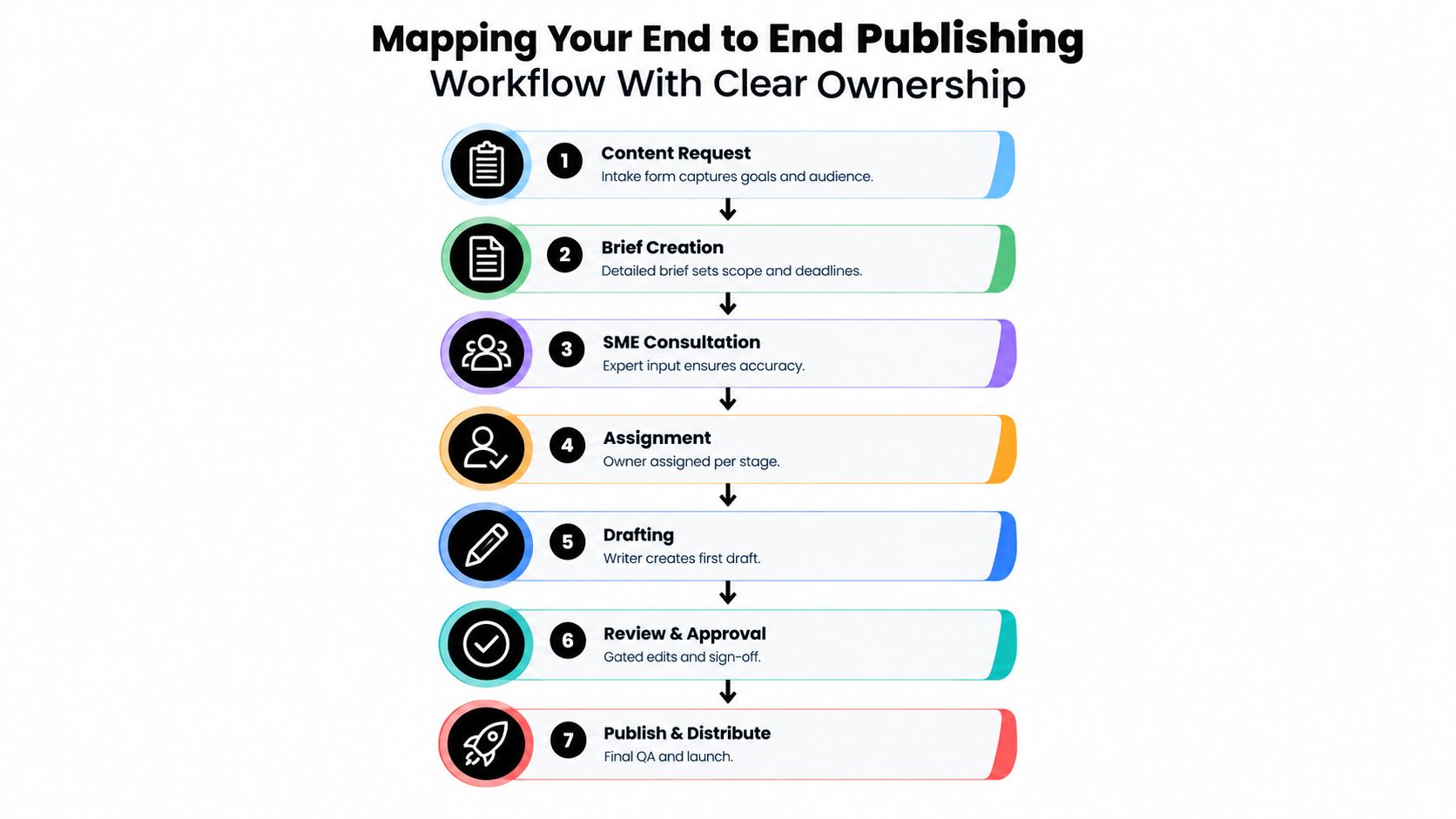
The gated sequence that works in practice
A workable publishing map usually includes these stages: content request, brief creation, SME input, writer assignment, first draft, editorial review, SME accuracy review, revisions, final approval, formatting and upload, QA, publish, distribution, then refresh. The exact labels matter less than the control points. Each stage needs one owner, one entry condition, and one decision about whether the piece moves forward.
Here is the sequence I use.
Content request
The request needs a business reason, target reader, format, and desired outcome. The owner is usually the managing editor or content lead. If the request is just “we should cover X,” it is not ready.Brief creation
Weak workflows create delays. A usable brief sets the angle, audience, search intent if relevant, required sources, claims that need proof, internal links, constraints, and deadline. It should also name who reviews for accuracy and who has final approval. If those names are missing, the brief is incomplete.SME consultation
Pull expert input forward when the topic can break on accuracy. Early input is faster than rewriting a draft built on the wrong premise. I do not bring SMEs in to wordsmith. I bring them in to prevent factual drift and bad framing.Writer assignment
Assign one writer and one editor. Shared ownership sounds flexible, but in practice it usually creates drift, duplicate feedback, and avoidable waiting time.
A clean handoff model helps here. This idea-to-published workflow example is a good reference if your current process is spread across docs, spreadsheets, and chat.
First draft
The writer's job is to answer the brief, not guess at strategy mid-draft. If source gaps or open questions remain, they should be flagged clearly at submission. Hidden uncertainty is what creates messy review loops.Internal review and editing
Editorial review should resolve structure, argument, positioning, and brand fit before the piece goes to an SME. Editors should not send rough thinking downstream and ask specialists to sort it out.SME accuracy review
This stage checks facts, claims, terminology, and omissions. It is not a second editorial pass. If SMEs are routinely rewriting intros and headlines, the handoff into review is wrong.Final approval
One person should decide whether the piece is approved. Other stakeholders can advise, but a crowded approval chain slows output and weakens accountability.Formatting, upload, and QA
Production work needs its own slot. Metadata, links, images, schema, formatting, and mobile checks are real tasks. Treating them as cleanup at the end is how teams ship broken pages.Publish, distribute, and refresh
Publishing is not the finish line. Someone still owns scheduling, promotion, performance checks, and future updates.
Define "ready" at each handoff
Work slows down when teams pass along drafts that are technically present but operationally incomplete.
Use a checklist like this:
| Stage | Owner | Ready means | Artifact that moves forward |
|---|---|---|---|
| Brief | Editor | Scope approved and benchmark attached | Final brief |
| Draft | Writer | Draft addresses brief and source needs | First draft |
| Internal review | Editor | Structure and positioning are sound | Edited draft |
| Accuracy review | SME | Claims checked and corrections added | SME-approved draft |
| Final approval | Decision-maker | Brand, legal, or campaign sign-off complete | Approved copy |
| Upload | Publisher | CMS entry built with assets and metadata | Staged post |
| QA | Editor or publisher | Links, formatting, and proofing complete | Publish-ready page |
This table does more than organize tasks. It stops bad handoffs from masquerading as progress.
If a writer submits copy with unresolved source questions, that draft is still in drafting. If an editor sends a structurally messy piece to an SME, that piece is still in editorial review. Calling both items "in review" hides the problem.
Keep the pipeline visible
A map on paper does not change throughput by itself. The team needs a live pipeline that shows where each piece sits, who owns the next action, and how long it has been there.
Use statuses that reflect decisions, not generic activity labels. Requested, Briefing, Assigned, Drafting, Editing, SME Review, Approval, Upload, QA, Scheduled, Published, and Refresh Needed work better than stacking everything under "In Progress." That visibility matters even more when you blend AI and SEO into your content, because faster drafting increases pressure on review, approval, and production if those gates are still loosely defined.
A short walkthrough can help teams align on the flow before documenting it in your own system.
Where Publishing Workflows Stall and How to Diagnose Bottlenecks
A draft lands on time, the writer did the work, and the publish date still slips by four days. That failure rarely starts in the document. It starts in the handoffs around it.
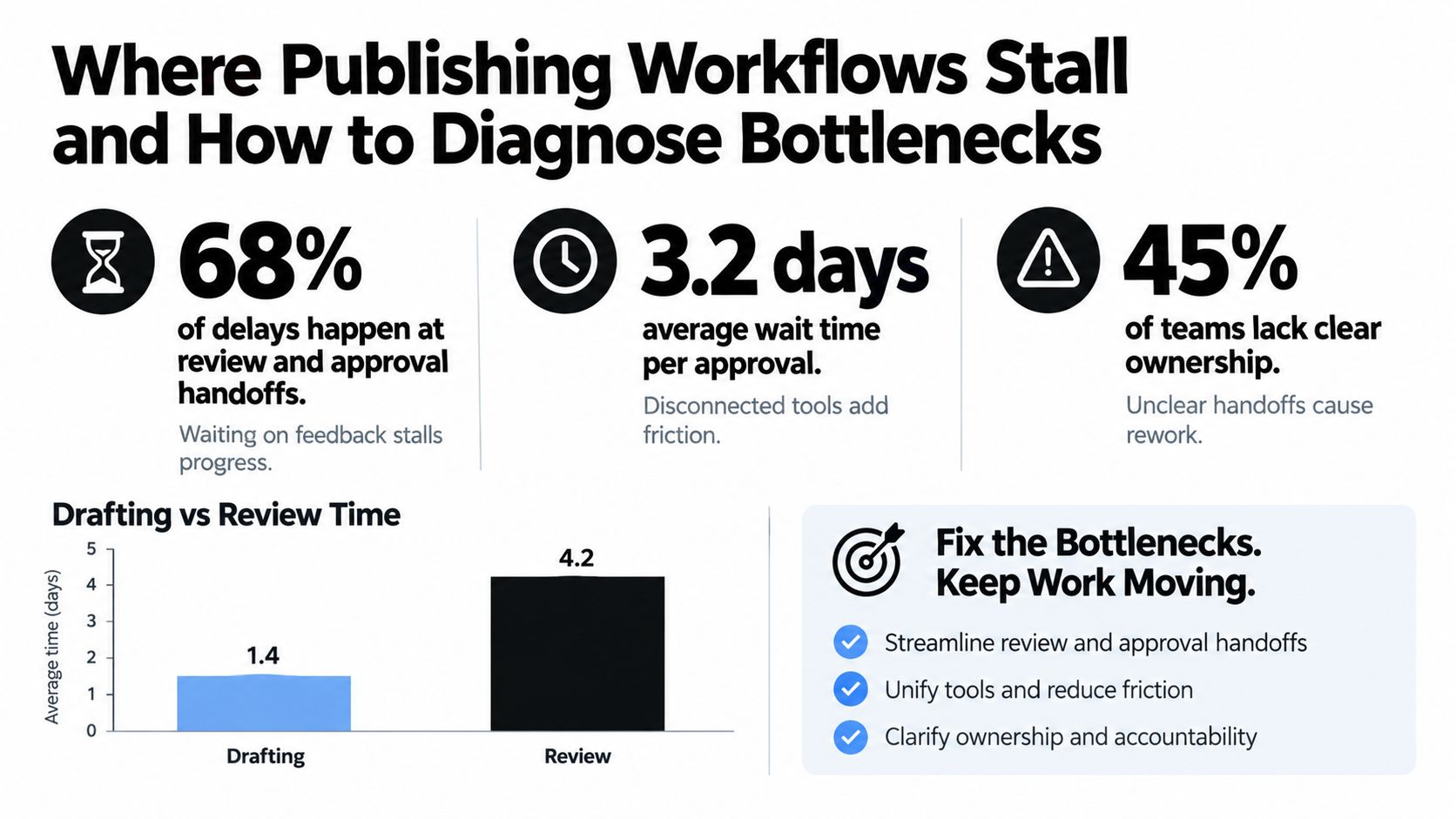
Publishing bottlenecks are usually coordination failures. Review sits with the wrong person. Approval rights are spread across too many people. Production work lives across tools with no clear next owner. Analysts at Contentoo found that internal review and approvals are the top bottleneck for 45% of teams, ahead of getting a clear brief at 41% and producing a first draft at 40%, in their digital content workflow guide. The practical takeaway is simple. Draft speed matters less than gate design once a piece enters review.
The symptoms that point to a real bottleneck
Bottlenecks show up in behavior before they show up in reports.
An editor starts asking in Slack where a piece is because the system does not show the current owner. A product marketer comments on structure after editorial review was supposed to be complete. A publisher rebuilds formatting by hand because the draft, assets, and metadata never arrived in one usable package. None of that is a writing problem.
Watch for these signals:
Status updates happen in chat, not in the workflow
If people need to ask who owns the next step, ownership is already unclear.Reviewers and approvers are treated as the same role
Broad input is useful. Broad veto power slows throughput.Articles keep moving backward
Rework is normal. Rework caused by unclear stage criteria is a design flaw.Production work depends on manual transfer
Copying text, images, links, and metadata between systems adds avoidable delay and creates errors.
A lot of teams label that last category as publishing time. In practice, it is handoff friction.
Diagnose waiting time versus working time
The cleanest way to identify the primary constraint is to separate time spent doing work from time spent waiting for someone else to act.
Jottler's analysis of automated content publishing workflows recommends tracking cycle time by step because the recurring failure points are familiar. Unclear guidelines, unclear ownership, too many approvers, and compliance or brand checks that enter late and stop the flow. Their write-up also notes common patterns such as approval delays, multiple stakeholder sign-offs, repeated approval rounds, and missing ownership.
That gives teams a practical scorecard:
Review lag
How long a piece sits before the assigned reviewer opens it.Approval density
How many separate approvals are required before publication.Re-route rate
How often the piece gets pushed back into drafting, editing, or SME review.Tool friction
How many manual production steps are required to get from approved copy to publish-ready page.Owner clarity
Whether one person is accountable for moving the item forward at each stage.
If you need a clearer system for seeing those choke points, this guide to workflow management for content teams is useful because it focuses on editorial operations, not generic task tracking.
Slow publishing usually comes from hidden waiting. The workflow allows a piece to sit without forcing a decision.
A simple bottleneck review
Review the last 10 pieces you published.
For each one, identify the longest delay, the stage owner, and the rule that should have moved the piece forward. Then ask three blunt questions. Did the current owner know the piece was with them. Did they know what decision they needed to make. Could they approve it on their own, or did the workflow force another round of escalation.
This audit works because it names the actual failure point. Teams often blame slow publishing on writers because drafting is visible. Waiting is quieter, and it usually does more damage to throughput.
If a stage has no clear owner, no due-by expectation, or no entry and exit criteria, fix that stage first. Asking people to work faster inside a vague system rarely changes the publish date.
How to Optimize and Automate Without Losing Control
A piece gets approved in the doc by noon, misses the CMS handoff, sits in someone's Slack for a day, then goes live with the wrong headline because nobody owned final page QA. That is a workflow failure, not a writing failure.
Optimization starts there. The goal is to reduce waiting and remove repeatable busywork without blurring who can approve, who can block, and who has to fix mistakes after publish.
Fix the control points before adding automation
Automation makes a clean process faster. It also makes a messy one harder to see.
I've seen teams add reminders, auto-assignments, and CMS triggers before they decide who has authority to approve a piece. The result is more motion, not more throughput. Drafts move quickly between statuses, but no one knows which comments are optional, which review is final, or who can release the article.
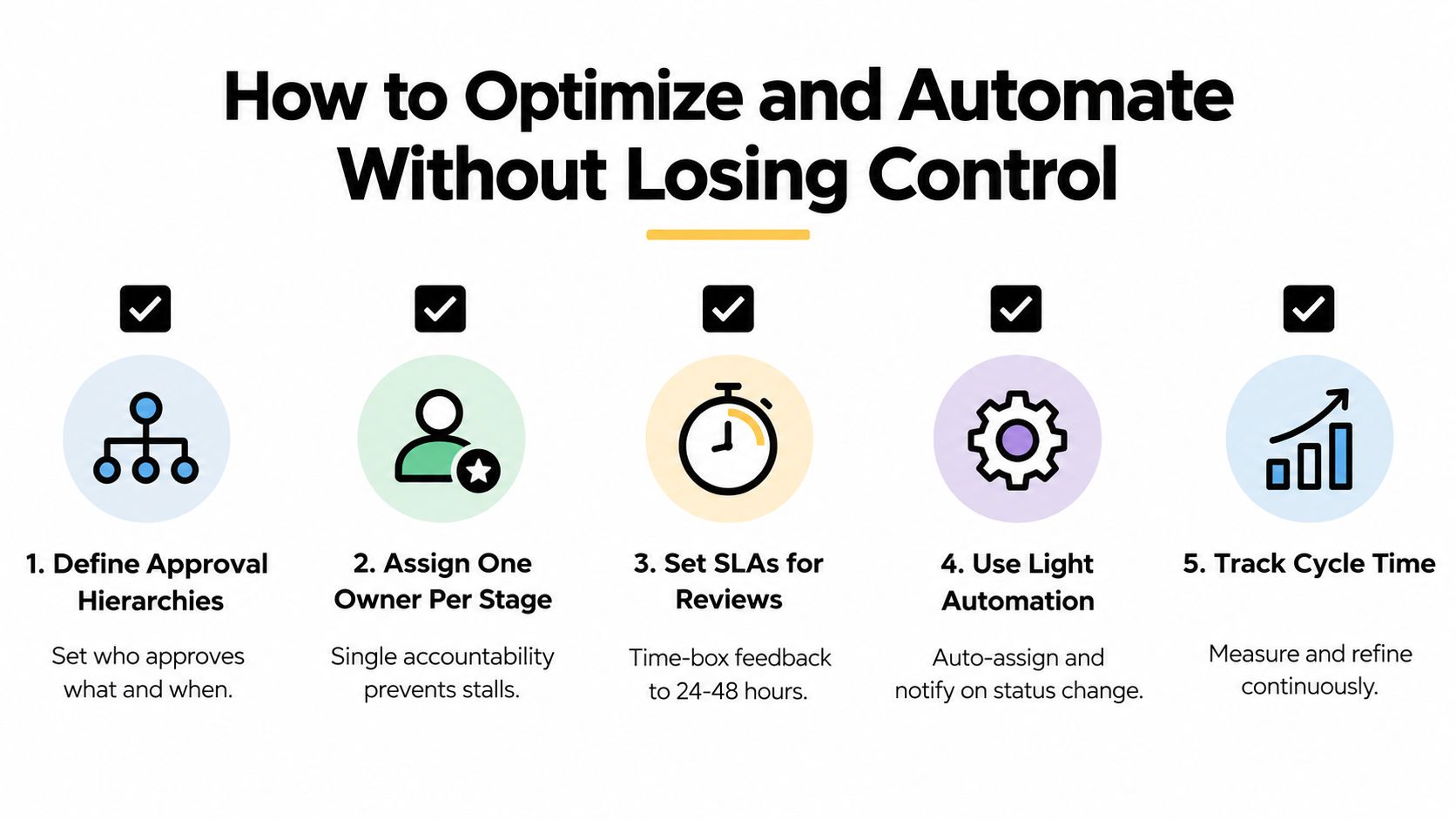
Set the control points first:
One accountable owner at each stage
One person moves the piece forward, returns it with a specific reason, or escalates a real conflict.A short list of actual approvers
Reviewers can advise. Approvers decide. If everyone can stop publication, the queue backs up fast.Time limits on review
Approval windows keep articles from disappearing into “I'll look later.”Defined pass-fail criteria
Each gate needs a job. Legal checks legal risk. SMEs check accuracy. Editorial checks clarity, structure, and brand fit.
That structure matters even more when drafting gets faster. Analysts at The Starr Conspiracy found that AI-assisted B2B blog production can reduce time to publish, while human review and fact checking still remain common steps in the workflow, according to these AI content workflow benchmarks. Faster input increases pressure on approvals, QA, and handoffs.
Operational warning: If you speed up drafting without tightening approvals, backlog shifts downstream into review and publishing.
Automate the handoffs, not the decisions
The safest automation handles routing and visibility.
Use automation for the parts nobody needs to debate:
- Change status after approval so the next owner gets the item immediately.
- Notify the next reviewer when their decision is required.
- Create publish-prep tasks for CMS build, image checks, metadata, and URL review.
- Trigger post-publish distribution tasks for email, social, and internal promotion.
- Flag aging items that have sat too long in one stage.
Tool choice matters. Generic project boards can track tasks, but editorial teams usually need statuses tied to decisions, approval gates, and publish readiness. If you're comparing systems, this guide to marketing workflow management software is a useful starting point.
Keep manual review where errors are expensive
Some work should stay manual because the cost of being wrong is higher than the time saved.
Keep a person responsible for:
- Source and claim verification
- Brand-risk and sensitive language review
- Headline selection
- Final page QA in the CMS
- Channel-specific distribution copy
The trade-off is simple. Automate the steps that move a piece between owners. Keep human judgment at the gates where a weak decision creates rework, reputational risk, or a public mistake.
Teams usually lose control when they automate around unclear ownership. Teams keep control when they standardize the handoff, limit who can approve, and let automation carry the administrative load.
Roles Tools and Editorial Calendar Setup That Keep Teams Aligned
Monday starts with a familiar problem. The draft is done, but nobody knows whether legal has cleared the quote, whether design owes a header image, or whether the publish date is still real. Teams often call that a writing issue. It is usually a coordination issue.
Roles, tools, and calendar design determine whether work keeps moving after the first draft. Strong teams make ownership visible, limit who can change status, and keep the next decision in one place. Draft speed matters. Throughput usually depends more on handoffs than on writing pace.

The core roles that matter
Editorial work slows down when responsibility is shared casually instead of assigned clearly. Every piece needs one owner for priority, one owner for the draft, and named reviewers for decisions that can block publication.
This setup holds up in practice:
| Role | What they own | What they should not own |
|---|---|---|
| Managing editor | Calendar, priorities, deadlines, exception handling | Final factual review on specialist topics |
| Writer | Drafting to brief, revisions tied to feedback | Chasing approvals across departments |
| Subject matter expert | Accuracy, missing context, technical corrections | Rewriting for tone, structure, or SEO |
| Copy editor | Style, clarity, consistency, basic fact checks against cited sources | Deciding whether the piece ships this week |
| Publisher or content manager | CMS build, formatting, on-page QA, scheduling | Fixing argument gaps that should have been handled earlier |
One caution from experience. If the managing editor is also the writer, approver, and publisher, the team can still function for a while. It just stops scaling. Bottlenecks hide inside one reliable person until deadlines start slipping all at once.
Set up tools around handoffs, not departments
Teams do not need a large stack. They need a stack that matches the way content changes hands.
A useful setup gives every article one record that carries the brief, status, due date, assignee, comments, and publish details. If those live across separate systems with no clear source of truth, people work from memory, chat threads, and guesswork. That is when review gets skipped and publish dates become aspirational.
The practical minimum is usually:
- One planning system that shows status, owner, deadline, and blockers
- One drafting environment where comments stay attached to the document
- One CMS with clear responsibility for final build and QA
Anything beyond that should solve a specific coordination problem. Agencies often need client-specific permissions and separate views by account. In-house content teams usually need cleaner intake and easier cross-functional review. Publishers often need faster rescheduling and clearer assignment load because volume creates conflict quickly.
Build an editorial calendar that answers operational questions
A calendar is not just a list of publish dates. It is a control surface for the whole workflow.
Editors should be able to scan it and answer five questions immediately:
- What is scheduled to publish, and when
- What is still in production
- Who owns the next action
- Which items are blocked
- Which deadlines are at risk because an earlier step slipped
If the calendar cannot answer those questions, it is decorative.
I prefer a calendar tied directly to workflow status rather than a separate spreadsheet maintained by hand. The trade-off is less flexibility for ad hoc tracking, but the gain is much better schedule accuracy. Once dates and statuses split into different tools, teams spend more time reconciling information than moving articles forward.
Calendar fields worth standardizing
Keep the setup simple, but standardize the fields that prevent confusion later:
- Content title or working title
- Format or channel
- Primary owner
- Current stage
- Next due date
- Planned publish date
- Blocking dependency
- Campaign, audience, or topic tag
These fields do more than organize work. They expose where the delay sits. A piece marked "waiting on review" with no named reviewer is not delayed by writing. It is delayed by missing ownership.
Match the setup to the team you actually have
A three-person team should not copy the process of a newsroom. A multi-stakeholder enterprise team should not run off a shared sheet and good intentions.
Use the lightest setup that still makes handoffs explicit:
- Small team: one editor can own the calendar, assign drafts, and schedule publication, as long as review standards are still documented.
- Agency team: build around approvals, client visibility, and the ability to separate urgent client work from planned production.
- High-volume publisher: optimize for assignment balance, fast schedule changes, and repeatable production checks.
Good alignment comes from clear ownership, visible status, and one calendar the whole team trusts. That is what keeps content moving when plans change, feedback arrives late, or three articles need to ship on the same day.
Measure Improve and Sustain Your Publishing Workflow
A piece goes live on Friday, but no one can say why it missed Tuesday. The draft was done. Legal had comments. The SME replied late. The editor made two rounds of fixes. By the time it publishes, the team has a result but not a reliable process.
That is the test of a publishing workflow. A team does not improve throughput by writing faster alone. It improves throughput by measuring handoffs, review lag, and ownership gaps, then fixing the stages that create waiting.
Treat the workflow like an operating system for content production. Keep editorial judgment human. Measure the parts that determine whether work moves or sits.
The metrics worth watching every month
A useful dashboard is small and specific. It should help an editor spot where coordination is failing before the calendar slips again.
Track these consistently:
Lead time
Time from approved idea to published piece.Cycle time by stage
How long work spends in drafting, review, revisions, upload, and approval. Separate active work from waiting time.On-time publish rate
Whether articles ship on the date the calendar promised.Revision rounds per piece
Extra rounds usually point to weak briefs, unclear standards, or too many reviewers changing the target.Blocked items by cause
Late SME input, missing assets, legal review, and formatting issues should not all live under "in progress."Repurposed vs. net-new output
This shows whether the team is building efficiently or restarting from zero too often.
These metrics matter because they expose a coordination problem in plain terms. If lead time is growing while draft time stays flat, the issue is not writer speed. It is handoff design, review capacity, or approval sprawl.
Build a post-publish review that feeds the next brief
Publishing is not the finish line. It is the point where the team gets evidence.
A short review after publication should answer four questions:
- Did the piece achieve the goal set in the brief?
- Which stage created the most waiting?
- Which edits or comments keep repeating?
- Should this piece be updated, repurposed, or retired?
Patterns matter more than one-off misses. If editors keep rewriting structure, the brief is weak. If factual changes arrive at the end, SMEs are entering too late. If formatting problems show up during upload, the handoff into CMS is under-specified.
Performance review should connect back to workflow review. Teams that want a clearer framework for evaluating results can pair operational metrics with content performance metrics that matter, then use those findings to tighten briefs, adjust review gates, and make better scheduling calls.
One small fix often beats a large process rewrite.
Removing one unnecessary approver can do more for throughput than asking writers to produce drafts a day faster.
A sustainment checklist
Workflows drift. People change roles, new approvers appear, templates get ignored, and old exceptions become standard practice. A monthly review keeps the system clean.
Use a short checklist:
- Audit one recently published piece from intake to publish
- Confirm that each stage still has one clear owner
- Check where waiting time exceeded working time
- Remove approval steps that no longer reduce risk
- Review recurring editor comments for template or briefing problems
- Update statuses, forms, or checklists that the team has stopped using
- Feed performance lessons into the next cycle of planning
Teams sustain quality by keeping the workflow explicit and easy to inspect. Throughput holds up when ownership is clear, bottlenecks are visible, and process changes stay tied to real failure points instead of opinions.
Related Articles
Writing Styles Guide: Complete Plan for Consistent Content
A writing style guide can unify a team's content, and research found that approximately 82% of s...
Software10 Content Scheduling Apps for Editorial Teams
Your team's ideas live in a document, drafts sit in a shared drive, approvals happen in chat, an...
SoftwareHashtags in Twitter: A Complete Guide for Publishers in 2026
You're about to publish a thread about a new climate report. The copy is ready, the images are a...
Comments (0)
No comments yet. Be the first to share your thoughts.