Hashtags in Twitter: A Complete Guide for Publishers in 2026
Learn how hashtags in Twitter work, why they matter for discovery, and proven strategies publishers use to plan, track, and measure hashtag campaigns in 2026.
You're about to publish a thread about a new climate report. The copy is ready, the images are attached, and your cursor is hovering over the hashtag field. Should you use #climate, the broader #climatechange, or a narrower tag that only specialists may search?
That small decision matters, but probably not for the reason many social guides suggest. Hashtags on Twitter, now X, can help publishers create searchable conversation paths, organize campaign participation, and identify posts for later analysis. They don't guarantee distribution, and they can't rescue a weak opening or unclear story.
The useful question isn't “How many hashtags get the most reach?” It's “Which tag gives readers and editors a reliable way to find, join, and measure this conversation?”
Table of Contents
- Why Hashtags Still Matter for Publishers
- What a Hashtag Actually Is on X
- Why More Hashtags Do Not Mean More Reach
- Choosing the Right Hashtag Before You Publish
- The Language Problem Most Hashtag Guides Ignore
- Branded Versus Campaign Versus Trending Hashtags
- Measuring Whether a Hashtag Actually Worked
- Turning Hashtags Into an Editorial Workflow
Why Hashtags Still Matter for Publishers
The climate editor has three reasonable options. #climate is broad and easy to understand, #climatechange is more specific, and a report-specific tag might be useful only to people following that publication or event. None is automatically best. The right choice depends on the conversation the editor wants to enter and the search behavior readers are likely to use.
That's the practical role of hashtags in Twitter. They act as explicit retrieval keys. A reader can select a tag to find public posts using the same token, while an editor can search and filter posts by hashtag, date, account, and location through X's search tools. X's hashtag guidance describes this basic function clearly: the tag connects posts that share the same written identifier.
The history explains why the feature still feels different from ordinary keywords. On August 23, 2007, Chris Messina proposed using the hash symbol to group conversations, drawing on Internet Relay Chat. Users adopted the idea before Twitter made it an official platform feature. In October that year, Nate Ritter used #SanDiegoFire to collect wildfire updates, showing that a hashtag could become a live information channel rather than a decorative label. Twitter added automatic hashtag hyperlinking in 2009, turning the convention into a built-in navigation feature. Britannica's history of the hashtag documents that progression.
Editorial principle: Treat a hashtag as a public query that your post can join, not as a button that commands X to distribute it.
For a publisher, that distinction changes the workflow. Store the approved tag with the story, campaign, language, owner, and dates. Then reporting can separate posts that participated in a defined conversation from posts that merely mentioned the same subject in ordinary text.
What a Hashtag Actually Is on X
A hashtag is an indexable token formed by placing # before a keyword or phrase. X treats the resulting string as a clickable identifier, so selecting it retrieves public posts containing that same token.
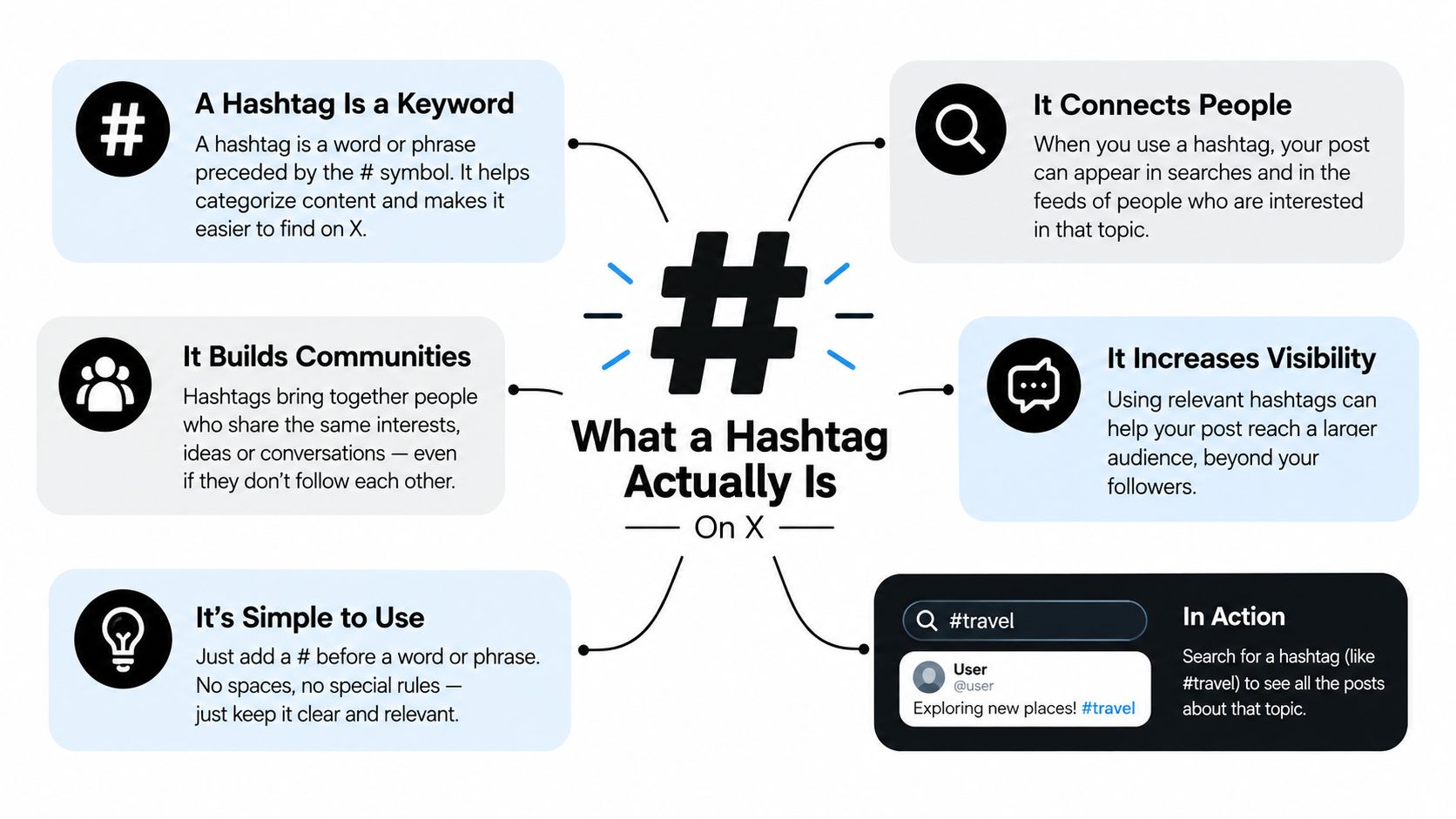
The mechanics are simple, but small formatting choices have large editorial consequences:
- The hash must touch the token.
#ClimateReportcan function as a hashtag.# ClimateReportcannot, because the space breaks the identifier. - Spaces and punctuation split phrases.
#Climate Reportcreates a hashtag for “Climate” and leaves “Report” outside it. Punctuation can also stop the token, so editors should check the rendered post rather than trusting a draft. - Spelling creates the destination.
#climatepolicy,#climate-policy, and#climatepoliciesare different strings. Readers using one form won't automatically enter the other stream. - Capitalization improves reading, not identity.
#ClimatePolicyis easier to scan than#climatepolicy, while the letters still represent the same underlying phrase for ordinary hashtag matching.
A hashtag isn't a private folder owned by the account that created it. It's a shared public query. Anyone can add the same token to a post, which is why a campaign tag can gather contributions from a newsroom, interviewees, event attendees, and readers in one searchable stream.
That makes hashtags different from topics curated or inferred by X. A topic may describe a subject that the platform associates with a post, while a hashtag is the exact character string an editor or reader types. The hashtag's value comes from predictability. Clever wording is less useful than a token that readers can spell, search, and recognize.
Editors should also remember that indexing doesn't equal ranking. A post may appear in a hashtag search and still rank poorly among other results because X evaluates relevance and interaction signals. The tag opens a door. The post still has to give people a reason to enter.
Why More Hashtags Do Not Mean More Reach
A city newsroom is preparing two posts about a new flood-prevention plan. One uses a single, precise tag. The other fills the final line with broad terms. The second post looks busier, but the extra labels do not create extra distribution.
X ranks posts using several signals, including engagement, media interaction, author quality, network proximity, media popularity, trend status, category, latency, and search relevance. A hashtag supplies context and a retrieval path. It does not operate as an independent reach switch. An independent analysis of search and recommendation signals supports that broader view.
Compare the two drafts:
- Focused version: “The city's new flood plan prioritizes wetlands over concrete barriers. Our analysis explains what changes for residents. #ClimatePolicy”
- Stacked version: “The city's new flood plan prioritizes wetlands over concrete barriers. Our analysis explains what changes for residents. #Climate #ClimateChange #News #Environment #Policy #Green”
The focused post gives readers one clear query path. The stacked post offers several overlapping contexts, so the editorial subject becomes less distinct. It also makes the message feel more promotional and leaves less room for readable copy.
| Tagging approach | Engagement testing | Topic signal | Editorial risk |
|---|---|---|---|
| One focused hashtag | A clear baseline for comparison with similar posts | Specific and easy to interpret | Low clutter, with one query key to monitor |
| Several broad hashtags | Results are harder to attribute to any one tag | Diffuse, with competing meanings | Can look promotional and weaken the post's focus |
| No hashtag | A clean control for posts where the copy carries the subject | The written copy defines the topic | No deliberate hashtag query for retrieval or reporting |
The practical conclusion is narrower than “one tag always wins.” Editors should compare similar posts, record the tagging approach in a workflow such as TheContentMap, and report whether the tag improved discovery, interaction, or neither. Adding tags alone does not guarantee higher reach. An irrelevant tag can also make performance harder to interpret.
A specific hashtag still cannot rescue weak relevance or limited interaction. An untagged post with clearer writing may rank above a tagged post because its content gives readers a stronger reason to engage.
Research on hashtag diffusion also challenges the idea that a tag spreads through a simple chain reaction. Spread reflects network structure and user identity, as well as the outside events driving attention. For editorial planning, the useful rule is direct: select a conversation the publication genuinely covers, then make the post valuable within that query. Track the tag as a retrieval and measurement field, not as a promise of reach.
Choosing the Right Hashtag Before You Publish
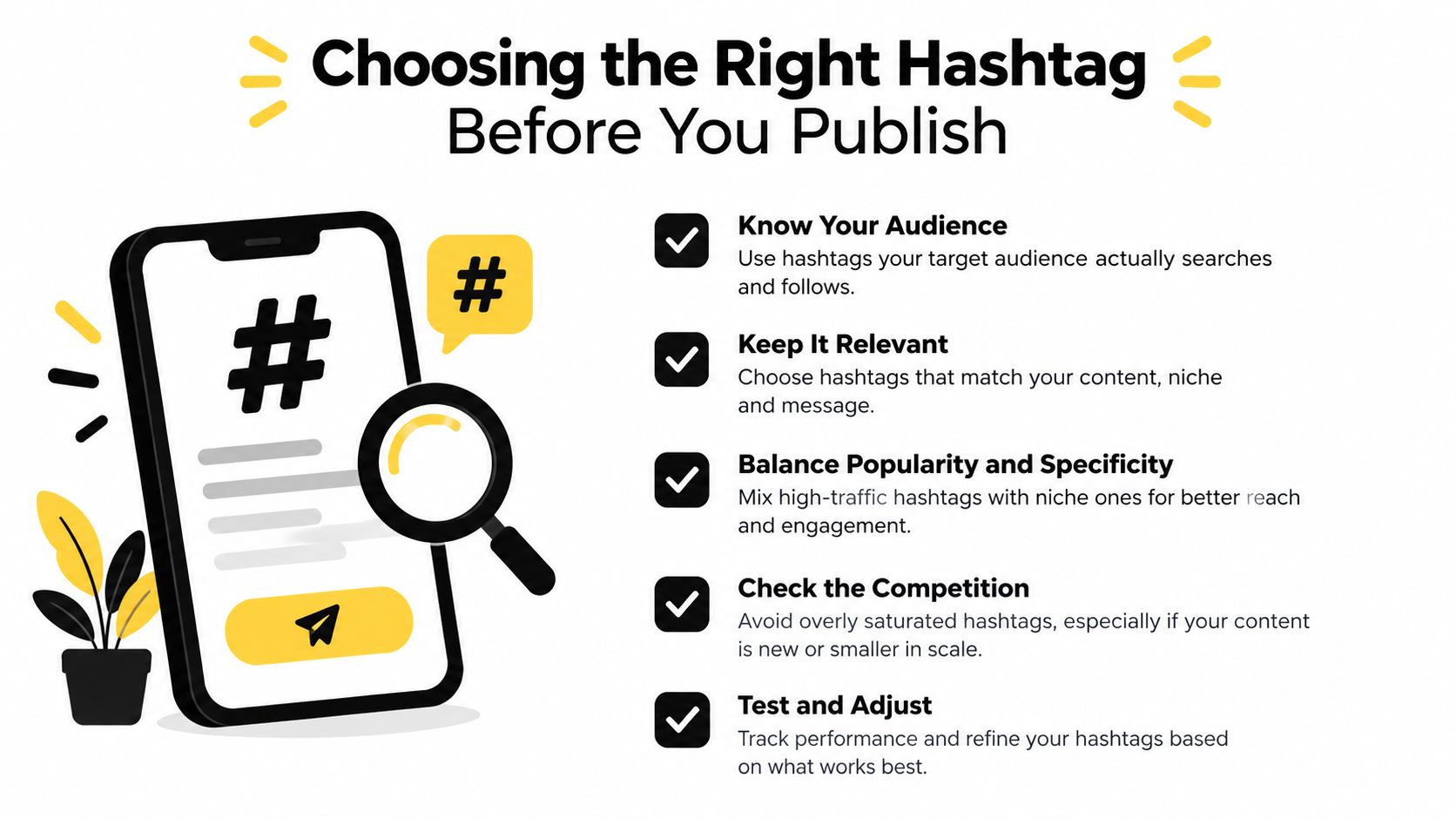
Start with a search question: Would a reader type this exact tag into X to find posts like mine? If the answer is no, the tag may be a label for the newsroom rather than a useful public query.
Run each candidate through four checks:
- Token check: The tag must parse as one uninterrupted string. Remove spaces and test punctuation before approval.
- Reader check: Prefer familiar words over clever abbreviations unless the community already uses the abbreviation.
- Specificity check: A tag should describe the story's actual subject. A health desk covering preventive care might choose #HeartHealth for a broad explainer, #CardioTips for practical advice, or a branded series tag for a recurring editorial format.
- Ownership check: Search the tag before publishing. Make sure another group hasn't attached an unrelated, confusing, or unsuitable meaning to it.
Readable casing helps when several words are combined. #HeartHealth is easier to parse than #hearthealth, especially in a fast-moving feed. It doesn't change the underlying phrase, but it helps readers recognize the words quickly. Avoid excessively long tags because they're harder to type, remember, and fit naturally into a post.
The health example produces three different editorial jobs. #HeartHealth is a broad subject key that readers may recognize. #CardioTips narrows the content toward practical advice, but it may not match the terminology used by the target audience. #YourPubExplains identifies the publication's series and helps create an archive, but it doesn't describe the health topic on its own. The final choice may be one topical tag, one branded tag, or no tag, depending on whether the post is joining a public health conversation or primarily building a series archive.
Store the decision in the content brief, not in one editor's memory. A useful tag record includes:
- Canonical hashtag: The approved spelling and casing.
- Approved variants: Alternative forms worth monitoring, not necessarily publishing.
- Campaign or series: The editorial initiative connected to the tag.
- Owner and dates: Who maintains it and when its active use ends.
- Primary language and region: The audience context for the term.
- Intended use: Search navigation, campaign participation, community conversation, or reporting.
A scheduler can help place the tag in planned posts, but it shouldn't replace the validation step. A structured social media scheduling workflow is most useful when the approved identifier and its purpose are already clear.
The Language Problem Most Hashtag Guides Ignore
Hashtag habits vary by language. Advice written for English-speaking publishers often assumes that readers everywhere use the same balance of plain keywords, abbreviations, and tags. They don't.
Research covering 62 million tweets across more than 100 languages found that hashtags appeared in 11% of tweets overall, with usage ranging from 18% of German-language tweets to 5% of Japanese-language tweets. The multilingual hashtag study shows why a universal instruction such as “always use one or two hashtags” can mislead an international editorial team.
The issue isn't only translation. Local readers may use a coined phrase, a shortened form, a transliteration, or a term that has no direct equivalent in English. A translated global tag can be grammatically correct and still fail as a retrieval key because people don't search for it.
| Language context | Hashtag behavior | Risk for English-first teams |
|---|---|---|
| English | Often treated as the default campaign language | Assuming an English tag is the strongest route in every market |
| German | Research reports comparatively frequent hashtag use | Copying global rules without checking local conventions |
| Japanese | Research reports comparatively infrequent hashtag use | Assuming low tag use means low topic interest |
| Spanish, Arabic, and Portuguese markets | Requires local terminology validation | Translating a global list without testing how readers actually search |
Multilingual network behavior adds another layer. The same study found that multilingual users increased their network betweenness centrality by 13.5%, and multilingual network neighbors made monolingual users nearly four times as likely to share hashtags from another language. Those findings support a practical workflow, not a universal volume rule.
Create a separate registry for each language and market. Record the local spelling, transliteration, meaning, audience, and possible false associations. Then monitor equivalent tags across markets rather than assuming one English tag represents the whole campaign.
A smaller tag in the audience's own language may offer better relevance than a globally popular English tag.
For example, an international publisher covering a public health issue could maintain one English tag for its global desk, a locally coined tag for a regional edition, and a transliterated variant for search monitoring. The newsroom can publish the version that local readers recognize while still connecting the variants in reporting.
Branded Versus Campaign Versus Trending Hashtags
Publishers usually ask hashtags to perform different jobs, then judge all of them by reach. That creates bad decisions. A branded tag may be valuable because it builds an archive, while a campaign tag may matter because it groups a defined set of posts for reporting.
| Hashtag type | Ownership | Typical lifespan | Primary job | Metric that proves it worked |
|---|---|---|---|---|
| Branded | Publisher or recurring series | Ongoing or recurring | Create a searchable identity archive | Relevant reader posts, searches, and archive usage |
| Campaign-specific | Publisher, partner, or event team | Time-boxed | Group participation around an initiative | Participation from intended contributors and campaign reporting clarity |
| Trending | External public conversation | Short and unstable | Join a topic people are already searching | Relevant discovery and qualified interactions |
| Community | External group or shared interest | Depends on the community | Enter an established conversation credibly | Meaningful replies, shares, and audience fit |
A branded tag such as #YourPubExplains is useful when the publication wants readers to find related explainers. It shouldn't be added to every post automatically if no archive or series exists.
A campaign tag gives a launch, investigation, live blog, or reader callout a common key. Assign an owner and an end date. Without those controls, old campaign tags can drift into unrelated use and contaminate later reports.
A trending tag is borrowed context, not owned real estate. Use it only when the story fits naturally in that conversation. Adding several unrelated trending tags may expose the post to the wrong audience and weaken its topical clarity.
A community tag requires more care. A newsroom entering a specialist conversation should contribute reporting, explanation, or a useful question, rather than attaching the tag merely to attract attention.
SupaBird's hashtag insights for trending conversations are useful background for editors comparing tag purposes and monitoring public usage. The operational conclusion is straightforward: one post should usually have one primary hashtag job. If a campaign needs both a branded archive and a public event tag, choose the combination deliberately and record why.
Measuring Whether a Hashtag Actually Worked
Counting hashtag appearances doesn't show that a hashtag caused discovery. A post may use a popular tag because it covers a major event, and the event itself may explain the attention. Measurement should separate correlation from contribution.
Begin with comparable posts. Compare similar story formats, topics, audience sizes, languages, and publication windows. Change the hashtag variable where possible, then log the result in a shared report. A useful test can alternate tagged and untagged versions across equivalent stories, provided the editorial treatment remains comparable.
Track three groups of signals:
- Discovery: Impressions from non-followers, search activity, profile visits, and visits that begin from the tagged conversation.
- Engagement: Replies, reposts, quote posts, and engagement rate relative to impressions.
- Downstream value: Link clicks, article sessions, newsletter signups, and time on page.
| Metric category | Specific metric | What it tells you | Minimum sample needed |
|---|---|---|---|
| Discovery | Non-follower impressions | Whether the post reached beyond the existing audience | Define a comparison set before the test |
| Discovery | Search activity and profile visits | Whether readers took an intentional next step | Compare with similar posts without the tag |
| Engagement | Replies, reposts, and quote posts per impression | Whether the conversation attracted active response | Use repeated comparable posts |
| Downstream | Article clicks and newsletter signups | Whether discovery produced a useful editorial outcome | Set a decision threshold in advance |
| Archive value | Posts and interactions using the campaign tag | Whether the tag organized participation | Review the complete campaign window |
Don't declare a tag effective after one unusually timely post. Record the story type, publication context, language, tag purpose, and any external event that could have affected attention. A broader guide to content performance metrics can help teams connect social signals with downstream editorial outcomes.
Measurement rule: Keep a hashtag only when it creates a useful discovery, participation, archive, or reporting outcome that comparable posts can support.
Retire a tag when its relevant conversation has plateaued, its meaning has been hijacked, or it repeatedly attracts the wrong audience. Preserve the historical record, but stop treating an inactive or contaminated identifier as an active campaign asset.
Turning Hashtags Into an Editorial Workflow
The simplest way to improve hashtag decisions is to move them from last-minute decoration into the publishing record. Before approval, the editor confirms that the tag describes the story, parses correctly, has a suitable public meaning, and belongs to the intended language and market.
A workable routine looks like this:
- Select the job. Decide whether the tag supports search, a campaign, a branded archive, or community participation.
- Validate the destination. Search the exact spelling and inspect recent public use for confusion or unrelated meanings.
- Attach the metadata. Add the canonical tag, variants, language, owner, campaign, start date, end date, and story URL to the content record.
- Publish with restraint. Use the smallest number of relevant tags needed to create the intended query path.
- Review the evidence. Check discovery, engagement, and downstream results after the post has had time to gather activity, then review the campaign record again after its close.
This approach fits naturally into a content publishing workflow, where the same record can hold the brief, approval status, scheduled post, tag choice, and performance notes. The 48-hour review can capture early discovery and conversation quality. A later review can assess archive value, downstream visits, and whether the tag should remain active.
The core mental model is simple: hashtags are retrieval and measurement keys. They help people find a shared stream and help editors identify a defined set of posts. They don't replace strong writing, clear context, relevant timing, or distribution.
Start today by auditing your current hashtag usage, choose one campaign for a controlled comparison, and schedule its first measurement review before publishing.
TheContentMap gives editorial teams a shared place to plan stories, assign ownership, organize topics and campaign tags, schedule publishing, and connect published work with performance insights. Use it to turn hashtag decisions from improvised post edits into a repeatable part of your content operation, then visit TheContentMap to explore the workflow.
Related Articles
Brand Awareness Measurement: Surveys, Metrics and Results
Aided recognition can look impressive while spontaneous recall barely moves. In research analyzing b...
SoftwareProject Management Checklist for Editorial Teams: 10 Steps
The feature is due Friday. The writer never saw the approved angle, the legal reviewer is out, and t...
SoftwareContent Performance Metrics: What to Track, How, and Why
You've got a folder of published articles, a traffic report that doesn't look bad, and a mee...
Comments (0)
No comments yet. Be the first to share your thoughts.