10 B2B Marketing Examples Worth Studying in 2026
Explore 10 B2B marketing examples with tactics, workflows, metrics, and actionable lessons for stronger content strategy and campaign planning.

The best B2B marketing examples don't succeed because a single campaign idea happens to be clever. They succeed because teams build an operating system around the idea, with a clear audience, repeatable production, coordinated distribution, visible ownership, and a measurement plan that survives beyond launch day. A memorable video or landing page is only the visible layer.
That distinction matters because 91% of B2B organizations use content marketing, yet only 12% rate their programs highly effective, according to a 2026 compilation of Content Marketing Institute research. The gap isn't usually a shortage of ideas. It's a shortage of connected planning. Nearly half of organizations in the same source lack a documented content strategy.
The ten examples below are therefore best read as ten different systems. Some scale production. Others coordinate account-based campaigns, product launches, distributed teams, executive voices, or content repurposing. Each example separates the tactic from the execution mechanics, the trade-offs, and the action a B2B team can adapt. That's also why editorial visibility matters. A platform such as TheContentMap can make ideas, assignments, deadlines, campaign relationships, and performance insights visible in one place.
For broader context on connecting search activity with pipeline development, see this B2B SEO pipeline-building resource from SemDash.
Table of Contents
- 1. HubSpot's Content Strategy Hub
- 2. Drift's Account-Based Content Campaign
- 3. Salesforce's Editorial Content Engine
- 4. Marketo's Product Launch Content Coordination
- 5. Okta's Thought Leadership Publishing Program
- 6. Databox's Data-Driven Content Strategy
- 7. Freshworks' Distributed Content Team Collaboration
- 8. Intercom's Product-Driven Content Strategy
- 9. ConvertKit's Content Repurposing Factory
- 10. Monday.com's Editorial Hub
- 10 B2B Content Strategy Comparisons
- Turn These B2B Lessons Into Your Next Campaign
1. HubSpot's Content Strategy Hub
HubSpot's content model is useful as an editorial workflow pattern, not as a benchmark to copy blindly. The central lesson is that a large content operation needs one visible system for ideas, briefs, assignments, reviews, publishing dates, and learning. Without that structure, growth in output can produce more duplication, inconsistent quality, and unclear responsibility.
A software company applying this model might begin by bringing its blog, customer education, sales enablement, and product marketing requests into one editorial pipeline. Each idea would carry a defined audience, search or business purpose, format, owner, reviewer, and next action. Editors could then see whether a request is still an idea, waiting for subject-matter input, in production, or ready for publication.

The operating model
The trade-off is that centralization can feel slower at first. Contributors must use shared fields and approval stages instead of sending requests through scattered documents or chat messages. That friction is productive when it prevents late stakeholder objections and makes editorial standards explicit.
Start with one channel, document the workflow, and connect schedule signals to outcomes such as qualified conversations, sales usage, or assisted opportunity activity. A structured editorial workflow management system gives editors a practical place to capture those dependencies.
Practical rule: Scale the workflow only after the team can explain who owns every stage and what evidence allows an asset to move forward.
2. Drift's Account-Based Content Campaign
Drift's example is best understood as an account-based content operating system. The important tactic isn't just personalizing a landing page. It's coordinating content, sales outreach, and account intelligence around a defined group of prospects.
A practical version might connect one target account to a campaign containing a landing page, a relevant customer story, a webinar invitation, a sales email sequence, and follow-up assets. The content should answer different stakeholder questions. An executive may need a business case, a technical evaluator may need implementation detail, and an operational user may need proof that the workflow fits daily practice.
Coordination is the differentiator
The workflow needs more than an account name. Tag each asset by account, persona, buying stage, owner, and intended action. Sales stakeholders should review messaging before publication, not after a prospect has already received conflicting information. The calendar should also follow the sales motion, with content timed to discovery, evaluation, procurement, or renewal milestones.
The trade-off is production cost. One-to-one personalization can consume disproportionate editorial time, especially when the account has no confirmed buying activity. A tiered model is safer. Reserve bespoke assets for strategically important accounts and use industry or use-case variations for broader clusters.
Measurement should focus on account progression rather than raw traffic. Track engagement from named accounts, sales usage, qualified conversations, opportunity quality, and whether content supports movement between stages. The strongest ABM examples make the relationship between editorial activity and CRM evidence visible without claiming that one asset caused a deal.
3. Salesforce's Editorial Content Engine
Salesforce represents the challenge of distributed scale. A multi-product company needs local expertise from business units, but it also needs shared standards for positioning, terminology, review, accessibility, and search quality. A fully centralized team may become a bottleneck. A fully decentralized structure can create competing priorities and inconsistent customer experiences.
The repeatable model is a central topic library with decentralized execution. A central editorial team can define strategic themes, audience problems, content standards, taxonomy, and approval requirements. Product or regional teams can then propose and produce assets within those boundaries.
Governance without bottlenecks
Reusable briefs are essential. A brief can require the problem being addressed, the intended audience, product relevance, evidence, subject-matter reviewer, distribution plan, and maintenance owner. Templates reduce avoidable back-and-forth, while shared tags allow editors to find related work across product lines.
The trade-off is autonomy. Business units may resist shared planning if they believe central governance limits their speed or voice. The answer isn't to remove controls. It's to distinguish between essential standards and flexible execution. Brand claims, legal review, accessibility, and factual accuracy may require consistency. Examples, formats, and distribution tactics can remain local.
A team applying this example should create a content library that shows what already exists before commissioning another article. Search visibility improves when a company maintains coherent topic coverage and updates useful pages, not when every division publishes disconnected material. A visible calendar also helps editors identify collisions, gaps, and opportunities to turn one research insight into several audience-specific assets.
4. Marketo's Product Launch Content Coordination
Product launches expose weaknesses that ordinary editorial calendars can hide. A launch may require product messaging, blog content, documentation, customer education, sales assets, email, webinars, and support preparation. If those pieces live in separate systems, one delayed review can create an inconsistent customer experience.
The useful Marketo pattern is to treat a launch as a project with dependencies, not as a collection of unrelated content requests. Create a launch workspace with critical-path assets, responsible owners, reviewers, dependencies, embargo rules, and a final readiness check. The product team should confirm the positioning before writers begin, while sales and customer-facing teams should review whether the materials answer real buyer and user questions.
Design the launch backward
Work backward from the public release date. Identify the assets that must be complete before launch, the materials that can follow, and the approvals that could block publication. Add a review buffer for technical validation, legal claims, screenshots, links, and localization.
The trade-off is planning overhead. A highly controlled launch process can make small releases feel bureaucratic. Match the workflow to risk. A minor interface update may need a lightweight checklist. A change affecting pricing, security, compliance, or core customer workflows deserves formal sign-off.
The measurement plan should distinguish attention from adoption. Track whether target audiences reached the announcement, whether sales used the supporting assets, whether customers accessed education, and whether product or support teams observed meaningful changes after release. A launch calendar becomes valuable when it connects these signals to the next product communication cycle.
5. Okta's Thought Leadership Publishing Program
Executive thought leadership works when it is treated as an editorial portfolio, not a series of urgent requests sent to senior leaders. The operational challenge is to preserve the executive's point of view while managing ideation, drafting, external publication, approvals, distribution, and reuse.
A practical program begins with an idea bank organized by executive, audience problem, topic, publication, perspective, and evidence. Editors can interview executives instead of asking them to draft from a blank page. That approach protects scarce executive time while keeping the finished piece grounded in a real point of view.
Protect the voice and the calendar
External publications operate on their own schedules, so the team needs realistic lead times and clear ownership. A pitch may require one process, an invited article another, and a rapid response to industry news a third. The editorial calendar should show those differences rather than treating every byline as an identical task.
The trade-off is control. Publishing in respected external channels can increase credibility, but the company may have less control over timing, edits, headlines, or final presentation. The team should therefore define which topics require legal or compliance review and which can move through a lighter approval path.
One strong byline can become a webinar discussion, sales briefing, short video, executive social post, customer newsletter, or internal talking point. That isn't duplication. It's adaptation for different contexts. The team should track which themes produce meaningful engagement, invitations, qualified conversations, or sales usage, then use those signals to shape the next editorial cycle.
6. Databox's Data-Driven Content Strategy
Databox illustrates a simple but often neglected principle: performance insights should influence what gets planned next. Many teams publish, glance at traffic, and move immediately into the next production cycle. A stronger system gives editors a formal review point before they fill the next calendar.
A monthly planning process could group results by topic, format, channel, audience, and business action. Editors might compare whether an educational article attracted relevant visitors, whether a template helped users progress, whether a webinar generated qualified conversations, or whether a case study supported sales follow-up.

Turn evidence into planning decisions
A useful review doesn't ask only, “What got the most views?” It asks:
- What deserves expansion: Which topics or formats repeatedly attract the intended audience?
- What needs revision: Which assets receive attention but fail to support the next action?
- What should be retired: Which pieces consume maintenance effort without showing useful engagement?
- What needs better attribution: Which assets assist sales activity even if they don't receive the final conversion touch?
The trade-off is that data can narrow creativity if teams treat past performance as a guarantee. Keep space for experiments, but document the hypothesis and the evidence required to continue, revise, or stop. More detail on this planning connection appears in content performance measurement and the metrics that matter.
The evidence problem becomes especially important in long B2B journeys. One SaaS SEO program reported growth from 500 to more than 6,500 monthly organic sessions, alongside 125 qualified leads per month, a 68% reduction in acquisition cost, and $4.2 million in attributed pipeline. The reported SaaS SEO case also tracked multiple interactions before conversion, which supports evaluating content as a connected system rather than isolated pages.
7. Freshworks' Distributed Content Team Collaboration
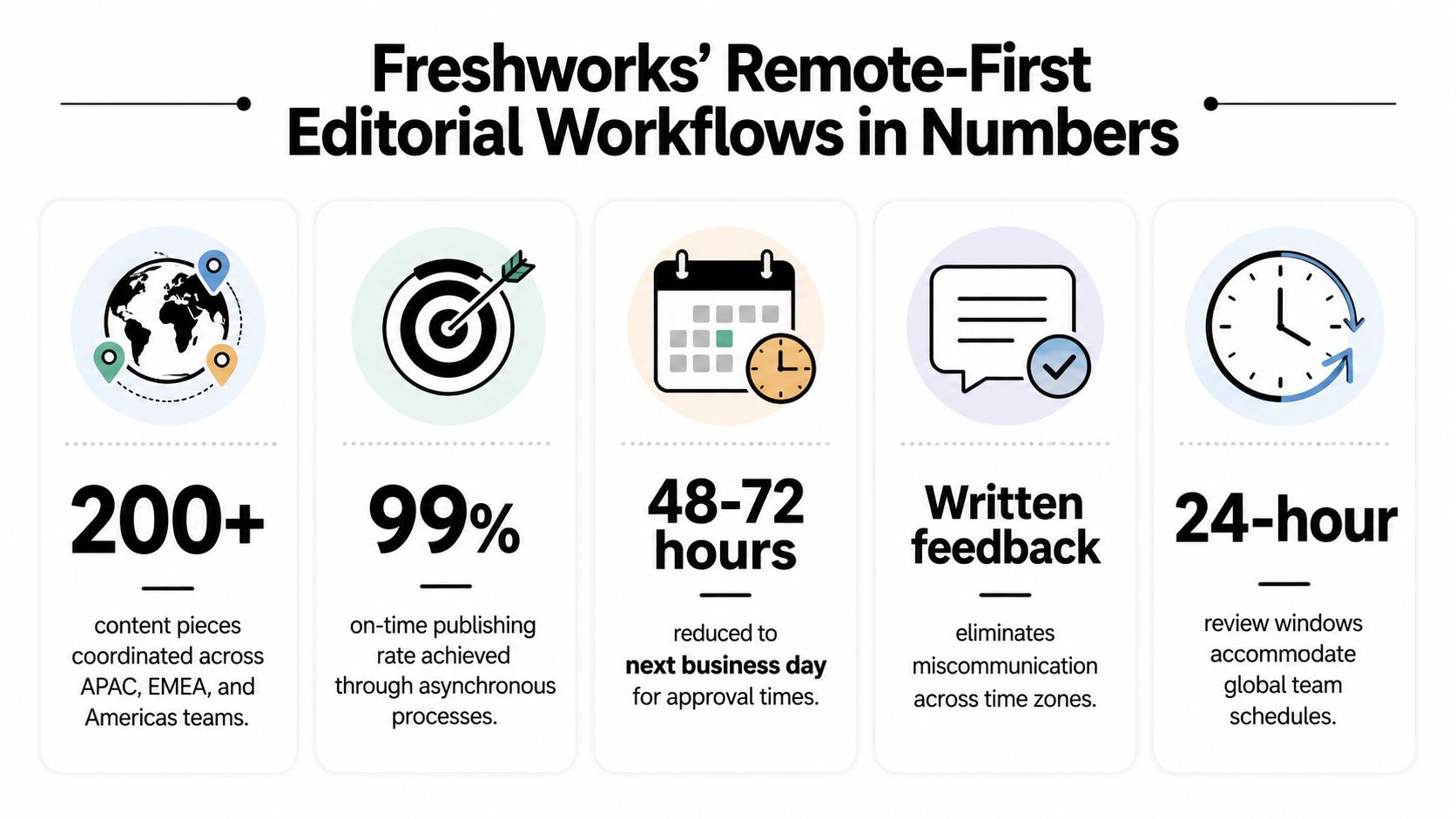
Distributed teams don't mainly need more meetings. They need written context, explicit turnaround times, and workflow stages that remain visible when colleagues are offline. A remote-first editorial system should make it possible for a writer in one region to understand what an editor in another region changed, why the change matters, and what happens next.
A practical workflow assigns one owner for each stage and uses comments attached to the relevant brief or draft. Reviewers should know what they're checking, whether they're responsible for factual validation or style, and when their response is due. A written approval record prevents the same question from resurfacing in another channel.
Asynchronous work needs designed handoffs
Use regional handoffs deliberately. One team can prepare a draft and leave a structured review request for the next time zone. Automated reminders should surface overdue actions, while guidelines answer recurring questions about tone, sources, formatting, and escalation.
The trade-off is reduced spontaneity. Written feedback can feel less immediate than a conversation, and contributors may interpret comments differently. A short live discussion still has a place for complex disagreements. The important point is to record the decision in the central workflow afterward.
This model also supports quality. When feedback stays attached to the asset, future contributors can see the reasoning behind a change instead of receiving unexplained edits. Distributed collaboration becomes more reliable when the system preserves decisions, ownership, and deadlines as carefully as it preserves the content itself.
8. Intercom's Product-Driven Content Strategy
Product-driven content performs a different job from demand-generation content. It helps users understand a feature, decide whether it solves a problem, and take the next step successfully. Intercom's example can therefore be read as a product roadmap and editorial calendar integration model.
The workflow starts before a feature becomes public. Product managers, customer education specialists, support teams, and marketers identify the questions users will ask. The editorial plan can then include an announcement, help documentation, onboarding guidance, examples, customer communication, internal enablement, and follow-up education.
Make the customer's first use easier
The trade-off is early uncertainty. Product details may change during development, which creates a risk that content becomes outdated before publication. Use staged drafts and embargoed materials. Writers can prepare the stable explanation first, then insert final interface details after the product team confirms them.
A feature launch should also have a measurement hypothesis. The team might ask whether the content helps the right users discover the feature, complete setup, understand the use case, or avoid predictable support questions. Those are more useful signals than page views alone.
The Adobe “Creativity for All” campaign demonstrates the broader value of coordinating content, audience roles, and distribution. The campaign combined account-oriented personalization with LinkedIn, YouTube, technology publications, webinars, and use-case content. Its reported outcomes included a 14% increase in enterprise-tech-buyer brand favorability, 180% year-over-year growth in Adobe Experience Cloud searches, more than 25 million LinkedIn impressions, a 2.7× engagement lift, and a 33% increase in sales inquiries during the first 90 days, as described in this Adobe B2B campaign case study. The planning lesson is to tag assets by persona, channel, and journey stage before comparing results.
9. ConvertKit's Content Repurposing Factory
ConvertKit's example represents a content portfolio system. The original asset isn't the end of production. It's the source material for formats that serve different moments, channels, and levels of attention.
A useful workflow begins during the brief. The writer, editor, video producer, social lead, and email owner decide together which derivative assets the central idea can support. That prevents repurposing from becoming a vague promise made after publication, when the team has already moved to another priority.
Adapt the idea, don't copy the file
A detailed customer story might become a case study, webinar, sales narrative, short video, newsletter explanation, executive post, and onboarding resource. Each derivative should have a distinct audience job. A social post creates curiosity. A webinar develops the issue. A sales asset reduces evaluation risk. Documentation helps a customer act.
The trade-off is audience fatigue and editorial dilution. Repeating the same wording everywhere can make the brand feel mechanical. Adapt the framing, length, evidence, and call to action for each channel. Spread distribution according to audience behavior rather than releasing every derivative at once.
Teams also need an ownership map. The original author may not own the video, email, design, or sales enablement version. Assign each derivative to a named person, connect it to the source asset, and record its publication date and result. This content repurposing workflow turns reuse into a planned production line rather than an aspiration.
10. Monday.com's Editorial Hub
Monday.com offers a useful model for self-service idea generation with controlled selection. Employees outside marketing often see customer questions, product friction, industry changes, and useful stories before the editorial team does. An open idea pipeline can capture that knowledge without allowing every request to bypass strategy.
The submission form should ask for the audience, problem, proposed angle, evidence, subject-matter contributor, and intended business purpose. Editors can then assess ideas against transparent criteria instead of relying on informal preference. Rejected ideas should receive a reason or a suggested revision, because contributors who understand the decision can submit stronger proposals later.
Openness needs boundaries
The trade-off is volume. A self-service pipeline may produce many duplicates, promotional requests, or ideas that lack evidence. Use tags, editorial statuses, and selection criteria to separate promising concepts from immediate priorities. A visible pipeline also helps employees understand what happens after submission.
The wider B2B context supports this emphasis on trust and evidence. A 2025 LinkedIn Marketing Collective benchmark surveyed 1,500 B2B marketers across six countries. It found that 94% agreed trust is the key to B2B marketing success, while 78% used video and 55% used influencer marketing or partnered with creators. Those findings suggest that an idea hub shouldn't accept only blog requests. It should support expert interviews, customer evidence, educational video, webinars, and social adaptations.
The strongest contribution system closes the loop. Show contributors which topics perform, celebrate useful participation, and invite subject-matter experts into review. That turns idea capture into a learning network rather than an inbox.
10 B2B Content Strategy Comparisons
| Example | 🔄 Implementation Complexity | ⚡ Resource Requirements | 📊 Expected Outcomes | 💡 Ideal Use Cases | ⭐ Key Advantages |
|---|---|---|---|---|---|
| HubSpot's Content Strategy Hub | Medium–High, centralized workflow & onboarding | Moderate, platform + team training + analytics | 📊 Consistency ↑; time-to-publish −30%, ⭐⭐⭐⭐ | Centralized B2B editorial teams coordinating marketing, sales, CS | Faster iteration, cross-team visibility, data-driven planning |
| Drift's Account-Based Content Campaign | High, multi-variant ABM workflows and approvals | High, CRM integration, campaign tagging, sales alignment | 📊 Pipeline influence +45%, ⭐⭐⭐⭐ | ABM for high-value accounts needing multi-channel consistency | Consistent account messaging; improved sales asset adoption |
| Salesforce's Editorial Content Engine | High, multi-tier governance and standards | High, central frameworks, templates, governance teams | 📊 3x content scale; improved SEO & velocity, ⭐⭐⭐⭐ | Enterprise-scale, multi-division content production | Scale without proportional headcount; brand consistency |
| Marketo's Product Launch Coordination | Medium, strict dependencies and launch checkpoints | Moderate, cross-team approvals, countdown automation | 📊 Launch delays −60%; on-time assets 80%+, ⭐⭐⭐ | Time-bound product launches and coordinated campaigns | Reliable launch timing; clear ownership and dependency control |
| Okta's Thought Leadership Program | Medium–High, long lead times & exec coordination | High, executive involvement + repurposing workflows | 📊 Executive visibility +400%; high impressions, ⭐⭐⭐⭐ | Executive bylines and reputation-building programs | Authority building; high ROI via systematic repurposing |
| Databox's Data-Driven Strategy | Medium, analytics integrated into planning | Moderate–High, dashboards, analytics expertise, A/B testing | 📊 Organic traffic +250%; repeatable high-performers, ⭐⭐⭐⭐ | Performance-led editorial planning and optimization cycles | Eliminates guesswork; faster iteration on proven formats |
| Freshworks' Remote-First Workflows | Medium, asynchronous processes and documentation discipline | Moderate, collaboration tooling and automated notifications | 📊 99% on-time publishing; approval time ↓, ⭐⭐⭐ | Distributed teams across time zones and async workflows | Reduces time-zone bottlenecks; preserves review context |
| Intercom's Product-Driven Content Sync | Medium, roadmap integration and embargo controls | Moderate, product coordination, lead-time tracking | 📊 Support tickets −35%; feature adoption +40%, ⭐⭐⭐⭐ | Product launches requiring pre-release education content | Improves adoption; reduces post-launch support burden |
| ConvertKit's Repurposing Factory | Medium, content genealogy and derivative workflows | Moderate, templates, versioning, distribution planning | 📊 Content ROI +600% per original, ⭐⭐⭐⭐ | High-investment content that can be multiplied across channels | Maximizes asset ROI; steady multi-channel presence with less new ideation |
| Monday.com's Self-Service Editorial Hub | Medium, open contributions with formal approvals | Moderate, embedded guidelines, review capacity scaling | 📊 Output +350% while improving review efficiency, ⭐⭐⭐ | Democratized idea contribution across distributed orgs | Scales contribution, reduces editorial bottlenecks, maintains quality |
Turn These B2B Lessons Into Your Next Campaign
The ten examples point to a common conclusion. B2B marketing performance depends less on isolated creativity than on operational fit. A campaign aimed at a few named accounts needs different controls from a product launch. A thought leadership program needs a different approval path from a help article. A distributed team needs stronger written handoffs than a small local group working in one room.
Start by centralizing visibility. Bring ideas, briefs, owners, deadlines, dependencies, channels, and review stages into a shared workspace. This doesn't mean every team must use the same process for every asset. It means people should be able to see what exists, who is responsible, what is blocked, and how a piece connects to a wider campaign or customer milestone.
Then match workflow complexity to risk. Use a lightweight process for routine updates. Add subject-matter, legal, product, sales, or executive approvals when the claim or business consequence requires them. Assign one accountable owner even when several teams contribute. Shared responsibility without a named decision-maker usually creates delay.
Next, connect content to a real business or product event. An account campaign can follow a sales cycle. A launch can follow a roadmap milestone. Customer education can follow a feature release. A research asset can support a webinar, sales conversation, video series, and executive perspective. The calendar should show those relationships instead of treating each item as an independent publication.
Repurpose deliberately, but preserve editorial judgment. One customer story can become several useful assets, but each format needs a clear audience purpose. Review performance before planning the next cycle. Look at qualified conversations, account progression, sales usage, product engagement, repeat interaction, content-assisted opportunities, and evidence quality. Don't present one-touch attribution as proof of causality.
A practical implementation sequence is straightforward:
- Choose one bottleneck: Start with missed deadlines, scattered ideas, launch coordination, weak sales usage, or poor performance feedback.
- Map the required assets: List the formats, owners, reviewers, dependencies, channels, and customer or business milestones.
- Define a small measurement set: Select indicators that match the intended action, not just convenient reach metrics.
- Run a focused pilot: Use one campaign, product area, audience, or channel before expanding the workflow.
- Document what changed: Record the stages, decision rules, recurring delays, and evidence that should shape the next cycle.
For teams that need a focused planning system, TheContentMap supports editorial calendars, idea pipelines, assignments, comments, reminders, tags, projects, and content insights in one web-based workspace. It can help editors move work from concept to publication while keeping campaign relationships and performance learning visible.
TheContentMap gives B2B editorial teams a shared calendar, visual idea pipeline, ownership controls, reminders, collaboration tools, tags, projects, and content insights. Use it to turn the operating patterns in these examples into a practical workflow your team can run and improve. Visit TheContentMap to explore the platform.
Related Articles
Brand Awareness Measurement: Surveys, Metrics and Results
Aided recognition can look impressive while spontaneous recall barely moves. In research analyzing b...
SoftwareProject Management Checklist for Editorial Teams: 10 Steps
The feature is due Friday. The writer never saw the approved angle, the legal reviewer is out, and t...
SoftwareContent Performance Metrics: What to Track, How, and Why
You've got a folder of published articles, a traffic report that doesn't look bad, and a mee...
Comments (0)
No comments yet. Be the first to share your thoughts.