Content Plan Format That Actually Works for Editorial Teams
Learn a practical content plan format built for editorial teams. Covers essential sections, proven templates, and real examples you can adapt today.
You open the shared spreadsheet before the editorial meeting. A draft is overdue, a reviewer hasn't responded, and the article marked ready still has no destination URL. Before anyone discusses what readers need, you're reconstructing what happened to the work.
Table of Contents
- The Monday Morning Problem With Most Content Plans
- What a Content Plan Format Actually Means
- The Five Pillars Every Plan Must Cover
- Spreadsheet Plan vs Structured Record Plan
- A Ready to Use Editorial Plan Template
- Connecting the Plan to Performance Data
- Adopting This Format Across Quarterly, Monthly, and Weekly Planning
The Monday Morning Problem With Most Content Plans
Consider a familiar editorial week: the writer thinks the editor owns the next step, the editor is waiting for subject-matter approval, and the person scheduling publication sees only a green cell. Nobody is deliberately holding things up. They're working from different definitions of ready.
A title-and-date calendar can show publishing intentions. It can't, by itself, explain whether an assignment is properly briefed, approved, or safe to publish. That distinction matters when writers, reviewers, designers, and distribution owners share responsibility for an item.
The strain shows up at the editor's desk.

The problem isn't the spreadsheet
A spreadsheet can hold a useful plan. The trouble starts when the team relies on cell colors, comments, and someone's memory to represent decisions that deserve explicit fields.
An overdue date tells you that something slipped. It doesn't tell you whether the writer needs evidence, the approver is unavailable, or a related landing page hasn't shipped. Moving the date without recording the blocker delays the same conversation.
Practical rule: If the editor has to ask what a status means, the team hasn't defined that status well enough.
The better starting point is a structured content record: a durable home for the decisions, responsibilities, and checks attached to an item. The calendar becomes a view of that record, not the entire planning system.
That's the upstream repair. Before changing tools, decide what the team must know to move work forward without reconstructing its history in chat.
What a Content Plan Format Actually Means
A content plan format is the agreed structure of information and workflow states that every planned item carries through its editorial life. It defines what contributors must record, what reviewers must verify, and what allows an item to advance.
The calendar answers when. The record answers what, why, who, and under what conditions.
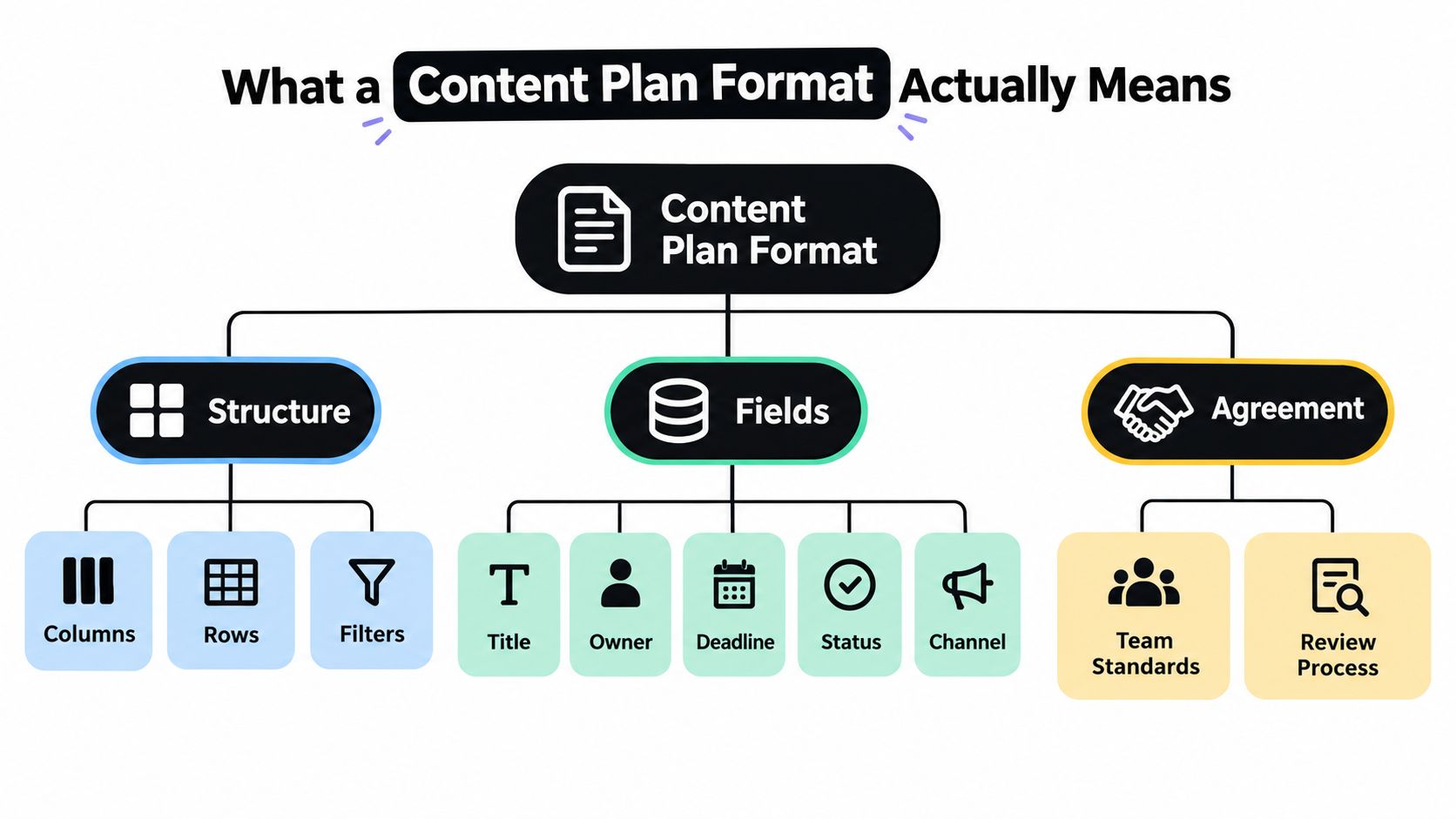
The minimum useful field set
Use fields that support decisions rather than collecting information nobody will maintain.
| Field group | Required information | Editorial purpose |
|---|---|---|
| Reader and purpose | Audience, user intent, content or page type, distinct angle | Sets boundaries for the brief |
| Accountability | Owner, workflow status, approval state | Makes responsibility and permission explicit |
| Delivery | Dependencies, target URL, distribution channels | Exposes prerequisites and destinations |
| Connection and learning | Internal-link targets, review trigger, post-publication metric | Connects publication to the wider library and later evaluation |
This record-based approach follows the operational structure described in Dmarketer Tayeeb's content calendar planning system, including separate editorial review and publication-quality checks.
Workflow status and approval state aren't interchangeable. A draft can be in progress while its proposed direction is approved. A completed article can be awaiting approval even though the writer has finished their work.
For search-led assignments, intent and page type also belong upstream of drafting. Teams considering outside support can use AY Rank's content SEO services as a resource when deciding which search-related responsibilities to include in the review process.
Define the agreement behind the fields
A dropdown doesn't establish a shared standard by itself. Document who changes each field, when they change it, and what evidence supports the change.
For example, the assigning editor confirms audience and angle; the production owner maintains dependencies; the designated approver records sign-off. Contributors shouldn't have to infer responsibility from whoever last edited the row.
Keep free text for context and judgment. Use controlled values for fields you need to filter, compare, or validate.
The Five Pillars Every Plan Must Cover
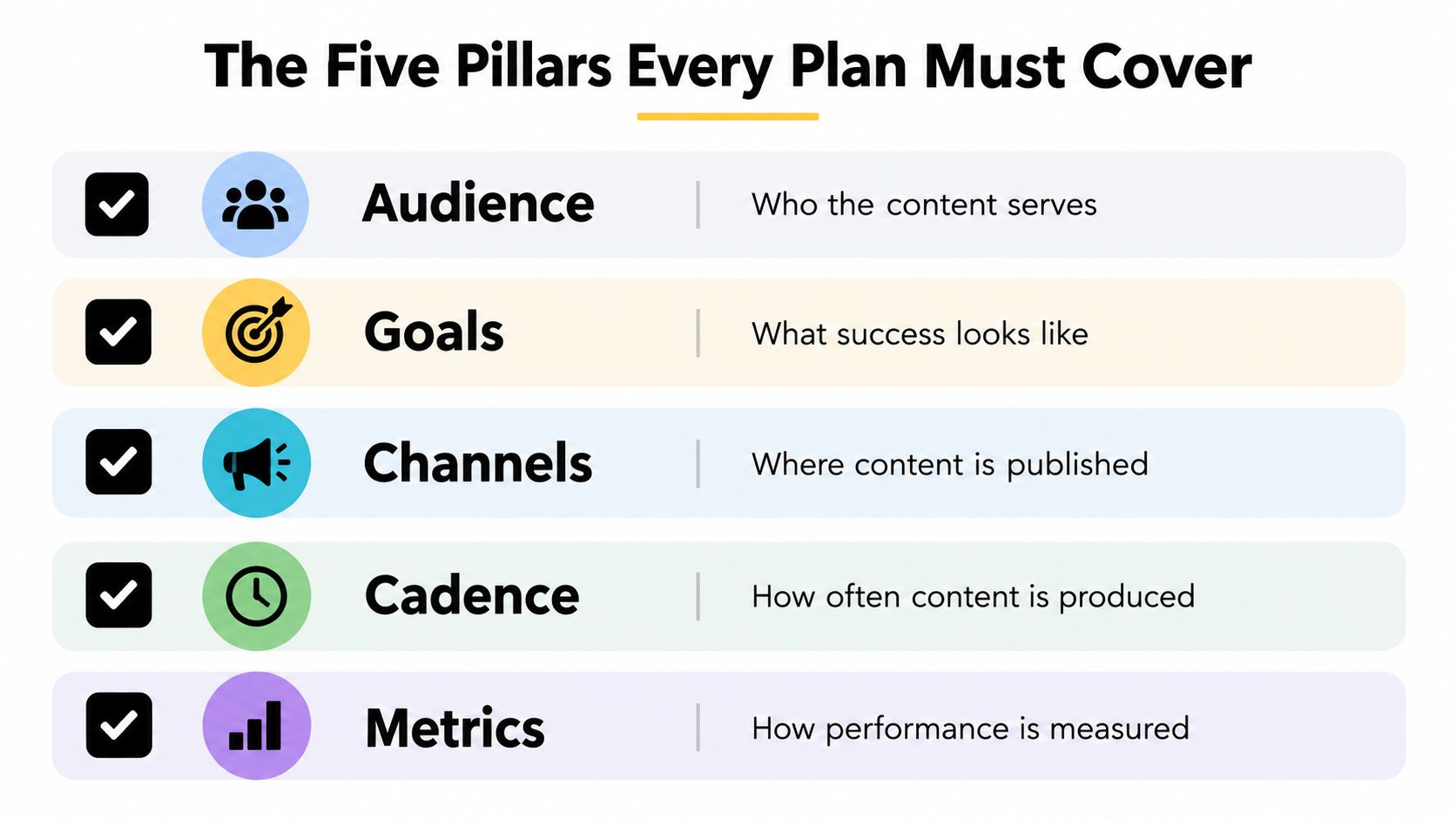
A filled-out record can still describe work that shouldn't be commissioned. Test assignments against audience, goals, channels, cadence, and metrics before treating them as production commitments.
Use these pillars as a commissioning checklist.
Audience and goals set the assignment
Audience should identify a recognizable reader in a particular situation. For example, marketing managers replacing an informal approval process need different guidance from freelance writers learning to submit drafts.
Add the reader's decision stage. Someone diagnosing missed deadlines needs an explanation; someone selecting a workflow needs criteria and a usable example.
Goals describe the intended action or change. For a downloadable checklist, the goal might be helping readers assess their existing review process, with completed downloads as the outcome to evaluate. Don't commission an educational article and then judge it solely as a sales page.
If those strategic choices aren't settled, use the guide to planning a content strategy from scratch before filling the calendar.
Channels and cadence make the commitment realistic
- Channels: Name actual destinations and responsible people. Website publication, newsletter inclusion, and a LinkedIn adaptation are separate deliverables, not a distribution checkbox.
- Cadence: Build around available writing, editing, design, and review capacity. An interview-led customer story shouldn't inherit the production assumptions of a short commentary post.
A sustainable rhythm leaves room for revisions and maintenance. When capacity is tight, reduce the commitment rather than removing review.
Metrics determine what you'll learn
Give each item a primary outcome metric that matches its purpose. A newsletter-led article might use click-through from its newsletter placement; a template might use completed downloads.
Supporting diagnostics can help explain the result, but they shouldn't obscure the main question: did readers take the intended action?
For a complementary planning walkthrough, use the embedded video alongside your own commissioning checklist.
Spreadsheet Plan vs Structured Record Plan
Compare hypothetical teams handling the same editorial week. The spreadsheet-only team records title, publication date, and writer. The record-based team also maintains explicit responsibilities, prerequisites, and release checks.
The difference becomes visible when the week stops going to plan.
| Editorial Moment | Spreadsheet Plan | Structured Record Plan |
|---|---|---|
| A draft arrives late | The editor moves the publication date and asks for an update | The owner records the blocker and identifies affected dependencies |
| A claim lacks evidence | A comment asks for a citation, but publication readiness remains ambiguous | Editorial review remains incomplete until the evidence issue is resolved |
| Publish QA finds a broken destination | Someone corrects the page if they notice the issue | The release stays blocked while the assigned publisher resolves the defect |
| Performance needs reviewing | The team searches for the published page and original objective | The reviewer uses the recorded URL, intended outcome, and review trigger |
Choose structure before software
A spreadsheet isn't disqualified because it has rows. With validation, named owners, and disciplined maintenance, it can support a structured approach.
An Excel editorial calendar template is a reasonable starting point when the immediate need is a shared schedule. Extend it deliberately rather than using comments as an unofficial workflow database.
A more expensive tool won't fix a team agreement that nobody has made.
The trade-off is upkeep. In a spreadsheet, the editor must decide how required fields, state changes, and approval records will be checked. A dedicated workflow tool is worth considering when maintaining those controls becomes distracting work in its own right.
Agency teams also need to distinguish client production from their own marketing commitments. For that broader planning context, browse 100Signals agency resources, then keep the chosen commitments visible in the same operational format rather than in a disconnected strategy document.
A Ready to Use Editorial Plan Template
Build the template around identity, production, distribution, and learning. Keep a compact planning view for meetings and a fuller record for the people doing the work.
The following layout is a copyable specification, not a requirement to display every field in every view.
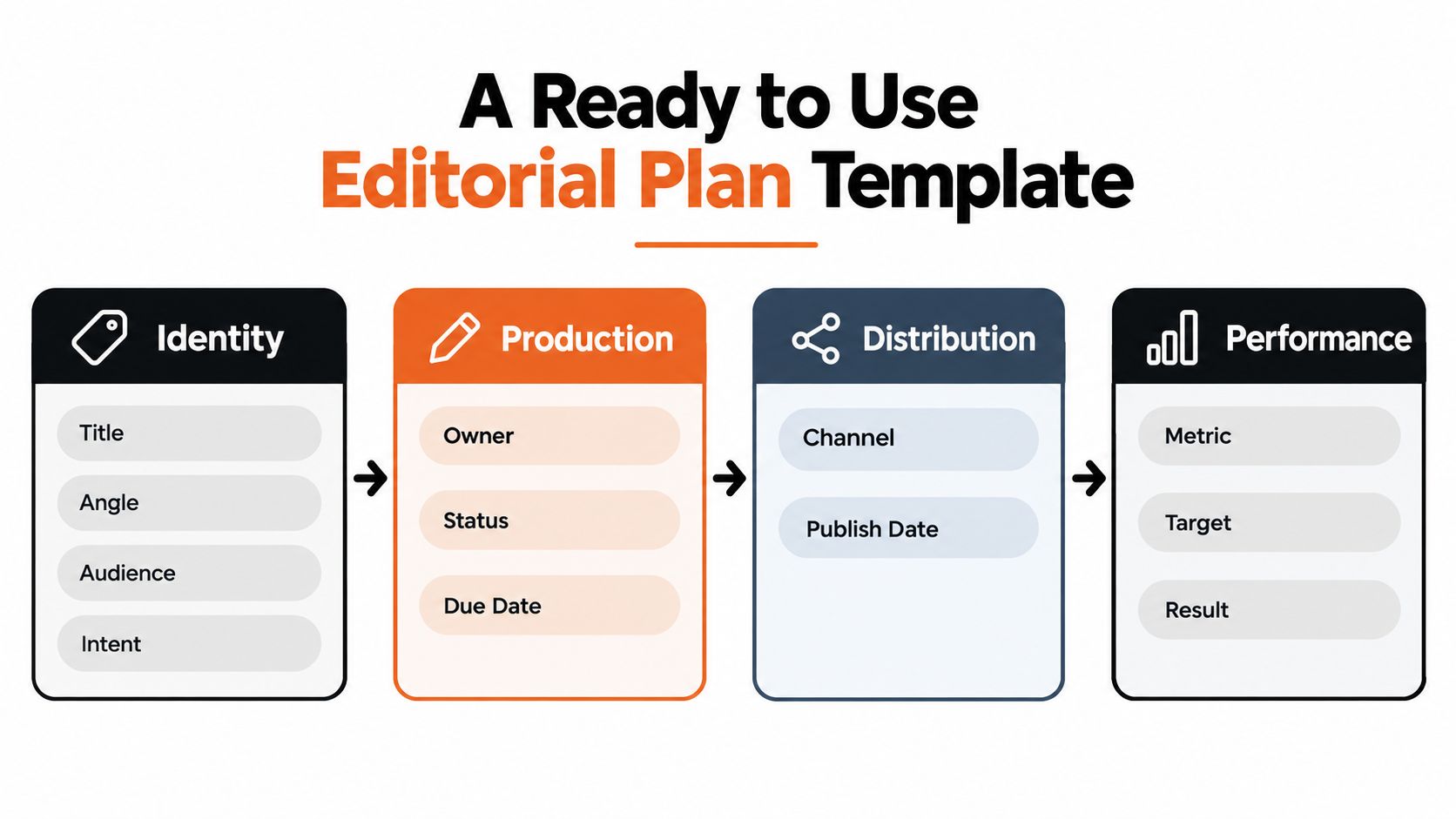
| Block | Fields to create |
|---|---|
| Identity | Content ID, title, angle, audience, intent, content type, topic, source links |
| Production | Owner, reviewer, status, approval state, dependencies, draft deadline, review deadline, planned publication date |
| Distribution | Canonical URL, channels, distribution owners, internal-link targets, publication checklist |
| Learning | Primary outcome metric, target, result, review trigger, review owner, refresh flag |
A sample item in flight
For illustration, a record could contain the following values. These describe a proposed assignment, not a reported result.
| Field | Example entry |
|---|---|
| Title and angle | Editorial approval checklist, focused on preventing unclear handoffs |
| Audience and intent | Marketing managers seeking a repeatable review process |
| Content type | Instructional article with a checklist |
| Owner and reviewer | Assigned writer and managing editor |
| Status and approval | Editorial review; final sign-off pending |
| Dependency | Subject-matter review of approval responsibilities |
| Distribution | Website, newsletter, and LinkedIn adaptation |
| Target URL | Existing editorial-workflow resource page, pending confirmation |
| Primary metric | Newsletter click-through to the article |
| Review trigger | Monthly performance review after distribution |
| Refresh flag | Pending review |
Keep the broader marketing objective accessible beside the assignment. For an industry-specific planning reference, Advisor Momentum's marketing plan template for advisors is an optional resource to consult alongside this editorial record.
Move the item through explicit gates
Use the sequence Idea → Researching → Needs approval → Approved → In progress → Editorial review → Publish QA → Published → Refresh. Define the entry and exit conditions rather than letting contributors select whichever label feels closest.
Editorial review checks usefulness, accuracy, and evidence. Publish QA checks metadata, links, media, schema where relevant, rendering, accessibility, and indexability.
For reuse across systems, maintain controlled tags, stable IDs, canonical URLs, author details, publication and update dates, and rights information. The Research Data Alliance's structured-data publishing guidelines describe established vocabularies such as Schema.org and formats including JSON-LD, RDFa, and Microdata.
Treat validation as a release gate: missing ownership, required metadata, approval, or QA completion should stop publication, not generate a reminder someone can overlook.
Connecting the Plan to Performance Data
Production volume isn't evidence of effectiveness. In the Content Marketing Institute's 2025 B2B benchmark, covering reported activity during the previous year, 92% used short articles or posts, 76% used video, and 75% used case studies or customer stories; reported effectiveness differed, with 58% rating video most effective, 53% selecting case studies or customer stories, and 43% selecting short articles or posts.
Those responses don't establish what your audience will prefer. They provide a reason to question an editorial mix determined entirely by what the team can produce most easily.
Compare purpose before comparing results
Review content type alongside audience, channel, production effort, and intended outcome. Otherwise, you risk treating a newsletter article and a customer story as competing assets when they serve different decisions.
Use a focused review table:
| Review question | Planning decision it supports |
|---|---|
| Did the item reach its intended audience? | Reconsider channel or distribution |
| Did readers take the intended action? | Revisit the offer, angle, or call to action |
| Was the production effort justified? | Adjust the format mix or scope |
| What should the next assignment retain? | Record a specific instruction for the next brief |
Review discipline: Write down the decision that follows from the result, not just the result itself.
A weak outcome doesn't automatically justify abandoning a format. Check whether the assignment had a clear purpose, received its planned distribution, and had a fair opportunity to generate the intended response.
Use content performance metrics that matter to refine the evaluation, then keep the resulting recommendation attached to the planning record. Where an editorial platform includes content insights, use that view as the meeting point between published work and the next commissioning discussion.
Adopting This Format Across Quarterly, Monthly, and Weekly Planning
Don't maintain separate versions of the truth for strategy meetings and production meetings. Use the same records at different levels of detail, while distinguishing a tentative idea from an approved commitment.
Quarterly direction and monthly commitments
Quarterly planning establishes themes, audience priorities, and capacity boundaries. Record proposed formats and major dependencies, but don't manufacture precise production dates for work that hasn't been scoped.
At this horizon, editors should ask what the team is choosing not to produce. A theme without capacity behind it belongs in the idea pipeline, not among promised deliverables.
Monthly planning turns selected ideas into approved assignments. Confirm scope, contributors, review availability, and dependencies before the team commits to dates.
This is also the point to reconcile new production with refresh work. Updating published material requires capacity, even when it doesn't create a new calendar entry.
Weekly execution and adoption checks
The weekly meeting should focus on decisions and exceptions: blocked drafts, pending reviews, QA failures, distribution readiness, and changes that affect other work. Contributors can read routine status updates before the meeting.
Use this adoption checklist to make the transition manageable:
- Choose the field set: Retain fields that support assignment, delivery, release, or evaluation decisions.
- Define state transitions: Write clear conditions for entering and leaving each workflow state.
- Assign responsibility: Name the person maintaining each active record and the person approving release.
- Set the outcome: Confirm the primary metric and review trigger before publication.
- Review the mix monthly: Use results and production effort to reconsider future assignments.
Pilot the format on an active batch of work before migrating the entire archive. Remove fields nobody uses, clarify labels people interpret differently, and preserve the controls that catch actual problems.
The test isn't whether the plan looks complete. It's whether an editor can identify the next action, the responsible person, and the reason an item isn't ready without starting another status conversation.
TheContentMap offers an editorial calendar, a visual idea pipeline, ownership assignments, comments, and content insights as an option for teams moving beyond spreadsheet-based coordination. Visit TheContentMap to evaluate those tools against your field set and try organizing active assignments from idea capture through publication and performance review.
Related Articles
10 Team Collaboration and Productivity Software Picks
The popular advice says consolidate everything into the biggest platform you can afford. For editori...
SoftwareEditorial Calendar Template Excel: Setup and Workflow Guide
A publish date slips, and the editor opens the shared workbook to find two competing copies. One has...
Software10 Best Approval Workflow Software Picks
Your polished draft is ready, but publication isn't. The editor's feedback lives in a docume...
Comments (0)
No comments yet. Be the first to share your thoughts.